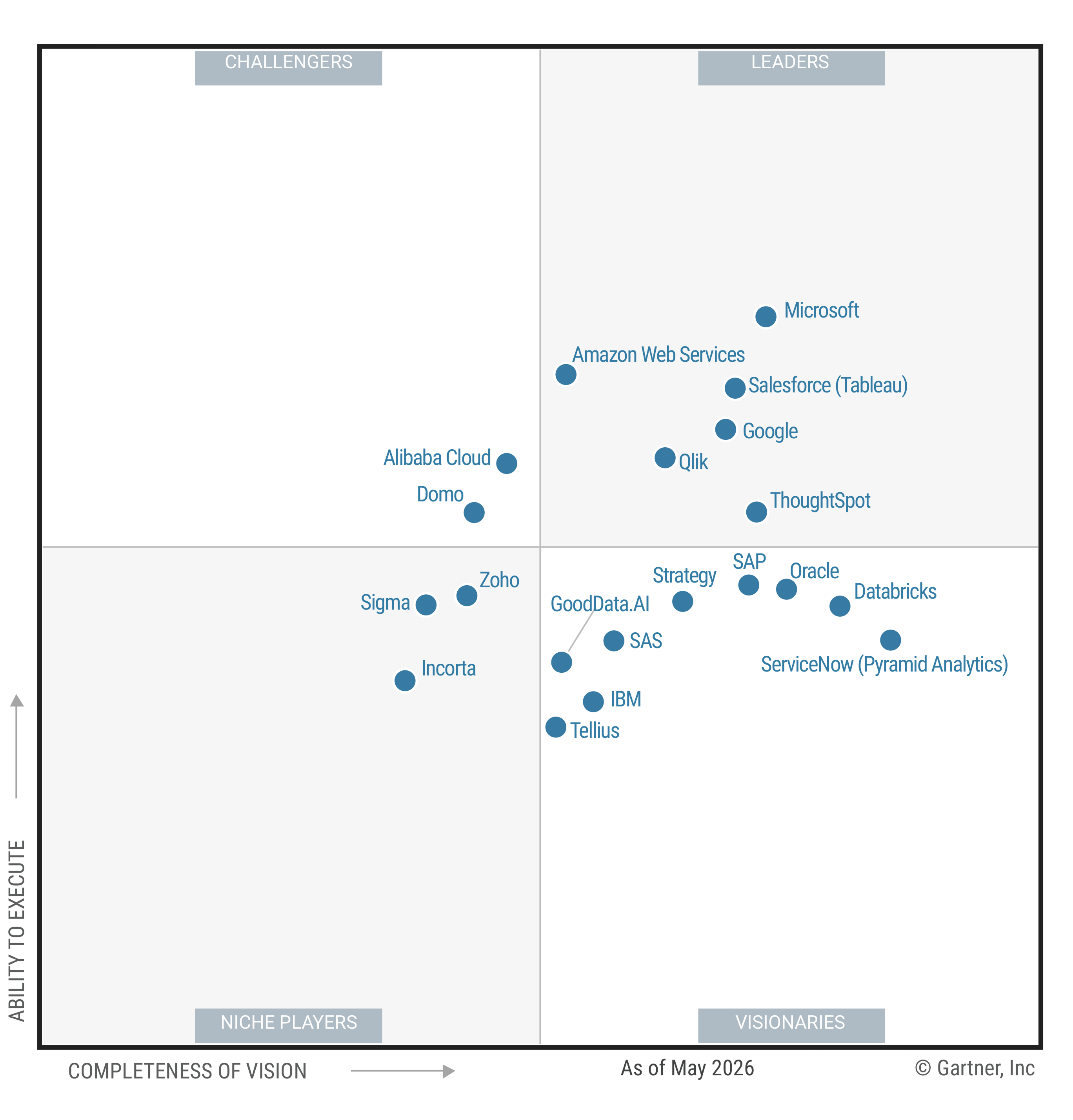
- A list of AI BI tools is a starting point, not a universal ranking. Your fit depends on data, users, workflows, and controls.
- Test natural-language analysis against approved answers and metric definitions. A polished chat experience alone cannot prove that an answer reflects your business context.
- Review governed context, permission handling, answer transparency, correction paths, and fit with your current data stack.
- Run a focused pilot with representative questions before you commit.
- Market adoption figures do not replace a representative pilot using your questions, definitions, permissions, and expected answers.
Your shortlist can look convincing after a few smooth demos, yet the hard questions often come later. Will the platform use your approved revenue definition, respect each user's access, and show enough logic for your team to review an answer?
A credible comparison pairs platform options with tests for trusted results. The vendors below are editorial examples to evaluate, not an objective ranking. NIST's AI evaluation practices support treating test and evaluation as a distinct measurement activity rather than a marketing claim.
What AI BI Tools Do and Why Context Matters
AI business intelligence is a broad label for BI software with one or more AI-assisted functions. When a vendor uses the term, ask which tasks it covers: natural-language questions, analysis assistance, automated explanations, visualization guidance, or something else.
Treat the interface as the start of your test. Does the platform use the approved metric, choose the expected relationship between data elements, and interpret an ambiguous term as your team does?
You can evaluate a semantic layer, or an equivalent source of governed context, with similar questions. Ask whether it represents your metrics, relationships, approved terms, calculation logic, and access rules in a form you can review.
When you compare approaches, ask how the system connects a user's words to those approved definitions. Then ask whether you can inspect, correct, and retain that context as your business language changes.
ThoughtSpot describes its agentic semantic layer as a way to connect conversational analysis with governed business meaning. Its stated objective is to support deterministic, explainable answers, which you should verify with your own questions and approved results.
You still need evidence from your own environment. ThoughtSpot's recommended analytics evaluation experiments provide a practical way to test how an analytics system behaves with real questions, known answers, and reviewable results.
AI BI Tools to Put on Your Shortlist
The list below gives you a neutral set of vendors to investigate. It does not rate vendor performance or confirm current features, pricing, deployment options, security controls, or contract terms.
Examples to evaluate
| Platform | Neutral Investigation Prompt |
|---|---|
| ThoughtSpot | Review its stated Agentic Analytics Platform approach, then test it with your approved questions, metrics, and permissions. |
| Microsoft Power BI | Ask the vendor to demonstrate your representative questions, identity requirements, data connections, and administration needs. |
| Tableau | Ask the vendor to run your test cases and show how users can inspect, review, and correct the resulting analysis. |
| Looker | Ask the vendor to map your approved metrics, relationships, permissions, and change-review process during a pilot. |
| Sigma | Ask the vendor to test your target users' recurring questions with your data, definitions, permissions, and expected outputs. |
| Qlik | Ask the vendor to document how your required integrations, identity controls, data handling, and review process would work. |
| Sisense | Ask the vendor to demonstrate your chosen internal or customer-facing scenario with your access rules and expected results. |
| Hex | Ask the vendor to run your analyst scenarios and document permissions, review steps, handoffs, and outputs. |
For ThoughtSpot, review the stated role of ThoughtSpot BI agents in conversational analysis. You can also examine how its enterprise BI platform describes governed analytics, exploration, and review paths.
Treat every row as a prompt for deeper verification. Ask each vendor for current documentation covering capabilities, integrations, pricing, deployment, data handling, identity controls, security claims, and support terms.
How to Read the Comparison Table
A vendor list gives you candidates; an evaluation shows whether any candidate fits your environment. Map each platform to your data, highest-value questions, user groups, and desired destination for answers.
Next, define the evidence you will accept. A demo based on sample data may show interface quality, but your decision also depends on behavior with your metrics, permissions, terminology, and edge cases.
For generative AI features, NIST's voluntary guidance suggests reviewing intellectual property, data privacy, security, and other risks during procurement. This guidance is not legal advice, a certification, a product endorsement, or a universal buying requirement.
Do not convert that checklist into a score without context. A requirement that matters for a regulated customer-facing workflow may carry different weight for an internal analyst sandbox.
What to Test Before You Choose an AI BI Platform
Your evaluation should make vague claims testable. Use this five-part framework to compare the same questions, controls, and operating conditions across each candidate.
Business context and metrics
Give each platform representative questions tied to approved metric definitions. Include synonyms, time filters, multi-step questions, and terms that have different meanings across departments.
Compare the response with a known answer, then inspect how the platform selected fields, relationships, calculations, and filters. If it gets a result wrong, record whether the problem came from the model, the question, the governed context, or an unresolved ambiguity. 2. Answer transparency and correction
Ask what a business user can inspect without reading raw code. Can the user see the logic, cited source, metric definition, filters, or explanation behind the answer?
Then test the correction path. Your team should know who can approve a fix, how feedback changes future behavior, and whether an earlier answer remains available for review. 3. Identity, permissions, and data handling
Test with users who have different roles and data access. Check whether each response follows the permissions already defined for those identities, including row-level and column-level restrictions where relevant.
Review what data leaves your environment, what is retained, which subprocessors are involved, and how logs are handled. NIST's voluntary AI contract requirements guidance also covers ownership, usage rights, quality, security, and content provenance expectations. 4. User and workflow fit
Put the platform in front of the people who will use it. A finance leader asking recurring metric questions has different needs from an analyst preparing a model or a product team placing analytics inside an application.
Watch where users hesitate, abandon a question, or switch back to another workflow. Those moments may tell you more about fit than a scripted feature tour. 5. Cost and operating controls
Ask vendors to explain pricing units, usage limits, administrative controls, support tiers, and the events that can increase spend. Model your own question volume and user mix instead of relying on a generic estimate.
Also document who will maintain metrics, permissions, context, testing, and user support. Do not assume that a license price represents the full operating effort.
Match the Tool to the Job You Need Done
A single platform may support several analytics jobs, but your buying criteria should follow the work that matters most. Use each job below to build scenario-based tests rather than naming one vendor as the default winner.
For business-user questions on trusted metrics, start with recurring decisions. Can a sales leader ask about pipeline coverage, apply the right time period, understand the metric definition, and follow up without losing context?
For data team analysis and model preparation, examine how analysts move between SQL, code, modeling, validation, and shared outputs. Ask how approved work becomes reusable context for later questions, and check whether changes can be reviewed before they affect a wider audience.
For embedded analytics, focus on the customer-facing experience and operating model. Ask how identity, permissions, branding, interaction patterns, and analytics behavior fit inside your product without creating a separate governance path.
For cross-workflow insights, map where people already make decisions. Then test how governed answers can appear in those workflows while preserving context, permissions, and a route back to the underlying analysis.
ThoughtSpot's perspective on AI analytics context emphasizes governed meaning across agents and applications. Its AI-ready analytics workflows also describe conversational analysis that remains connected to business definitions and reviewable logic.
Whatever platform you test, ask how human feedback changes future answers. You also need a clear way to review explanations as metric definitions, business terms, and user needs shift.
Run a Focused AI BI Pilot Before You Commit
A representative pilot gives you firmer evidence than a broad product tour. Keep the scope small enough to review closely, but varied enough to expose ambiguous terms, permission differences, and difficult questions.
Select 10 to 20 representative questions. Include recurring executive questions, analyst follow-ups, common filter changes, and a few known edge cases.
Write the approved answers and metric definitions. Record the expected result, calculation logic, source data, applicable time window, and any valid ambiguity.
Assign test users and permissions. Include different roles so you can check both usability and access behavior.
Compare responses with approved results. Capture the answer, logic, source, corrections, and failure type for each test.
Review quality, adoption, operating cost, and errors. Separate answer quality from user preference, then document the work needed to maintain the system.
Market context can explain why AI evaluation is on your agenda, but it cannot replace a pilot. The U.S. Census Bureau's AI use by firm size data reported that 37% of firms with at least 250 employees used AI in business operations.
The figure applies to the stated observation period. It is not an AI BI adoption statistic.
Your pilot should produce a decision record, not a polished demo recap. ThoughtSpot's five evaluation experiments offer one structure for testing question handling, business context, trust, and fit against your own expectations.
Conclusion
Chat fluency should not decide your AI BI purchase. Choose the platform that can prove how it works with your business definitions, data controls, real user questions, and review process. If you want to assess ThoughtSpot's stated approach, Start your free trial of the Agentic Analytics Platform.