📌 Key takeaways
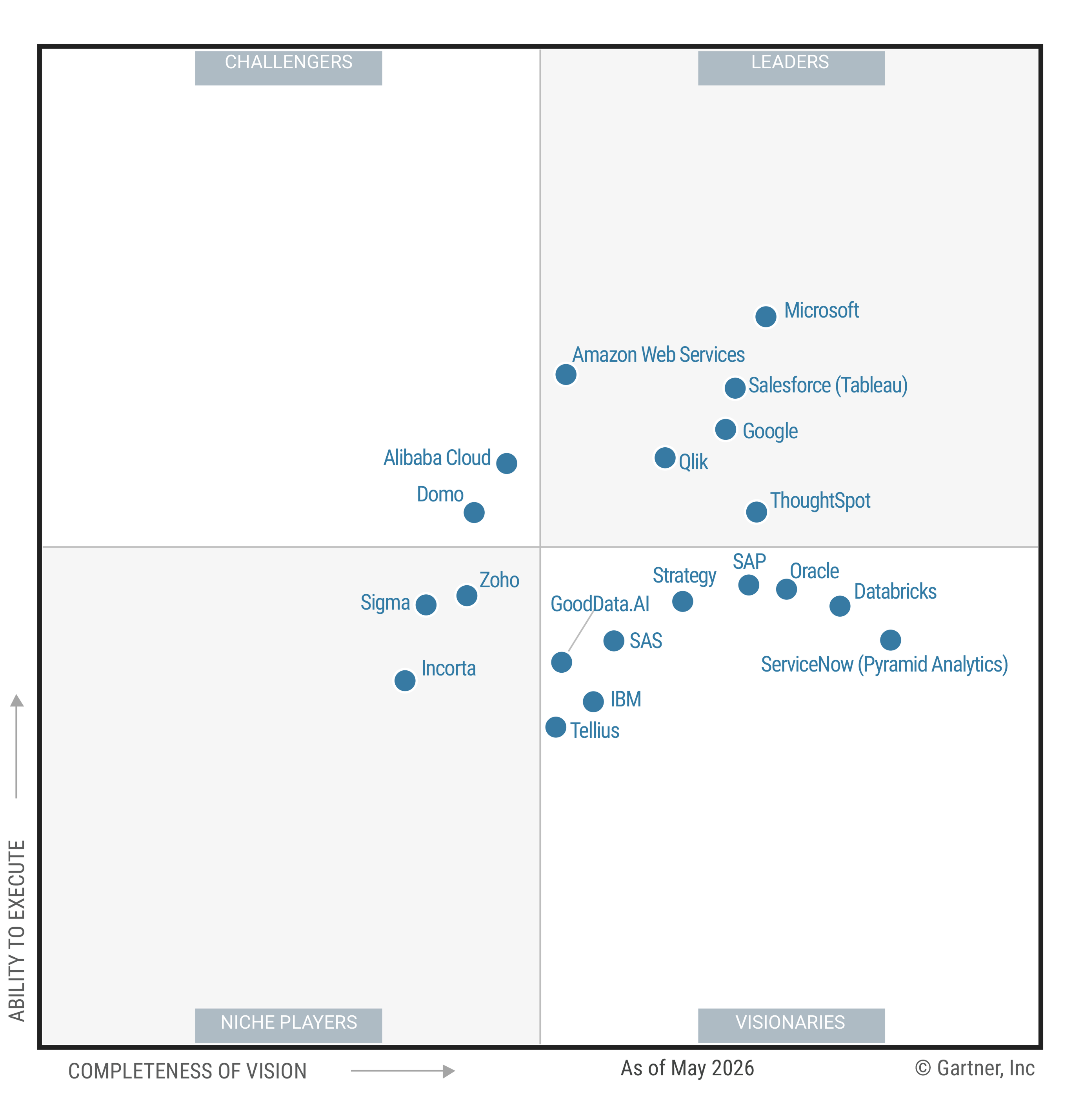
- ThoughtSpot is a Leader in the 2026 Gartner® Magic Quadrant™ for Analytics and Business Intelligence Platforms, and one of the only independent vendors in the Leaders Quadrant.
- Gartner highlighted three strengths: conversational analytics through Spotter, external semantic layer connectivity, and agent workflow orchestration.
- 60% of agentic analytics projects without a governed semantic layer will fail, according to Gartner. Consistent definitions across your stack aren't optional anymore.
- Customers are reporting that non-technical teams now get answers in seconds rather than waiting on data teams, a shift from requesting analytics to doing analytics.
- Agentic AI capabilities are now table stakes for analytics and BI providers; what matters most is that those agents act on governed, trusted intelligence across your entire org. If your current platform doesn't meet that bar, it's worth asking why.
Why Were We Recognized? It’s Simple: You.
When a company is recognized on a global stage, it’s easy to focus entirely on the technology. But the truth is, an analytics platform is only as powerful as the community of people using it to drive change every day.
ThoughtSpot has been named a Leader in the 2026 Gartner® Magic Quadrant™ for Analytics and Business Intelligence Platforms. While our engineering teams are incredibly proud of this achievement, my deepest gratitude goes to our customers and global user community.
The data analysts who push our platform past its limits, the data leaders who choose to bet on a different approach, and the frontline business teams using AI to make smarter decisions - this milestone belongs to you.
This recognition belongs to our customers as much as it belongs to us—you're the reason it means anything at all.
When I look at an industry matrix like the Gartner® Magic Quadrant™, I don’t just see vendor logos on a grid. I see the thousands of data professionals, creators, and business users behind those data points who bring the technology to life. Thank you for trusting us with your data and your vision.
What Does It Mean to Be a Leader in the 2026 Gartner® Magic Quadrant™ for Analytics and BI?
When I think about what this recognition actually represents, I think about the teams at companies like Unilever and Lyft who chose to do analytics differently.
Ketan Karkhanis, CEO of ThoughtSpot, framed this well:
"The analytics industry is entering a new phase, one where success will be determined not by who can build the best dashboard, but by who can deliver the most trusted intelligence. Organizations need AI that understands business context, reasons over trusted data, and can drive action inside the workflows where work actually happens."
For years, BI has promised self-service. But too often, that promise has meant giving business users more dashboards to interpret, more charts to build, and more complexity to navigate. That is not true self-service. That is shifting the work from one team to another.
Business users do not want to build charts all day. They want answers. They want insight. They want to know what changed, why it changed, what it means, and what they should do next.
AI is forcing the analytics category to confront that reality. When I read this year's criteria, the throughline was clear: the platforms earning Leader status are the ones that meet you where your data lives.
You need an analytics platform that connects to the governance layers you've already built, and lets every person on your team, from the CDO to the frontline rep, ask questions and trust the answers. That's the bar, and it's only going up.
Can this AI understand our business context?
Can it reason over trusted data?
Does it connect to the governed semantic layers we already use?
Can it work across our data wherever it lives?
Can it move from insight to action inside the workflows where decisions actually happen?
Those are the questions that separate Leaders from the rest of the market.
What Does Gartner® Say About ThoughtSpot's Platform?
Gartner's evaluation pointed to three specific strengths, and each one maps to a challenge you've probably felt firsthand. Here’s what sets us apart:
1. Conversational Analytics That Actually Understands Context
Spotter, ThoughtSpot's AI analyst, doesn't just pattern-match keywords against a database schema. It breaks down your natural language questions into transparent reasoning plans, retains conversational memory across follow-ups, and allows you to analyze all of your data.
It breaks down your natural language questions into transparent reasoning plans, retains conversational memory across follow-ups, and lets you analyze all of your data. And here's what I think matters most about that: you're not hoping the answer is right, you know it’s right.
Because Spotter is built on Spotter Semantics, a patented engine grounded in human-verified business definitions, the right answer is what the system is built to produce. That's the result of 70 patents and a decade of work that most vendors are only now starting to think about.
As a data analyst at a $30B+ healthcare and biotech company put it:
"Working with Spotter's conversational AI and Analytics is truly mind-blowing. We are absolutely impressed by the ability to ask "Why" questions and receive deep, actionable analysis complete with summaries, next steps, and recommendations. It's fundamentally transforming how we generate insights today.
What's particularly powerful is how the AI agents seamlessly blend structured, unstructured and external data into cohesive answers - work that previously took us weeks now happens in minutes. This has been genuinely transformative in how we run our business more effectively.”
2. Why Does a Semantic Layer Matter for Agentic Analytics?
If you've been in any conversation about agentic AI and analytics this year, you've probably heard someone bring up the semantic layer. There's a reason:
It usually starts the same way: someone asks why their AI project isn't delivering consistent answers. And when you dig in, the problem is that nobody agreed on what "revenue" or "churn" actually means before the agents started using those definitions. That's worse than no AI at all, because now you've added a trust problem on top of a data problem.
ThoughtSpot's approach addresses this directly. Spotter Semantics provides an AI-native semantic foundation, and the platform connects to external governed metrics through dbt Semantic Layer, Looker LookML via Open SQL, Snowflake Semantic Views, and Databricks Unity Catalog.
When Finance asks for Q2 net revenue by region, two or three different numbers can end up in the same board meeting, depending on who pulled the data and where. But with ThoughtSpot, the Finance team owns one verified definition, and every tool, query, and dashboard pulls from that same source.
And when that definition needs to change, updating it isn't a project you have to schedule. Because metric definitions are version-controlled in TML, a single update propagates across every query, every dashboard, and every embedded app automatically. So if Product redefines "active user" on a Tuesday, by Wednesday, nobody is pulling the wrong MAU number into a fundraising deck.
3. How Does Agent Workflow Orchestration Change Your Analytics Operations?
Think about the last time someone on your team asked for a new report. How many people touched that request before an answer came back, and how much context got lost between the person asking and the person building? That's the problem agent workflow orchestration is actually solving.
ThoughtSpot deploys a coordinated team of specialized BI agents: SpotterViz handles visualization, SpotterModel manages data modeling, and SpotterCode writes and validates analytical code. Together, they automate the entire analytics lifecycle, so your team isn't manually picking up where each tool leaves off.
What tends to get overlooked in these conversations is what happens to governance when agents are doing the work. In ThoughtSpot, row-level security, column masking, and full audit logs are enforced at the model level on every single query.
So when a sales rep asks a natural language question, the right data is returned, and the wrong data never surfaces, regardless of how the question was phrased. ThoughtSpot is also SOC 2 and ISO 27001 certified.
When non-technical teams can get answers themselves, in seconds and with answers they can trust, your data team stops being a request queue and starts doing the work that actually needs them.
Ask yourself honestly: how much of your team's time right now goes to fielding requests versus the work that actually moves your business forward? If that ratio feels off, it might be time to take a hard look at your platform.
What Does the 2026 Gartner® Magic Quadrant™ Mean for Your Analytics Strategy?
Companies like Booking.com, Intuitive Surgical, and Ecolab aren't waiting for the analytics category to catch up to their ambitions, and neither should you. The 2026 Gartner® Magic Quadrant™ for Analytics and Business Intelligence Platform is a useful signal to help guide you in the agentic era.
If you're in the middle of evaluating platforms or rethinking your AI strategy, this year's report is worth your time. The criteria alone will sharpen the questions you ask every vendor on your shortlist.
Frequently Asked Questions: The 2026 Gartner® Magic Quadrant™ for Analytics and BI