AI can now generate SQL, build dashboards, and answer questions in plain language. But generating queries isn’t the same as understanding a business. The model might not know which revenue definition finance approves, how your fiscal calendar works, or which fields require restricted access.
As AI agents become the front door to analytics, the real challenge isn’t query generation; it’s semantic grounding.
That’s where the Agentic Semantic Layer becomes essential.
The Problem with AI Analytics Today
As AI becomes conversational, expectations change. When you ask a question, you expect the system to return the right answer, not just a query that happens to run.
That raises the standard. It’s no longer enough for a query to execute successfully; the result must reflect:
Approved metric definitions
Consistent business logic
Enterprise governance rules
Most AI analytics systems weren’t designed for that level of responsibility.
They translate natural language into SQL and run it directly against warehouse schemas, assuming that table structures and column names capture business meaning. In reality, enterprise data environments are far more complicated.
Your data likely contains overlapping metrics, inconsistent naming conventions, and evolving business rules.
Without a structured semantic layer, AI systems end up inferring meaning from patterns instead of applying governed definitions.
When AI Lacks Business Context, It Relies on Probability
Large Language Models (LLMs) resolve ambiguity through probability. When several interpretations are possible, they choose the one that appears most statistically likely.
A simple example:
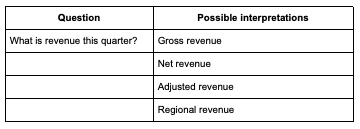
The model selects the field that best matches the wording of the question, but it doesn’t know which version finance has approved. Over time, this leads to conflicting answers where two people ask similar questions but receive different results.
Legacy semantic layers were built for dashboards, not agents
Traditional semantic layers were designed for dashboard-driven BI tools like Tableau and Power BI, where the goal was to centralize metric definitions and ensure consistent logic across reports.
That approach worked well when analytics revolved around predefined dashboards. Users explored curated reports, and the semantic layer ensured each visualization relied on the same underlying definitions.
AI agents introduce a very different interaction model.
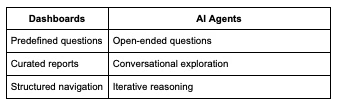
Dashboards assume known exploration paths. AI agents, on the other hand, support dynamic reasoning where users refine questions, pivot across domains, and ask follow-ups that were never anticipated.
Static semantic architectures struggle to support that level of flexibility. Supporting AI-driven analytics requires a semantic layer designed for agents rather than dashboards.
What is an Agentic Semantic Layer?
An Agentic Semantic Layer is a governed semantic foundation that powers AI agents. It sits between your data platforms and AI systems, translating natural language intent into deterministic, policy-aware queries grounded in approved business definitions.
Unlike traditional semantic layers built for dashboards, an agentic layer supports continuous interaction. Users ask evolving questions, AI agents reason across domains, and governance is enforced automatically.
Its architecture combines several core capabilities:
1. Flexible schema
A flexible schema balances centralized metric standards with domain ownership, allowing teams to extend models without breaking global consistency.
2. Business logic
KPIs, formulas, fiscal calendars, and aggregation rules are defined once so AI agents reference approved definitions instead of inferring calculations.
3. Security and governance
Row-level security, column permissions, lineage tracking, and a centralized metrics catalog guarantee queries follow enterprise policies.
4. Query generation
Natural language is translated into semantic intent before deterministic, governed SQL is generated.
5. AI enablement
Synonyms, semantic indexing, and feedback loops allow the system to improve its interpretation over time.
Start Getting Better Insights
Why AI Agents Require a Semantic Layer
AI agents are quickly becoming a primary interface to data, and analysts are no longer the only ones querying metrics. Executives, operators, and even customer-facing applications increasingly rely on AI-generated answers in real time.
When AI influences revenue forecasts, operational decisions, or embedded analytics, its answers must be consistent and reproducible.
Without semantic grounding, AI behaves like a probabilistic copilot.
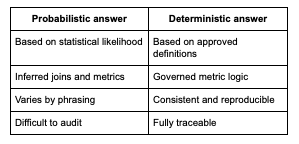
A semantic layer converts intent into reproducible business logic so the system consistently returns the same answer to the same question.
Open and Boundaryless: Ending Semantic Lock-In
Even as organizations invest in semantic modeling, a new challenge has emerged: fragmentation.
Business logic often spreads across tools. One version of revenue might live in BI, another in transformation pipelines, and a third in application code. Over time, metrics become trapped inside individual systems, and migrating platforms often means rebuilding definitions from scratch.
To avoid this, the semantic layer must be open and portable rather than proprietary or isolated.
Vendor-neutral initiatives such as Open Semantic Interchange (OSI) aim to make semantic definitions portable so metrics, relationships, and business logic can move across platforms without being rewritten.
That openness matters because modern data stacks are inherently distributed. Organizations operate across warehouses like Snowflake and Databricks, rely on transformation frameworks such as dbt, and embed analytics directly into applications.
A semantic layer built for this environment must support federated execution and integrate with existing tools rather than replace them.
How ThoughtSpot’s Spotter Semantics Leads the Shift
ThoughtSpot’s semantic architecture was built for search-driven analytics from the beginning. Spotter Semantics extends that foundation to power AI agents through:
1. Human-validated business semantics
Every organization relies on definitions that don’t exist directly in the data itself.
For example:
What qualifies as a churned customer?
Which products fall into high-value versus low-value cohorts?
What version of revenue does finance approve?
Which columns contain restricted data?
These kinds of rules often exist as tribal knowledge across teams.
ThoughtSpot captures that knowledge in its semantic model, where domain experts define and validate metrics, joins, security rules, and cohort definitions through a human-in-the-loop process. Rather than requiring a rigid upfront modeling exercise, these definitions can evolve collaboratively as the business changes.
The result is that AI agents operate on explicit, governed, and deterministic business definitions, rather than relying on probabilistic interpretations of schema structures.
2. Machine-readable context for AI agents
Once defined, the semantic model is stored in a machine-readable format that AI systems can ingest directly.
This gives agents the context they need to interpret questions accurately, including dataset relationships, metric definitions, join logic, fiscal calendars, and security policies.
So when someone asks:
“How many customers churned last quarter?”
The AI agent doesn’t scan the schema and guess which column might represent churn. Instead, it references the semantic model to identify the approved churn definition, locate the correct datasets, apply the appropriate fiscal calendar, and follow the modeled relationships between tables.
By grounding AI in a structured business context, the system consistently produces answers that reflect actual business logic rather than statistical likelihood.
3. Deterministic semantic query generation
Defining business semantics is only part of the challenge. Those definitions still need to be translated into executable queries.
ThoughtSpot’s query generation engine acts as the enforcement layer between the semantic model and the data warehouse. Instead of allowing AI models to generate SQL directly from natural language prompts, ThoughtSpot first interprets a user’s question as semantic intent. The query engine then constructs SQL using the governed semantic model as its source of truth.
This architecture ensures that every query guarantees a deterministic outcome that:
Enforces row-level and column-level data security policies
Applies approved metric definitions rather than inferring calculations from column names
Respects modeled joins and dataset relationships
Generates SQL optimized for the underlying data platform
As a result, AI-generated answers remain accurate, secure, and reproducible across complex enterprise data environments.
4. Analytics-as-Code with TML
ThoughtSpot’s semantic layer is defined using ThoughtSpot Modeling Language (TML).
TML promotes an Analytics-as-Code workflow, allowing semantic definitions to be managed using the same practices applied in modern software development.
Organizations can:
store semantic models in version control
review metric changes through pull requests
automate deployments using CI/CD pipelines
roll back changes when definitions evolve
This approach allows semantic models to evolve continuously while maintaining governance and reliability. It also enables organizations to scale analytics across internal teams, embedded applications, and AI agents without duplicating business logic.
5. Open and interoperable semantics
Historically, semantic layers have been tightly coupled to specific analytics platforms. Tools such as Looker and Microsoft Power BI provide powerful modeling systems, but their semantic definitions often remain locked within their ecosystems.
As organizations adopt distributed data stacks and AI-driven analytics, portability becomes increasingly important. ThoughtSpot is a founding contributor to the Open Semantic Interchange (OSI), which aims to standardize semantic models so business logic can move across platforms without being rebuilt.
The goal is to create a shared semantic format that allows models defined in one system to be reused across others.
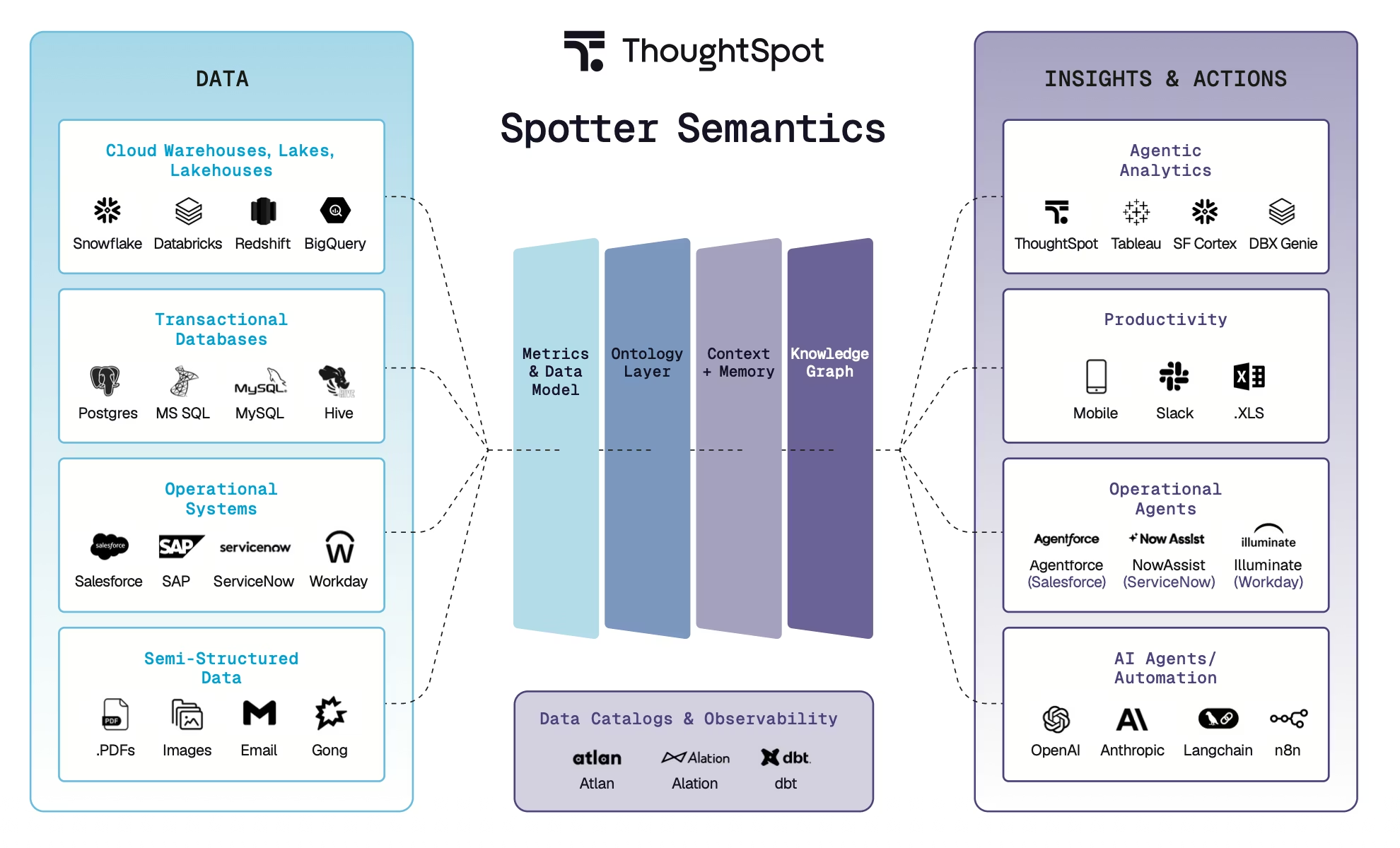
As AI agents become the primary interface to data, their reliability depends on the semantic infrastructure behind them. Spotter Semantics provides that foundation through human-validated business knowledge, machine-readable context for AI systems, deterministic query generation, and open semantic definitions.
Because in the era of agentic analytics, the challenge isn’t generating queries; it’s assuring every answer reflects the true logic of the business.
How Spotter Semantics Fits Into the Modern Data Stack
That semantic foundation doesn’t replace the modern data stack. Instead, it sits between data infrastructure and AI systems, ensuring governed business logic is applied whenever questions are asked.
Dashboard-first BI platforms
Tools like Tableau and Microsoft Power BI were built for dashboards and reporting. Their architectures were not designed for conversational, agent-driven analytics.
Transformation frameworks
Tools such as dbt focus on modeling and transforming data inside the warehouse, but they do not provide a semantic interface for natural language reasoning or AI-driven queries.
Data warehouses
Platforms like Snowflake provide scalable storage and compute. While they increasingly offer AI capabilities, they remain infrastructure systems designed for data teams rather than business users asking questions directly.
Spotter Semantics integrates across these systems rather than replacing them. Its AI-native architecture enforces governed definitions at query time, applies continuous learning through user feedback loops, and extends into embedded environments through MCP server capabilities.
The same semantic logic can power internal analytics, customer-facing applications, and agent-driven workflows without duplication.
As one enterprise data leader put it:
“AI doesn’t fail because the model is weak. It fails when the business logic underneath it is inconsistent.”
The shift isn’t about adding smarter models; it’s about building the smarter semantic foundation that makes AI reliable at scale.
Who Needs an Agentic Semantic Layer?
As AI agents become embedded in everyday workflows, the semantic layer becomes a shared foundation for how different teams interact with data.
Data leaders can scale analytics adoption without increasing governance overhead because metric definitions, policies, and access controls are enforced automatically.
Analysts spend less time validating metrics or rewriting SQL queries and more time focusing on deeper analysis.
Engineers reduce duplicated modeling across transformation pipelines, BI tools, and embedded applications by centralizing business logic in a single semantic foundation.
Business users get faster, trusted answers without navigating complex dashboards or second-guessing metric definitions.
Product teams embedding analytics can maintain consistent definitions across tenants through governed semantic SQL.
As AI becomes the primary interface to data, the semantic layer evolves from a backend component into shared infrastructure across roles.
Bring Agentic Analytics to Your Data Stack
AI is quickly becoming the primary interface to data. As more questions are asked through AI agents rather than dashboards, the reliability of those answers depends on the foundation behind them. The real shift isn’t simply from dashboards to AI. It’s from static semantic models to agentic foundations that make AI reliable at scale.
ThoughtSpot built Spotter Semantics to power that shift, grounding every AI interaction in deterministic business logic.
Start a free trial to see the agentic semantic layer in action.
Agentic Semantic Layer FAQs
What is a semantic layer in data analytics?
A semantic layer is a business logic layer that sits between raw data and analytics tools. It defines metrics, relationships, and governance rules so users interact with consistent business definitions rather than raw tables.
How is an agentic semantic layer different from dbt?
dbt Labs focuses on transforming and modeling data inside the warehouse. An agentic semantic layer governs how AI agents interpret, query, and reason over that data in real time, including natural language interaction and deterministic semantic SQL generation.
Why do AI agents need governed data?
Without governed data, AI agents rely on probabilistic interpretation of schema structures and column names. Governance provides consistent metric definitions, enforced access controls, and reproducible logic, ensuring answers are reliable and auditable.
What is Open Semantic Interchange (OSI)?
Open Semantic Interchange (OSI) is a vendor-neutral approach to making semantic definitions portable across analytics platforms. It reduces lock-in by allowing business logic to move consistently across tools and environments.