The narrative around AI analytics is that it's a seismic shift, a groundbreaking force that can catapult anyone from data uncertainty to actionable confidence. Natural language search puts data exploration in everyone's hands, and agentic AI takes it further, delivering context-rich guidance right when you need it. It's a vision that promises endless possibilities.
As a data leader, though, you know the reality isn't quite as picture-perfect. These capabilities are genuinely impressive, but they come with a catch: without the right tools and clear use cases, you're not adding value. You're creating another pile of technical debt. In fact, Accenture research found that 41% of executives identify AI as the highest contributor to tech debt.
So, here's the big question: how do you find the AI analytics tools that actually fit your business, the ones that align expectations with outcomes? Let this article be your guide.
Top AI analytics tools to explore in 2026
1. ThoughtSpot
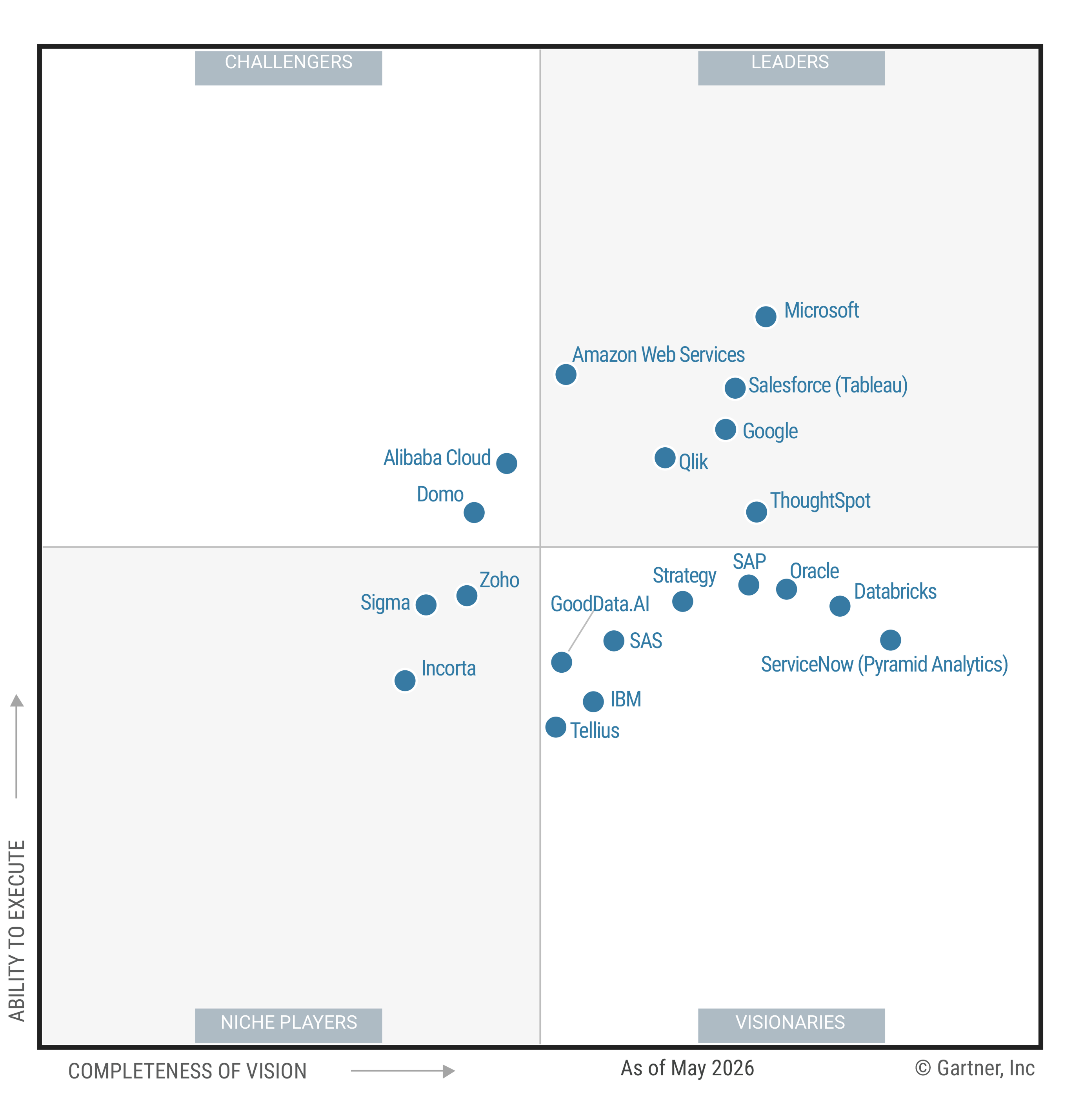
When the GenAI wave began in early 2023, ThoughtSpot was the first to announce and launch an AI-powered analytics experience. Recognized as a Leader in the 2026 Gartner Magic Quadrant for Analytics and Business Intelligence Platforms, ThoughtSpot gives you trusted, enterprise-grade AI that makes it easy to explore data from any angle, all in real time.
With ThoughtSpot's agentic analytics platform, you're not just viewing data. You're interacting with it: ask questions, get automated insights, run complex analyses, and drill endlessly into live visualizations. Granular security controls and an advanced human-in-the-loop system help you limit bias for accurate, trustworthy results.
Core features
1. AI agents: With Spotter as your AI analyst, insights become accessible to everyone, not just experts. No matter how complex your dataset is, you can ask questions in natural language and immediately get AI-generated insights that point to where you can make the most impact, from comparisons to cohort analysis, so you understand not just how your data changes but why.
2. AI-augmented dashboards: Traditional dashboards are static and limiting. ThoughtSpot's AI-augmented dashboards give you automated, real-time insights that respond instantly to whatever your business needs, letting you drill from high-level metrics to granular detail without pre-defined drill paths.
3. Actionable analytics: ThoughtSpot delivers real-time, actionable intelligence that goes beyond surface-level analysis. With capabilities like AI highlights, proactive KPI monitoring, predictive insights, and workflow automation, you get quick clarity on key trends and performance indicators so you can decide faster.
4. Analyst Studio: Your data teams get power tools to prepare data for AI and move between quick ad hoc analysis and advanced analytics. Analyst Studio connects data from multiple cloud data warehouses, preps it, and supports Python and R notebooks for sophisticated modeling, all in a shared workspace built for faster time to insight.
ThoughtSpot pros
The agentic analytics experience makes data exploration intuitive for everyone, even without a technical background.
You get a full suite of AI capabilities across a wide range of analyses.
You have the flexibility to work with multiple LLMs and data sources, and every plan includes unlimited LLM tokens with no separate metering charge.
ThoughtSpot cons
Business users may need additional training to get the most out of advanced analytics features.
Pricing
ThoughtSpot offers flexible pricing designed around how your team actually works:
Essentials, starting at $25 per user per month: built for small teams that want to find and share AI-powered insights.
Pro starts at $50 per user per month: for growing businesses ready to put AI analytics in front of business users, with Spotter AI agents and unlimited LLM tokens included.
Enterprise, custom pricing: for organizations scaling analytics with unlimited users, unlimited data, and enterprise governance.
Unlike AI add-ons that charge by the token or require separate compute capacity, ThoughtSpot's plans include unlimited LLM tokens, so your AI usage isn't a variable line item on top of your subscription.
2. IBM Cognos Analytics
IBM's Cognos Analytics supports AI-assisted data preparation, statistical modeling, and predictive analytics. Analysts can connect and clean data from multiple sources, build reports, and use machine learning to build time series models. Its "Ask Cognos Analytics" AI assistant helps you build a real-time dashboard and share insights without digging through menus.
That said, it isn't without its challenges. Cognos scores well in reporting and visualization, but industry reports point to performance bottlenecks during data prep, the kind of slowdown that keeps data leaders from building new pipelines and acting on opportunities quickly.
Core features
Data visualization and reporting: create interactive visualizations and use reporting capabilities for deeper analysis.
AI-powered insights: IBM's AI assistant surfaces automated insights that highlight key trends and patterns.
Data modeling: use machine learning to build models that structure data for further analysis.
Integration with cloud data sources: combine data from multiple sources, including cloud databases and spreadsheets.
IBM Cognos Analytics pros
The drag-and-drop interface helps you visualize, analyze, and explore data without writing code.
You can customize reports and dashboards with different chart, graph, and table types.
IBM Cognos Analytics cons
Subscription costs for add-ons and advanced features add up quickly, especially with advanced reporting.
The platform struggles with larger datasets or complex queries, which makes it a tougher fit for high-demand environments.
Pricing
Cognos Analytics pricing depends on user count, feature access, and deployment option, but two main cloud tiers anchor it:
1. Standard, around $10 to $11 per authorized user per month: basic dashboard creation, AI features, and sharing.
2. Premium, around $42 to $45 per authorized user per month: Standard plus enterprise reporting features, built for larger teams.
3. MicroStrategy
MicroStrategy's flagship AI analytics tool, Strategy One, lets you connect to data warehouses, streamline workflows, build AI-powered dashboards, and share reports. Its "Auto" AI assistant delivers automated insights to help you stay on top of your KPIs.
The platform has introduced generative AI capabilities, but reports indicate its augmented analytics features still lag behind purpose-built agentic tools, worth weighing if faster, more autonomous AI-driven insight is your priority.
Core features
Interactive dashboards and reporting: build customizable, real-time dashboards to monitor performance.
AI features: get automated insight into trends and anomalies through a natural language interface.
Embedded analytics: embed analytics directly into your existing applications.
Mobile app availability: access dashboards and reports from anywhere.
MicroStrategy pros
MicroStrategy stays highly competitive on governance and reporting capabilities.
With features like Auto SQL and Semantic Graph, your data teams can prep and clean data for deeper analysis.
MicroStrategy cons
The platform can be complex to navigate, especially without a technical background.
It may demand significant computing resources, which can create performance issues if it's not managed carefully.
Pricing
MicroStrategy uses a subscription-based licensing model, with costs varying by deployment type (cloud or on-premises), data storage needs, enabled features, user roles, and user count. Consult their team directly for pricing tailored to your setup. A 30-day free trial is available.
Want to see how MicroStrategy compares with other BI tools? Read the full story here.
4. Power BI
Microsoft's Power BI is an AI-powered data visualization tool that helps you spot trends and run complex analyses through a drag-and-drop interface. Copilot lets you ask questions in natural language and get visualizations back.
There's a catch, though: Power BI is popular among technical data teams, but the learning curve around its interface makes it less accessible to business users and frontline decision-makers.
Core features
Custom-built visuals: create visualizations and dashboards from pre-built templates.
Data modeling: shape, clean, and define data relationships, and build measures with Power Query, Power Pivot, and DAX.
Connectivity with the Microsoft ecosystem: integrates with tools like Azure, Excel, and SharePoint.
Real-time data analysis: monitor metrics and performance indicators as they happen.
Power BI pros
Power BI has a large, active user community, so you get plenty of resources and tutorials.
Copilot can help you speed up report creation.
Power BI cons
Power BI's service runs only in Azure, which limits how easily you connect external databases or applications.
Copilot isn't included with standard per-user licensing. You need a paid Fabric capacity (F2 or higher) or Premium Per User to turn it on, which adds a separate cost layer most buyers don't see coming.
Pricing
Power BI's pricing rose in April 2025 and now breaks down as:
Free: individual desktop use for building dashboards and reports, no sharing.
Power BI Pro, $14 per user per month: publishing and sharing in shared workspaces, best for small teams.
Premium Per User, $24 per user per month: larger model sizes, more frequent refreshes, and the license tier where Copilot becomes available.
Power BI Embedded: variable pricing for embedding Power BI into your own applications.
Quick note: Copilot needs a paid Fabric capacity (F2 or higher) or Premium Per User licensing. A Pro license alone won't unlock it.
5. Qlik
Qlik's platform uses AI to power associative modeling and data discovery, with augmented analytics capabilities like automated insight generation, natural language interaction, AI-assisted data prep, and predictive analytics through Qlik Predict. Qlik has moved fast on the agentic AI front too: its agentic architecture went generally available at Qlik Connect 2026, built on acquisitions including Talend, Upsolver, and Kyndi, with Qlik Answers and a Discovery Agent rounding out the conversational and investigative layer.
The platform still supports strong dashboard and advanced exploration capabilities, so if you're evaluating Qlik, weigh how well its expanding agentic stack fits your existing data foundation and governance needs.
Core features
Multiple data integration connectors: combine data from sources like cloud databases and spreadsheets.
Real-time monitoring: track data as it changes for the latest read on business KPIs.
Predictive analytics: use Qlik Predict to build models, explore data, run experiments, and forecast trends.
Automated insights: Qlik's AI-powered assistant surfaces instant insight into your data.
Qlik pros
Qlik integrates with multiple cloud warehouses and databases.
Users praise Qlik's data monitoring and alerting features for real-time notifications about KPI changes.
Qlik cons
Complex datasets sometimes require manual reloading or refreshing of data.
Qlik's pricing model can be confusing and grows expensive as usage scales.
Pricing
Qlik uses a subscription-based pricing model where cost varies widely by feature needs and usage. A standard plan exists, but getting the full feature set can get pricey at high data consumption. Connect with their team for the best estimate. A free trial is available.
Building blocks for your AI analytics tool selection
Joe Reis, data expert and author, said it well on an episode of "The Data Chief": when it comes to adopting AI in the organization, there's a lot of pressure from the top down, and understanding what that pressure actually means for your organization should be table stakes.
Without a clear, orchestrated roadmap for how, where, and when you'll invest in your AI analytics stack, you're not just wasting resources. You're creating more user frustration and backlog. Here are a few steps to make your selection and rollout easier.
1. Know what AI analytics means for your business and users
AI analytics means different things to different people. Business users might want instant visualizations, while power users like analysts want to identify hidden trends and shape raw data into meaningful stories. When you assess what your users actually need, you get clarity on which functionality matters and can set realistic expectations from day one.
2. Prioritize vendors with demonstrated use cases
Most AI analytics tools on the market are still maturing and don't have much documentation on real-world use cases, which can be misleading: plenty of tools promise a lot but fall short on delivering the capability behind the vision.
Choose a tool with in-depth documentation, resources, and training materials. Get hands-on experience with different products so you understand the trust, accuracy, and cost trade-offs firsthand, not just from a pitch deck. Check user reviews from reputable sources and read industry reports for an up-to-date read on platform performance.
3. Give precedence to the human-in-the-loop element
Everyone wants instant insight from their AI tool, but AI doesn't always get it right. From well-documented hallucinations to biased results, trusting AI blindly with your business data can lead to bad decisions, or worse, a loss of trust across your organization. A human-in-the-loop feedback system curbs bias and builds transparency, so your data stays accurately represented when queried.
Turn years' worth of data into actionable intelligence
Going from legacy BI to AI-powered analytics is a journey. Your success won't happen overnight, but with the right tools and the right partner, you'll hit your goals faster. Our MIT survey found that 56% of early adopters have already exceeded their business goals by building the right partnerships at the right time. So, are you ready to go from 0 to 100 with AI-powered analytics?
With ThoughtSpot, you get a purpose-built agentic analytics experience for everyone. Whether your team needs real-time insight or wants to predict next quarter's trends, our platform puts you in the driver's seat, delivering trusted insight anywhere, at the speed of business.
Want to see it for yourself? Sign up for a ThoughtSpot demo and see how agentic analytics can bring your data to life.