A few years ago, I got a call from Tesla telling me not to come in for my scheduled service, saving me $600 and a wasted afternoon. In over two decades of car ownership, no auto service had ever done that. The rep explained that data from my car had prescribed an action, or in this case, an inaction. My vehicle's sensors had been continuously monitoring performance metrics, and the data showed that the scheduled maintenance wasn't actually needed yet. Instead of following a rigid service calendar, the system analyzed real-time conditions and made a smarter call.
What struck me wasn't just the convenience or the cost savings; it was the shift in how decisions were being made. No human analyst had to pull a report, spot the pattern, and then recommend canceling my appointment. The system identified the insight and initiated the action autonomously. That's the promise of AI agents for data analysis in a single, real-world moment: intelligence that doesn't just inform decisions, but actively drives them.
Table of contents:
You already know that analyzing data and acting on it leads to better outcomes, more efficiency, stronger customer experiences, and smarter decisions. Organizations that use data well have a competitive edge. That's not new.
What is new is how fast things are changing.
Over the last three decades, the data and analytics industry has made steady progress in expanding data-driven decision-making. And each wave of progress has tracked closely with broader technology shifts:
1960s: Computing
1990s: Internet
2000s: Cloud computing
2010+: Mobile computing
2020+: Artificial Intelligence
Throughout each of these cycles, we gained new types of analytics: descriptive, diagnostic, predictive, and prescriptive. The chart below shows how these technology shifts overlay with analytics innovation.
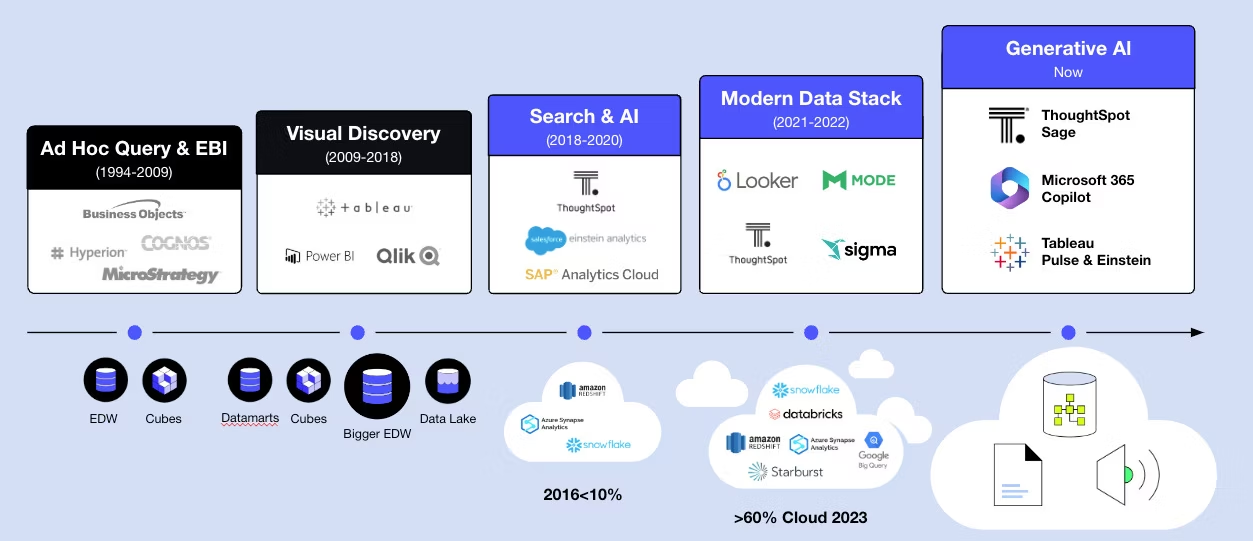
Generative AI is set to reshape how we interact with data in ways the previous waves didn't. According to Gartner, the next macro phase of technological change is the autonomous business, one operating in a programmable economy where AI initiates actions and humans supervise them.
What is autonomous business?
The AI evolution has moved through three stages:
Predictive: Machine learning forecasts trends and outcomes.
Assistive: Chatbots and copilots help users complete tasks.
Autonomous: AI initiates actions with human oversight.
An autonomous business is one that has moved from human-led, technology-assisted decisions to AI-initiated, human-supervised actions. It's not about removing people from the loop; it's about removing the tedious, repetitive work that slows your team down. That's where AI is the new BI.
AI agents are software programs designed to autonomously perform specific tasks based on a defined goal, with relevant input or context.
An AI agent, sometimes called an agentic AI system, might determine the best questions to ask to meet an objective, route between two potential paths, decide which tools to call, or assess whether a generated answer is good enough. These aren't simple chatbots. They're goal-driven systems that can reason, plan, and act.
You've likely already run into AI agents in customer service, where natural language processing powers the ability to understand and respond to questions. But the scope of what AI agents can do is expanding quickly across every business function, including analytics.
Here's the thing: AI agents will first make their mark by removing the mundane, repetitive tasks from your workflows. That frees your people to focus on work that actually requires human judgment. AI and human intelligence (HI) will collaborate to make organizations meaningfully more productive—in product, marketing, sales, customer support, and especially in data and analytics.
Analytics needs to evolve to match the speed and automation demands of modern business. That means moving from predictive and prescriptive to true autonomy, where AI agents can evaluate data, ask questions, and make decisions within the parameters of human control.
That might sound abstract, but it's more concrete than it seems. Think back to the Tesla example: instead of a human rep calling to cancel the appointment, an AI agent could do the same thing, and escalate to a human if the customer had questions it couldn't answer. The autonomous business is within reach for any organization that has already invested in solid data infrastructure.
Here's what AI agents for data analysis actually deliver:
1. Process large volumes of data quickly
Legacy BI tools often require manual data processing and a "file a ticket, get a dashboard in a few weeks" workflow. That creates bottlenecks at every step. Meanwhile, your competitors are getting answers in real time.
AI agents pull data from any source, process it, and generate actionable insights in minutes. They're designed to scan billions of rows, flag inconsistencies, and deliver clean, reliable data for analysis, automatically.
2. Speed up insight-to-action
Static dashboards give you a snapshot of data at a fixed point in time. If you spot something interesting, a spike in engagement, or a dip in sales, getting to the root cause usually means filing another request with your data team. By the time you have an answer, the moment has passed.
AI agents change that dynamic entirely. Instead of building dashboards from scratch, you use AI to surface relevant insights, visualizations, and plain-language summaries on demand. These systems understand your business goals and KPIs, analyze data on the fly, spot trends and anomalies, and can even take recommended actions, all without the multi-week turnaround.
3. Make data accessible to everyone
If your sales team is juggling spreadsheets, CRM tools, and dashboards that don't talk to each other, piecing together a clear picture of pipeline health means wading through tabs and reports, and often still needing to ask the data team for help.
With the right AI agent for data analysis, anyone on your team can type a question in plain English and get a meaningful answer. No technical expertise required. No ticket queue. This kind of self-service access means faster decisions across every team in your organization. ThoughtSpot's Spotter, for example, is built exactly for this—letting business users ask questions conversationally and get trusted, governed answers instantly.
4. Streamline and automate decision-making
AI agents can be trained to perform decision-making tasks autonomously, without constant human oversight. Using the Tesla example again: if you have the data and the model in place, you can train an agent to:
Trigger on a specific event (like a scheduled maintenance window)
Analyze the relevant data points (does this car actually need service?)
Take the appropriate action (send an automated message, or escalate to a human)
These systems improve over time. As they process more data, they refine their understanding of patterns, trends, and business objectives—making increasingly accurate predictions and decisions. That frees your team from repetitive report-building and gives your organization room to scale.
5. Detect anomalies and spot opportunities
Seasonal shifts, product launches, weather events, and economic disruptions all of these affect human behavior, and therefore your data. Traditional statistical methods often miss unusual patterns in erratic data because they rely on predefined rules that can't adapt quickly enough.
AI agents are different. They continuously adjust their models to detect subtle changes. For example, an AI agent could flag a sudden dip in customer engagement during a typically strong season, something a rule-based system might not catch until it's too late. That adaptability lets your team pivot faster and respond to market changes in real time.
6. Improve data team productivity
Your data team is stretched thin. Between building predictive models, monitoring KPI changes, and fielding ad-hoc requests from every department, there's little time left for the high-impact work that actually moves the business forward.
AI agents give data teams the support they need. Agents can handle time-consuming tasks like data logging, processing, real-time monitoring, and trend analysis automatically. That shifts your data team's role from order-takers to strategic advisors: coaching AI systems, driving ROI, and building a data-driven culture across the organization. Tools like ThoughtSpot's Analyst Studio are designed with exactly this in mind, giving analysts a full-featured environment to focus on interpretation and strategy, not assembly.
💡 Worth noting: While the promise of AI is significant, it's important to stay clear-eyed about the risks. Explore the dangers of AI and understand the ethical, security, and societal challenges that come with this technology.
2026 is shaping up to be the year of the AI Analyst, the AI agent built specifically for enterprise-scale analytics. But for the industry to deliver on that promise, AI agents need to go beyond novelty and actually embody the core competencies of a skilled human analyst.
Here's how to evaluate whether an AI agent is ready for the job, across four key perspectives:
Business user perspective
An AI analyst should work like any skilled analyst on your team—helping users understand data, ask the right questions, and get accurate answers.
Ask yourself:
Natural language: Does the agent communicate in natural language and provide the context that your business users are already familiar with?
Goal-driven: Does it help users start from a goal, guide them through the right questions, and lead to recommended actions?
Data literacy: Can it help users explore data through suggestions and break down complex elements into easy-to-understand tables and charts?
Query literacy: Does it guide users in framing the right questions? Can it suggest meaningful queries related to the topic being explored?
Breadth and depth: Can it handle both broad questions ("What happened?") and complex ones ("Why did this happen?")? Can it generate formulas or advanced insights?
Accuracy and explainability: How does the agent clarify its methodology? Is the explanation clear and verifiable?
Multi-turn conversation: Can it retain context across a conversation and offer alternatives to improve accuracy?
Personalization: Does it tailor recommendations based on a user's role, department, and organizational context?
Data and analytics team perspective
For your data team, these considerations are essential to make sure AI agents meet enterprise-grade standards:
Trainability: How effectively can you train the agent on your business's specific language and data taxonomy?
Governance: Can your data team establish clear governance frameworks to keep the agent compliant?
Safety: What steps are in place to address safety, ethics, and bias? How are responses constrained to prevent hallucinations?
Time to value: How efficient is the training process? Which steps can reduce the need for direct human analyst involvement?
Security: What measures make sure your data, operations, and suggested actions are secure and compliant?
Reliability: What mechanisms keep the agent delivering consistent results as data inputs evolve?
Technology perspective
Several technical factors determine whether an AI agent can scale and adapt to your business needs:
Multi-data system: Your enterprise data is often scattered across cloud warehouses, databases, files, apps, and on-prem systems. How well does the agent integrate across all of these?
Multi-LLM flexibility: Does the agent let you select and certify different large language models (LLMs) for specific business needs? Can you maintain control over which model is used?
Agentic skills: Does the technology stack support rapid capability expansion? Can the agent learn new skills and improve results over time?
User experience
Even the most capable AI agent fails if your people don't actually use it. Look for:
Self-service: Is the interface intuitive enough for users to ask follow-up questions and drill down without help?
Discovery: Does it encourage exploring existing analytical insights, not just answering direct questions?
Simplicity for advanced analytics: Does it give accurate, verifiable answers while accommodating users at different levels of data literacy?
Visualization: Can it automatically generate the most appropriate chart for the question being asked?
Flexibility: Can users converse, click, or code depending on their preference and skill level?
Available in your workflows
Data and insights should meet your users where they already are:
In-app: Is the AI agent available within your analytics app, as a built-in feature or add-on?
Standalone: Can it function independently for users who just want to ask data questions without the full analytics app?
Embedded: Can the AI agent be integrated as a feature within other tools or applications?
Mobile: Is it accessible on mobile, so your team can get answers on the go?
Insights to action
The real value of analytics isn't just finding insights, it's acting on them:
Automated follow-up: Can users set automated anomaly alerts and get proactive notifications when something changes?
Actionable outputs: Can users instruct the AI agent to take action once an analysis has been reviewed?
Whether we're ready or not, AI agents are driving the shift toward autonomous business. How your organization adapts will depend on the readiness of your data, the people you have in place, and the technology you bring in.
When it comes to data and analytics, don't settle for a basic chatbot or chart generator. Spotter, ThoughtSpot's AI agent for analytics, is an intelligent AI Analyst built for the complexity, security, and scale of enterprise data—with the usability and transparency that makes AI accessible to everyone, not just analysts.
Frequently asked questions about AI agents for data analysis
1. What are AI agents for data analysis?
AI agents for data analysis are software programs that autonomously analyze data, surface insights, and recommend or take actions based on defined business goals with varying degrees of human oversight.
Unlike traditional BI tools that require manual queries and dashboard builds, AI agents can interpret natural language questions, process large datasets in real time, and proactively flag anomalies or opportunities. They're designed to function like a skilled analyst that's always available, always up to date, and never stuck in a ticket queue.
2. How are AI agents different from traditional BI tools?
Traditional BI tools are largely reactive; they show you what happened, but only after someone builds a dashboard or runs a report. AI agents are proactive and conversational. They can answer questions in plain English, analyze data on the fly, detect patterns automatically, and take action based on what they find.
The key difference is autonomy: AI agents don't wait to be asked. They can monitor data continuously and surface insights the moment something worth knowing happens.
3. What are the main benefits of using AI agents in analytics?
The main benefits of AI agents for data analysis include:
Speed: Insights in minutes instead of days or weeks
Accessibility: Anyone on your team can query data in plain English, no technical skills needed
Automation: Routine monitoring, anomaly detection, and reporting happen automatically
Accuracy: AI agents continuously refine their models as they process more data
Productivity: Your data team spends less time on ad-hoc requests and more time on strategic work
4. What is an autonomous business?
An autonomous business is one where AI systems initiate actions and humans supervise them, rather than the other way around. It's not about removing people from decision-making, it's about removing the repetitive, time-consuming work that slows teams down.
In an autonomous business, AI agents monitor data continuously, identify opportunities or issues, and either recommend actions or execute them within predefined parameters. The result is faster response times, more consistent operations, and teams that can focus on strategy instead of manual data processing.