When your team needs to answer a critical business question, how long does it take? If you're waiting hours or days for reports, or if simple follow-ups like "What about sales figures for just the West region?" require starting over with a new request, you're experiencing the limitations of traditional BI tools.
Conversational analytics software introduces a whole new paradigm: data that you can query through a conversation in natural language, just like conversing with ChatGPT or other popular LLMs. This buyer's guide walks you through everything you need to evaluate conversational analytics platforms in 2025, from the 10 capabilities that separate leaders from followers to a complete 30-day proof of value plan you can implement immediately.
What is conversational analytics software (and what is it not)?
Conversational analytics software is a business intelligence tool that lets users query and analyze data using natural language instead of writing SQL or clicking through rigidly designed dashboards. The software interprets your questions, queries your data sources, and returns answers as visualizations, tables, or text summaries. It uses natural language processing (NLP) and AI-aided analytics to understand your intent and translate conversational queries into data operations.
Here's how it works in practice: You ask, "What were our top-selling products in the West region last quarter?" The system returns your answer within minutes. With proper data preparation, you can immediately follow up with "Show me California only" or "Break this down by customer segment"—all without starting over or submitting a new request.
This approach turns data access into a genuine investigation, where each answer opens new questions, and each insight leads to deeper understanding. You examine data from different angles, discover new perspectives on your business problems, and democratize your data so that every team member can help you build a data-driven culture.
Conversational analytics vs. conversation analytics software
Conversation analytics software typically analyzes recordings of customer interactions from calls, chats, and messages in contact centers. It focuses on sentiment analysis, topic detection, and quality assurance for customer support teams.
While working with conversation analytics data is one of many use cases for conversational analytics software, the two aren’t the same, so it’s important to avoid mixing them up.
10 essential capabilities that separate leaders from followers
When you're evaluating conversational analytics platforms, look for these 10 capabilities that distinguish enterprise-ready solutions from basic chatbots:
1. Grounded interpretation
The best systems don't just translate your words into SQL queries. They interpret the intent behind your question using a semantic understanding of your business context, so answers are accountable, relevant, and accurate. When you ask about "revenue trends," an analytics platform should understand whether you mean gross revenue, net revenue, or ARR based on your role and department. This cuts down on the back-and-forth clarifications that slow down decision-making and helps you move from question to decision in fewer interactions.
2. Multi-turn memory and context
Your tool should remember what you just asked, letting you ask follow-ups like "What about just California?" without starting over. This capability directly reduces the time your team spends on analysis because each insight naturally leads to the next question without rebuilding context. Instead of spending 30 minutes navigating multiple dashboards to understand a sales dip, you complete the entire investigation in under five minutes through a continuous conversation that lets you follow every thread where it leads.
3. Semantic layer and governance
Trust starts with consistency. A strong platform builds on a governed semantic layer where analysts define key business terms and logic, ensuring everyone gets the same answer for KPIs like "monthly recurring revenue." This eliminates the costly problem of different departments making conflicting decisions based on inconsistent metrics. When your sales, finance, and customer success teams all work from the same definitions, you avoid the strategic misalignment that leads to misdirected resources and missed opportunities across your organization.
4. Explainability and guardrails
You should never wonder how the AI reached its conclusion. This transparency is critical when you're presenting findings to executives or making high-stakes decisions, allowing you to defend your recommendations with clear data lineage. Platforms with strong explainability also reduce the risk of acting on flawed analysis. Look for solutions that provide transparent AI reasoning at every step, showing you not just the answer but the complete path from question to insight.
5. Enterprise security features
Your data security has to be a top priority. Look for robust features including:
Role-based access controls (RBAC): Users see only what they're authorized to access
Single sign-on (SSO): Seamless authentication through your existing systems
Row-level security: Granular data protection based on user permissions
These capabilities mean you can democratize data access without compromising compliance or exposing sensitive information.
For example, regional managers might be able to only see their territory's data, but corporate finance teams could access full P&L details. The end result is making faster local decisions while maintaining corporate governance standards that protect against data breaches and regulatory violations.
6. Live connectivity to cloud warehouses
True confidence in your business decisions requires the most up-to-date data available. Unlike traditional BI tools that rely on data extracts, modern platforms connect directly to cloud data warehouses like Snowflake, Databricks, or Google BigQuery for real-time insights.
This matters when you're responding to market changes, operational issues, or customer behavior shifts that require immediate action. Real-time connectivity means your supply chain team can identify and resolve inventory shortages before they impact customer orders, and your marketing team can adjust campaign spend based on today's performance, not last week's snapshot.
7. Agentic workflows and actionability
Getting an answer is just the start. Advanced platforms now include AI agents that suggest follow-up questions, surface related insights, and even trigger workflows in other applications. This capability transforms analytics from a reporting exercise into a decision-making accelerator. So, when the system flags that declining customer engagement correlates with delayed onboarding and suggests reviewing your implementation process, you move directly from insight to action without manual investigation, reducing your time-to-resolution for critical business issues.
8. Embedded experiences and APIs
Analytics should live where you work, and today’s best analytics solutions provide developer tools to embed conversational analytics directly into your applications, portals, and internal tools. Your customer success team can analyze account health without leaving Salesforce, and your operations team can investigate fulfillment issues directly in their warehouse management system.
Ultimately, it’s about keeping everyone focused on execution rather than hunting for data or constantly switching between tasks.
Verivox: From slow insights to strategic differentiation
Consider Verivox, a German online marketplace platform. Their teams were stuck with slow time-to-insight and limited exploration. That made it a challenge for them to keep pace as their data needs scaled rapidly.
ThoughtSpot Embedded was the key to reimagining their analytics experience, providing a fast, search-driven analytics experience for both internal teams and external partners.
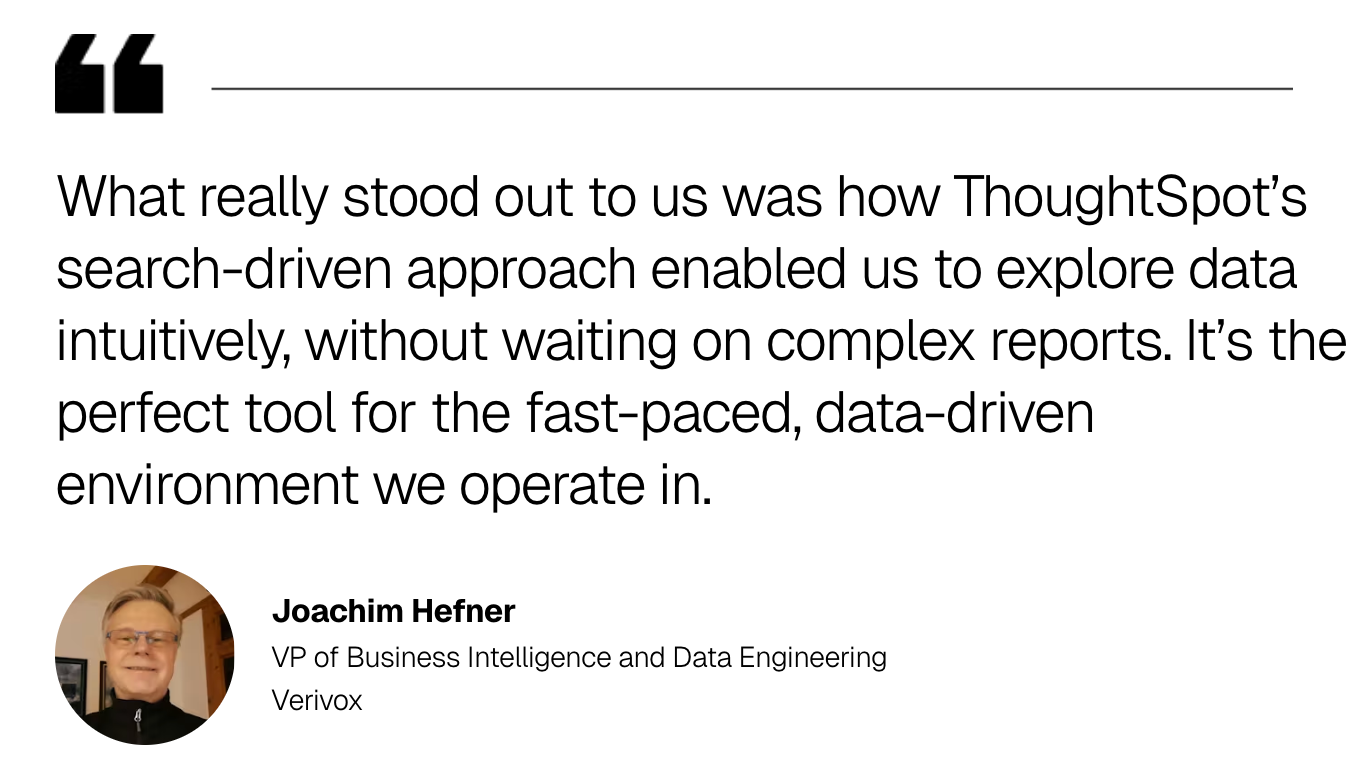
As a result, Verivox was able to decommission two legacy dashboard platforms. Even better, they’ve seen employee adoption of 70% across all Verivox divisions, meaning their team is putting the data to work driving business goals.
9. Flexible LLM integration
The AI landscape changes fast. Future-ready platforms let you bring your own preferred large language model (LLM) and switch between options from OpenAI, Google, or others, giving you control over cost, performance, and compliance. This flexibility protects your investment as AI evolves and lets you optimize for your specific requirements, such as using cost-effective models for routine queries while deploying more powerful options with per-query pricing for complex analysis.
If you’re part of a regulated industry, you can also choose models that meet data residency and compliance requirements without sacrificing conversational capabilities.
10. Usage analytics and observability
How do you know if the tool delivers value? The platform should include built-in analytics that monitor usage, track query performance, and show what questions your users ask most, so you can continuously improve the experience. These insights help you identify which teams are getting the most value, where users struggle with unclear answers, and which data sources need better semantic definitions.
This feedback loop transforms your analytics investment from a cost center into a measurable business driver, where you can see exactly how many hours you're saving and where to focus your optimization and automation efforts for maximum impact.
See what's possible with AI-powered analytics. Ready to stop waiting for reports and start getting answers? See how your team can make faster, smarter decisions with an intuitive analytics experience. Start your free trial today.
3 architecture patterns for enterprise conversational analytics
Behind every reliable conversational analytics experience is thoughtful architecture. These elements form a framework for trustworthy AI insights that let you turn your data into a competitive advantage.
1. Semantic layer as the AI foundation
The semantic layer is a centralized business logic layer that translates technical database structures into business-friendly terms. It acts as your single source of truth, defining how metrics like "revenue" or "conversion rate" are calculated across your organization. This layer maps business terminology to data tables, establishes calculation rules, and creates synonyms so AI understands that "sales," "revenue," and "bookings" might mean the same thing.
Without the semantic layer as a foundation, conversational AI can become unreliable. The system may misinterpret ambiguous terms, apply incorrect calculation logic to business metrics, generate answers from the wrong data sources, and produce results that contradict established reporting standards. A well-governed semantic layer helps verify that every department is operating from consistent definitions.
2. Retrieval and context enrichment
Retrieval and context enrichment are how the system identifies which data resources are relevant to your query, then augments your question with business context before generating an answer. An effective conversational analytics system understands each team member’s role, department, recent queries, and relationships between data elements.
When a sales manager asks about "Q4 performance," the system automatically applies the correct date range, filters to their territory based on permissions, and includes context like year-over-year comparisons. This eliminates clarification loops that slow down decision-making, reducing analysis time from hours to minutes.
Beyond SQL analysis capabilities
Advanced conversational analytics platforms perform multi-step analysis that mimics how skilled data analysts approach complex problems. The system automatically breaks down sophisticated questions into multiple analytical steps, from identifying trends to synthesizing actionable insights across multiple data sources.
When you ask "Why did customer churn increase last month?", the platform segments your customer base, compares behavior patterns, identifies which segments drove the change, and surfaces correlated factors. These advanced analytics tasks previously required specialized data science skills, but through the power of conversational analytics, anyone from a sales rep to the CFO can accomplish them on demand. For analysts who need deeper control, tools like ThoughtSpot Analyst Studio let you blend conversational exploration with custom SQL, Python, and R code.
Start Getting Better Insights
Your 30-day proof of value plan
Ready to test conversational analytics software against your real needs? Here's a simplified structure for a 30-day plan to evaluate any platform effectively.
Week 1: Scope and success metrics
Start by establishing clear benchmarks that reflect your actual business needs.
Pick focus areas: Choose three to five business-critical metrics and 10-15 representative questions your team asks regularly
Set acceptance criteria: Define targets for query speed, answer accuracy, and expected time savings
Identify pilot users: Select 12-20 users across different roles who will test the system
Week 2: Connect, govern, and configure
Build the semantic layer and governance framework that ensures consistent, trustworthy answers.
Connect data sources: Wire the software to one or two live datasets that represent your most important use cases
Align on definitions: Work with your data team to standardize metric definitions in the semantic layer
Configure security: Set up row-level security rules and user permissions to protect sensitive information
Enable feedback loops: Configure systems to capture user input during testing
Week 3: User testing with standardized prompts
Test whether the platform turns data access into a genuine investigation.
Run structured tests: Have your pilot group test using standardized questions
Measure performance: Track accuracy ratings, response times, and user satisfaction
Capture feedback: Document what works well and where users struggle
Week 4: Quantify results and plan rollout
Transform your testing data into measurable business value.
Measure improvements: Calculate time saved, reduction in ad-hoc data requests, and examples of faster decisions
Document gaps: Note any limitations or areas needing improvement
Build rollout plan: Use findings to create a phased implementation strategy with clear success metrics
Copy-paste prompt library for testing
Use standardized prompts to ensure you're measuring every platform against the same tasks. These examples demonstrate a few easy prompts to get you started:
|
Test Category |
What You're Testing |
Sample Prompt |
|
Baseline metric validation |
Test basic accuracy and visualization capabilities |
"Show total sales for the last quarter by product category and highlight any outliers." |
|
Trend analysis and diagnostics |
Evaluate the tool's ability to identify changes and explain root causes |
"What's driving the change in customer churn month-over-month? Break it down by customer segment and suggest likely drivers." |
|
Executive summaries |
Check summarization and prioritization capabilities |
"Summarize the top five movements across our main KPIs this week and suggest one action for each." |
|
Transparency and trust validation |
Test for explainability and data lineage |
"Explain how you calculated customer lifetime value. Which tables and filters were used?" |
A reliable tool will provide clear answers with transparent data lineage, not black-box responses. With an AI analyst like Spotter, you see exactly how answers are generated, building the trust needed for widespread adoption across your organization.
Build vs. buy: when platforms beat DIY approaches
With powerful APIs from cloud providers, building your own conversational analytics tool is technically feasible. If you have a dedicated engineering team and highly specialized requirements, a custom solution might make sense.
But consider what you're really taking on:
User experience design and maintenance
Semantic layer architecture
Governance framework implementation
Enterprise security controls
Ongoing model updates and optimization
Performance tuning as you scale
For most organizations, an enterprise platform offers a more practical path forward. You get these components working together out of the box, typically reducing your time to value from months to weeks while lowering total cost of ownership.
The critical question: Does building analytics infrastructure differentiate your business, or would you rather invest those engineering resources in your core product?
Implementation best practices
Your conversational analytics platform is only as effective as your implementation strategy. These practices separate successful deployments from those that struggle to gain traction:
Do: Standardize metric definitions first
Build your semantic layer before users access the system. When "revenue" means different things to sales and finance, you'll spend months resolving conflicts. Define every critical metric once, with clear ownership and metadata, then enforce those definitions across all queries.
Do: Start with high-impact use cases
Launch with business questions that directly affect quarterly revenue, customer retention, or operational costs. When your sales team closes deals faster because they instantly access pipeline data, adoption spreads organically as other departments see the value and demand similar capabilities.
Do: Build in feedback mechanisms
Provide access to complete data lineage for every answer and make it easy for users to flag inaccuracies. Transparency builds trust, so create friction-free ways for users to report issues. This will help you to keep improving accuracy and maintain your team’s confidence in the system.
Don't: Launch without proper governance
Deploying without role-based access controls and metric ownership exposes sensitive data and creates potential compliance violations. Establish clear data governance with designated stewards, implement row-level security, and define approval workflows before launch.
Don't: Skip user training
Users won't automatically know how to phrase effective queries. Provide structured onboarding that demonstrates available data sources, teaches query patterns for self-service analytics, and sets realistic expectations.
Turn conversations into a competitive advantage
Your organization's operational tempo determines whether you lead your market or react to it. Traditional analytics creates a fundamental mismatch: business conditions change by the hour, but your team waits days for insights. This lag compounds across every decision, creating a cumulative disadvantage against competitors who move faster, but there’s a better way.
See the difference conversational analytics makes in your own environment. Start your free trial today and discover how ThoughtSpot’s natural language search can help your organization drive.
FAQs about conversational analytics software
1. Does conversational analytics software replace traditional dashboards?
It reduces dashboard sprawl and speeds up data exploration, but most organizations still use curated real-time dashboards like Liveboards for monitoring key performance indicators. The two approaches function best as complementary technologies that work together to create a flexible backbone for modern analytics solutions.
2. How can I trust answers from conversational analytics tools?
Trust requires eliminating AI hallucinations through grounded architecture. ThoughtSpot's approach combines a governed semantic layer that defines business logic, retrieval-augmented generation that queries only your actual data (never inventing answers), and human-in-the-loop feedback mechanisms. Every answer shows complete data lineage—which tables, calculations, and filters were used—so you can verify accuracy before making decisions. This transparency transforms AI from a black box into an accountable decision-support system.
3. Can I embed conversational analytics in Slack or my own applications?
Yes, leading platforms offer APIs, SDKs, and pre-built integrations for tools like Slack and Microsoft Teams. This lets you directly integrate analytics into your existing workflows into your existing workflows where decisions actually happen.
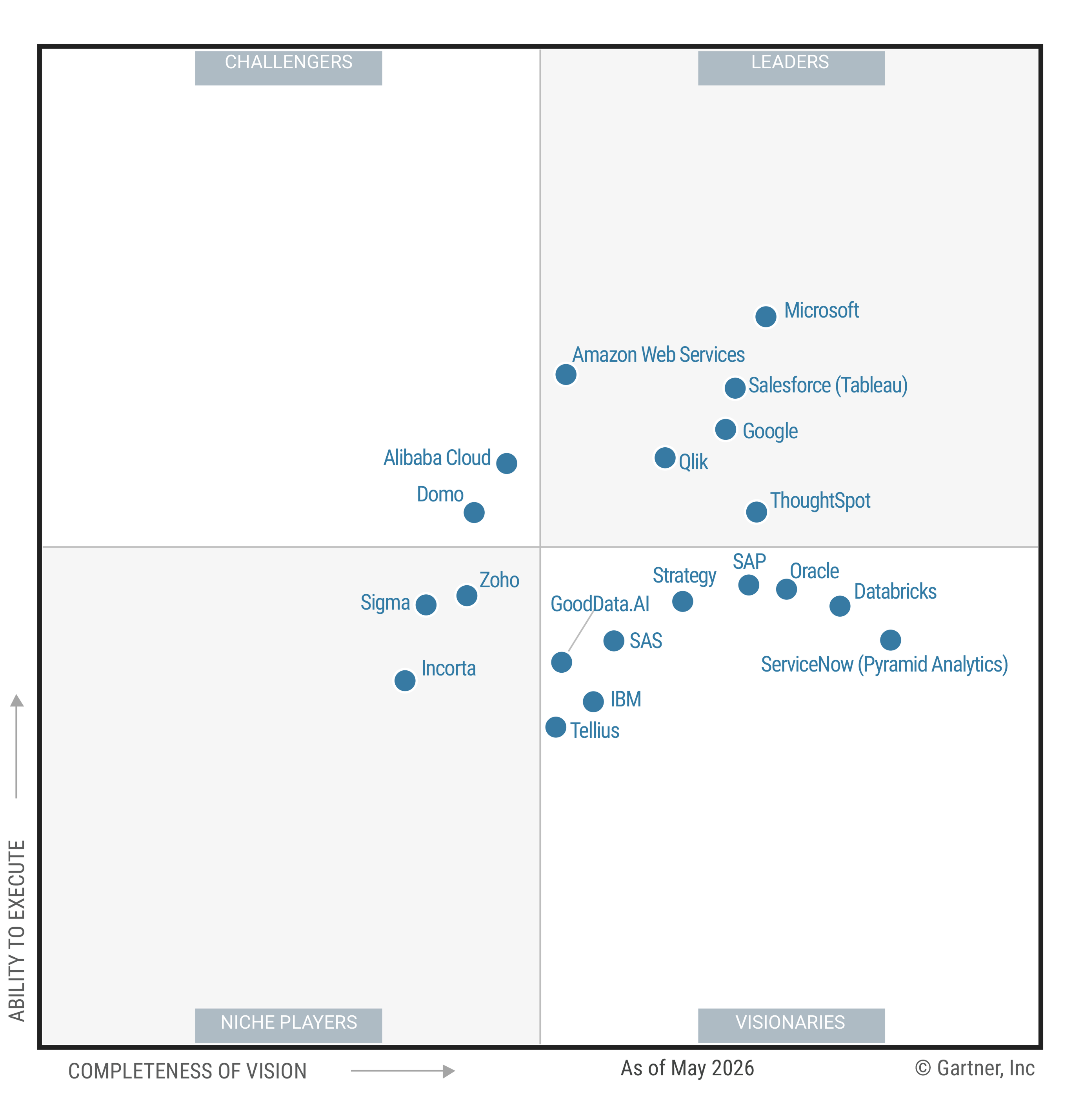
4. Which vendors currently offer conversational analytics capabilities?
Several major vendors provide conversational analytics features. Each takes a different approach to natural language data exploration. For a detailed comparison of how these platforms stack up against each other in capabilities, architecture, and enterprise readiness, see our analysis of modern BI platforms.