- Data science combines problem framing, data preparation, analysis, modeling, visualization, and communication.
- A useful business question and reliable data matter as much as the model or method.
- Data science overlaps with analytics, engineering, and machine learning, but each has a different focus.
- Governance becomes more important when data science includes AI or machine learning.
Data science can feel abstract when you face a messy spreadsheet, a crowded dashboard, or a question your data cannot answer quickly. You need a practical way to turn raw information into knowledge that can guide a decision.
So, what is data science? It is a multidisciplinary practice that combines data, statistical reasoning, programming, and domain context to investigate questions and explain findings. It can include AI and machine learning, but its scope also covers the work before and after a model.
What Data Science Is and Why It Matters
Data science begins with a question that matters to your organization. A team then identifies relevant data, prepares it, selects appropriate methods, evaluates the results, and explains what those results mean for a decision.
That end-to-end view is important because analysis alone rarely answers a business question. Data definitions, source quality, assumptions, and operating context shape whether people can interpret and use the findings.
A 2026 peer-reviewed article in Frontiers in Public Health offers one scoped example through its public-health data science lifecycle. The framework spans hypothesis generation, data collection and management, analysis, dissemination, and translation. It illustrates an end-to-end view for public health, not a universal definition or enterprise standard.
For business and data leaders, the value lies in connecting technical work to a clear purpose. A forecast, classification, or statistical finding becomes useful when you can trace its logic, discuss its limits, and relate it to a specific choice.
What Does a Data Scientist Do?
A data scientist commonly helps frame problems, collect and analyze data, test methods, validate models, build visual explanations, and recommend next steps. The mix varies by organization, project, and team structure.
The U.S. Bureau of Labor Statistics describes what data scientists do as using analytical tools and techniques to extract meaningful insights from data. Its occupational guidance also covers collecting data, updating models, using visualization software, and making business recommendations.
In practice, this work requires collaboration. Data scientists work with business leaders, data engineers, analysts, and subject-matter experts. Each contributes context needed to judge whether a result makes sense.
How the Data Science Lifecycle Works
A lifecycle gives your team a shared way to discuss the work. The recent public-health framework discussed above illustrates a flexible flow through problem framing, data collection and preparation, analysis, interpretation and communication, and use. It is an example rather than a mandated sequence for enterprise teams.
Data collection covers obtaining information from relevant sources. Preparation includes cleaning, joining, organizing, and checking that data so the team understands what it represents.
Analysis applies statistical, computational, or modeling methods to the question. Interpretation and communication make patterns, comparisons, and uncertainty easier to discuss, while use connects the findings to a decision or operating process.
Teams rarely move through this flow only once. An unexpected pattern may send you back to inspect a source, revise a definition, or choose a different method.
From Business Question to Decision
Consider a company investigating rising customer churn. The first task is to define the question and the decision it will support. The team might review customer groups or service issues.
Next, the team identifies trusted sources, such as account activity, support interactions, subscription changes, and customer attributes. It prepares the data, checks missing values and definitions, and looks for patterns that could reflect data collection problems rather than customer behavior.
The team may compare segments, test statistical relationships, or evaluate a predictive method. It then explains the result in plain language, documents uncertainty, and monitors what happens after the business responds.
The goal is a decision-ready explanation, not a model created for its own sake. An enterprise BI platform can give business users a way to explore governed data and ask follow-up questions as they review the findings.
Skills, Methods, and Tools That Support Data Science
Data science draws on several capability areas. Programming and data querying help teams retrieve, combine, and inspect information, while statistics and experimentation support sound comparisons and tests.
Modeling and algorithms can help describe relationships, group observations, or estimate likely outcomes. Domain expertise helps a team spot unrealistic assumptions, choose meaningful measures, and interpret findings in the right business context.
Visualization and communication make the work available to people who were not involved in the analysis. Documentation also helps others understand the sources, methods, assumptions, and limits behind a result.
The U.S. Bureau of Labor Statistics lists coding, analysis, algorithms, and visualization among the data science skills associated with the U.S. occupation. That guidance describes broad capabilities, not a fixed curriculum or required software stack.
Your tool choices should follow the question, data environment, team skills, security needs, and operating constraints. No single programming language, database, or analytics product is required for every data science project.
Why Communication Is Part of the Work
A technically sound analysis has limited value when decision-makers cannot inspect its logic or understand its uncertainty. Clear explanations help people see what the data supports, what remains unknown, and which assumptions could change the interpretation.
Visual communication can make relationships, outliers, and tradeoffs easier to discuss. Interactive charts also let people ask follow-up questions and compare views without treating a single display as the complete answer.
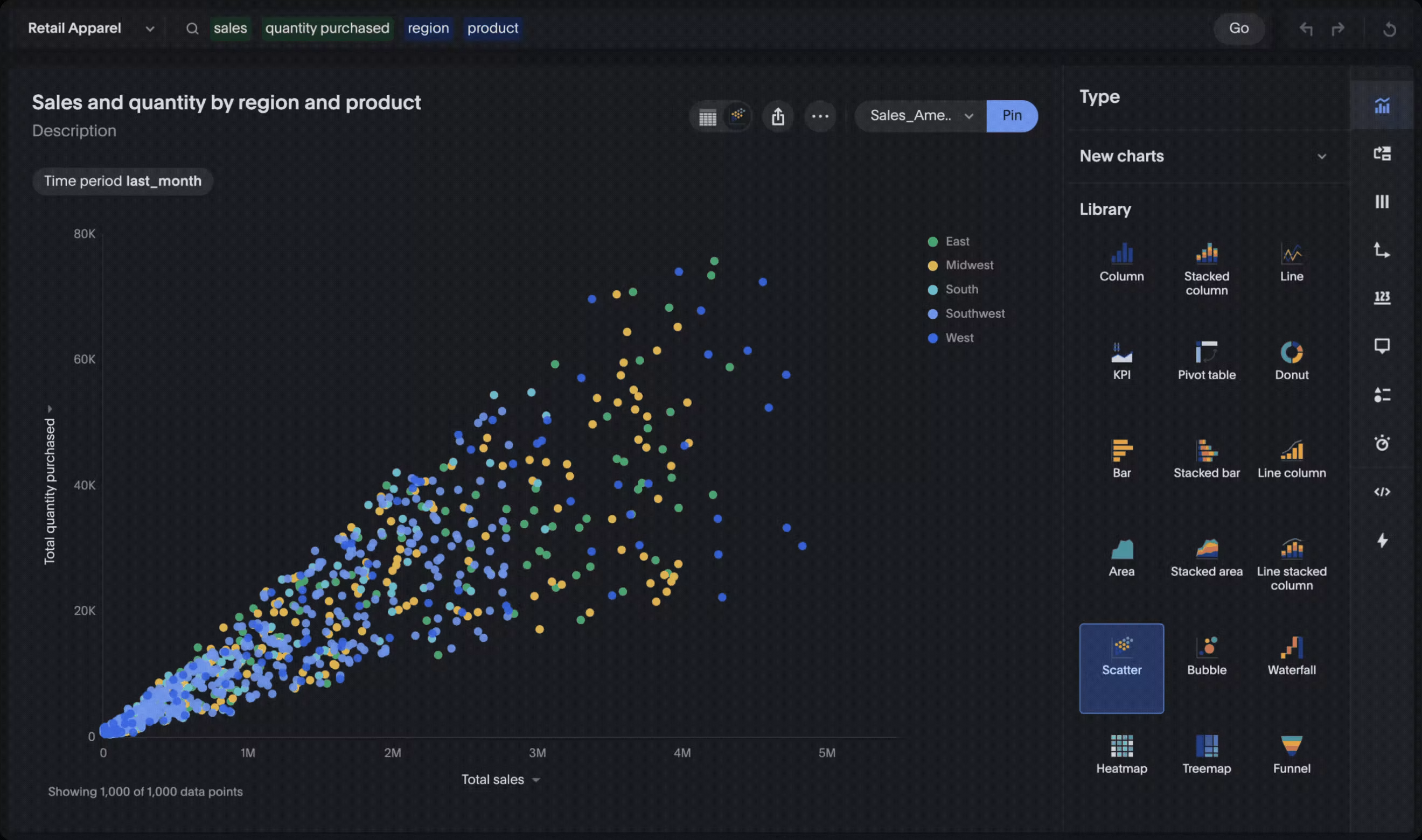
The figures in this screenshot are illustrative and do not represent a documented business result. The point is the interaction: people can examine a relationship, discuss its meaning, and decide what to investigate next.
ThoughtSpot Analyst Studio supports data preparation, exploratory analysis, and SQL, Python, and R workflows. Those capabilities can help technical teams connect analytical work with explanations that business partners can review.
How Data Science Differs From Analytics, Engineering, and Machine Learning
These disciplines overlap, and role boundaries vary across organizations. The clearest distinction is the primary focus of the work, not a rigid list of tasks or job titles.
| Discipline | Primary Focus | Typical Contribution |
|---|---|---|
| Data analytics | Examining data to answer defined questions | Reports, comparisons, trends, and explanations |
| Data engineering | Building and maintaining reliable data infrastructure | Data pipelines, storage, processing, and access |
| Machine learning | Developing methods that learn patterns from data | Classification, prediction, recommendation, or generation |
| Data science | Solving a broader problem through data and evidence | Framing, preparation, analysis, modeling, evaluation, and communication |
Data analytics often focuses on understanding what happened, why it happened, or how performance compares. Data science may include that work, then extend into experimentation, statistical modeling, prediction, or operational use.
Data engineering gives analysts and data scientists dependable access to usable information. Machine learning provides a set of methods that data science teams may apply when those methods fit the question and available evidence.
Shared business meaning connects all four areas. ThoughtSpot governed data models can provide reusable definitions and relationships, helping teams work from a consistent interpretation of metrics and dimensions.
Where Data Science Shows Up in Business
Data science can support many types of business questions. Teams might interpret customer behavior, investigate operational anomalies, forecast demand, or examine patterns related to product quality and safety.
These are possible applications, not promised outcomes. The quality of the result depends on the question, data, method, implementation, and the team's understanding of the operating context.
For example, a retailer could study purchasing patterns to understand demand. A manufacturer could investigate sensor and inspection data for conditions associated with quality issues. A service team could examine support patterns for recurring friction.
In each case, governed business definitions help people connect sophisticated analysis to everyday decisions. Accessible explanations also let business teams question a finding, compare it with their experience, and decide whether further analysis is warranted.
Build Trust Into Data Science From the Start
Trustworthy data science starts with shared definitions and clear responsibilities. Your team should know what each metric means, where the data came from, who can access it, and which checks were performed before analysis.
Document assumptions, exclusions, and known limitations. Human review matters because a statistically strong result can still mislead. It may reflect poor data, a weak proxy, or missing context.
Governance should match the use case. A descriptive analysis for internal planning may call for different controls than a predictive system that affects customers, employees, or regulated decisions.
When data science includes an AI system, current federal policy offers one scoped governance example. The OMB AI governance guidance applies to federal agencies and calls for governance across development, testing, deployment, and continuous monitoring.
Private-sector teams are not subject to this federal policy. They can still apply its practical idea: set accountability, review context-specific risks, measure performance, and monitor systems over time.
Governed definitions and explainable results become more important as more people work with data. Consistent context helps teams compare analyses, challenge assumptions, and understand whether a finding is suitable for the decision at hand.
Make Data Science Useful in the Moment
Data science earns its place when your organization can move from a well-framed question to a trusted, explainable decision. That requires capable people and methods, along with data definitions, access, documentation, and communication that fit the business context.
Ask whether your current data experience gives people enough context to understand a result and enough access to investigate it. If you want to connect governed data with natural-language exploration and interactive analysis, explore ThoughtSpot's Agentic Analytics Platform for the data leader platform perspective.