- This guide uses “data management platform” as an editorial umbrella term for technology that helps operationalize data-management practices.
- Start with lifecycle responsibilities, governance needs, and system ownership before comparing feature lists.
- Judge architecture fit by how a platform works with your warehouse, customer data, master data, catalog, and analytics systems.
- Treat AI readiness as preparation for governing data inputs, access, context, documentation, provenance, and review, never as a product guarantee.
Adding another platform can make your data environment harder to govern. If the new layer duplicates business logic, obscures ownership, or creates another permission model, your team inherits more friction instead of less.
A data management platform helps operationalize the policies, processes, and technical controls used to collect, organize, govern, protect, and use data. Drawing on the National Institute of Standards and Technology’s NIST definition of data management, this guide uses “data management platform” as an editorial umbrella, not a universally standardized product category or a category defined by NIST. You will learn what work a proposed platform should handle, where it fits in your architecture, and what evidence to request before you commit.
What a Data Management Platform Should Do
Your evaluation should begin with the work, not the label on the product page. The National Institute of Standards and Technology describes data management in its NIST definition of data management as the development, execution, and supervision of plans, policies, programs, and practices for delivering, controlling, protecting, and improving data assets.
A data management platform can help put portions of that organizational work into practice across connected systems. Depending on its scope, it may coordinate ingestion, integration, preparation, organization, access, governance, and downstream use. No single platform needs to perform every function natively.
That boundary matters when you compare a broad platform with a point product. A point product may address one defined job, while a platform may connect several jobs through shared controls, context, or workflows. Because this guide uses “data management platform” as an editorial umbrella term rather than a formal standard category, ask vendors to show how their stated scope maps to your operating model.
ThoughtSpot, for example, offers ways to connect data across your ecosystem for analytics use cases. That positioning should be assessed alongside the other systems that collect, store, govern, and serve your data, rather than treated as a claim that one product replaces the entire stack.
Start With the Data Lifecycle
Before you shortlist products, map how data moves through your environment. A simple lifecycle view gives you a practical starting point:
Bring data into the environment or establish a live connection.
Prepare, integrate, or connect data for the intended use.
Organize business meaning, metadata, and access.
Apply governance policies, quality standards, and lifecycle controls.
Make governed data available for decisions, analytics, and applications.
For each stage, name the owner, the handoff, and the source of record. Where does data quality get checked? Who approves a metric definition, and which system carries that definition downstream? These questions expose gaps that a generic capability grid can miss.
Connectivity also deserves a closer look because “supported” can mean several things. Review the available data connectivity options, then test the connection patterns, permission behavior, refresh requirements, and operational ownership that apply to your environment.
Capabilities That Matter Most
Once you understand the lifecycle, turn your requirements into a governance-oriented checklist. The National Institute of Standards and Technology identifies NIST’s notional data governance activities in working-session material for a profile under development. The list includes governance policies and roles, quality standards, integration, access management, metadata, provenance, lineage, storage, continuity, and disposition.
Because these activities are notional, they should guide questions rather than act as mandatory product controls. Use them to test whether responsibility is explicit across your platform and surrounding systems:
Governance roles and decision rights: Can you document who owns data domains, definitions, policies, exceptions, and approvals?
Fit-for-purpose data quality: Can owners set and monitor standards based on defined business uses?
Metadata, lineage, and provenance: Can people trace origin, movement, ownership, and known limitations?
Access management: Can permissions reflect established roles and remain visible across connected workflows?
Integration: Can the platform work with your sources, destinations, and control points without duplicating logic?
Lifecycle controls: Can your operating model cover sharing, retention, continuity, and disposition where required?
Capability ownership may be distributed. Your catalog might hold technical metadata, your identity system might govern access, and another platform might manage analytics semantics. The evaluation goal is to understand the handoffs and gaps, not to force every responsibility into one product.
Where analytics is in scope, examine whether the platform supports governed reusable data models. Focus on how definitions, permissions, and business logic are created, reviewed, reused, and changed over time.
Treat Semantic Context as a Core Requirement
Metadata tells you where data sits and what shape it has. For this article, a semantic model for analytics adds approved business meaning, such as how a metric is calculated, which joins are valid, and which rules apply when people explore the data.
For analytics use cases, governed data models can preserve shared business logic and access controls while giving people a consistent foundation for exploration. ThoughtSpot lets data teams build logical data models for this purpose, but you should still validate the model workflow against your review process and architecture.
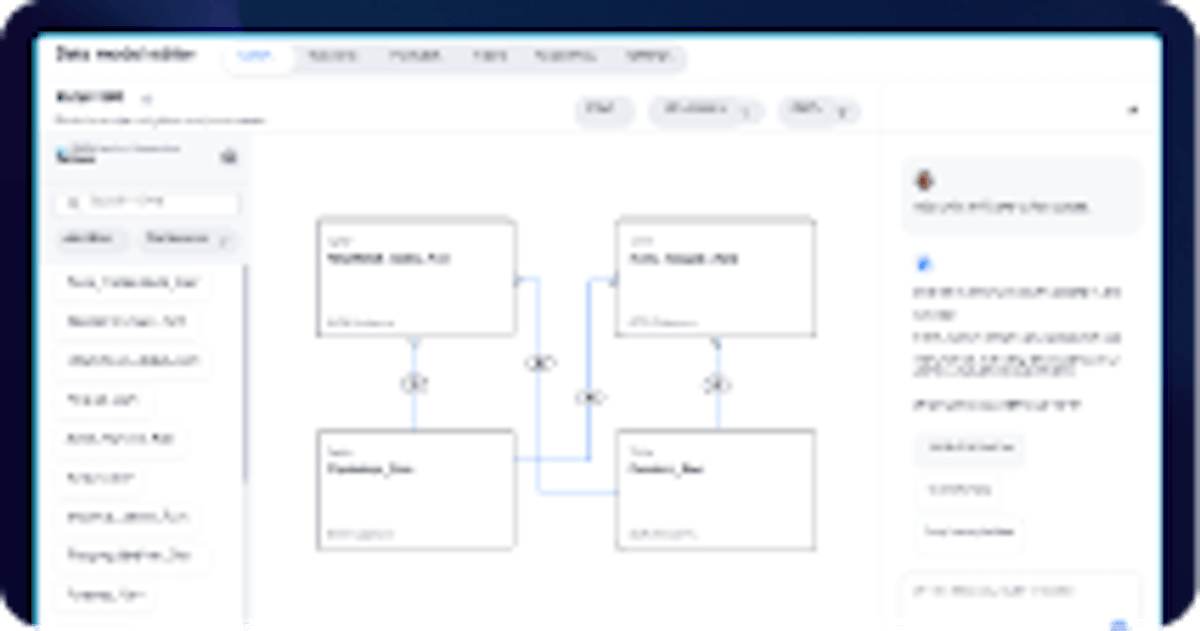
The visual is illustrative; it does not show a real customer’s data or outcome. In your proof of concept, use representative definitions and permission patterns so reviewers can see how the proposed model behaves under realistic conditions.
Semantic context becomes more important when the same terms reach dashboards, natural language interfaces, embedded experiences, or AI agents. Ask where canonical definitions live, how conflicts are resolved, and how downstream consumers receive approved changes.
AI Readiness Starts With Governance
When AI is part of your roadmap, storage and connectivity are only part of the evaluation. You also need a way to govern inputs, permissions, business context, documentation, review, and accountability across the AI lifecycle.
The National Institute of Standards and Technology states in its voluntary NIST AI Risk Management Framework that attention to governance is a continual and intrinsic requirement for effective AI risk management. For your shortlist, that means examining operating mechanisms, not assuming a platform purchase makes the organization AI-ready.
Ask whether owners can document policies, assign responsibilities, review risk-based controls, maintain system inventories, and record decisions. Then test whether the proposed platform supports those practices or connects cleanly to the systems that do.
Traceability matters as well. In its Generative AI Profile, the National Institute of Standards and Technology includes data provenance and metadata guidance that covers tracking the provenance of training data and metadata for generative AI systems.
Provenance and metadata can help you trace the origin and history of AI inputs and document known limits. They do not prove that an output is accurate, safe, lawful, or appropriate for a specific decision. Human review, testing, monitoring, and accountability still belong in the operating model.
If analytics and AI agents will use the same business definitions, review how governed AI analytics fits your controls. Look for clear answers about access enforcement, semantic context, review paths, and how changes become visible to affected users.
Where It Fits in Your Data Architecture
A platform name tells you little about its actual architectural role. Before you compare vendors, map your data domains, integration paths, source-of-record responsibilities, governance owners, and downstream consumers.
Use the table below to structure that discussion without relying on rigid category boundaries:
| Existing System | Question to Ask | Potential Relationship | Governance Owner |
|---|---|---|---|
| Data warehouse or lakehouse | Which data stays here, and which queries or processing steps occur elsewhere? | Live connection, preparation layer, governed consumption, or another verified pattern | Data platform owner |
| Customer data platform | Which customer domains and activation workflows remain in scope? | Source, destination, integration peer, or downstream consumer | Customer data owner |
| Master data management system | Where are mastered entities and stewardship decisions maintained? | Provider of governed entities or consumer of approved definitions | Domain steward |
| Data catalog | Which metadata, lineage, glossary, and ownership records live in each system? | Metadata exchange, linked workflow, or divided responsibility | Governance or catalog owner |
| Analytics platform | Where are metrics, semantic definitions, permissions, and user experiences managed? | Governed analysis and decision layer connected to existing data | Analytics owner |
These relationships vary by implementation, so avoid blanket replacement claims. During a proof of concept, test how the candidate platform will prepare data for analysis and support enterprise business intelligence within the architecture you already operate.
Ask the Architecture Questions Early
Four questions can prevent duplicate logic, unclear ownership, and brittle integrations:
What data domains and business decisions are in scope?
Which systems remain the sources of record?
Where will business definitions be created, approved, and maintained?
How will permissions, lineage, and changes be visible to owners and consumers?
Bring architecture, governance, security, and analytics owners into these conversations before the shortlist hardens. The data leader resources from ThoughtSpot can help frame analytics-specific questions, while your internal owners define the wider controls and responsibilities.
How to Evaluate Your Shortlist
A polished demo can hide weak ownership and integration details. Use a five-step evaluation that reflects your operating model:
Define priority use cases and decisions. Name the users, data domains, questions, and decision workflows the platform must support.
Inventory data and governance constraints. Document sources, sensitive fields, permissions, quality needs, retention rules, and required review paths.
Score capabilities against ownership. For each requirement, identify whether the candidate platform owns the work, connects to another system, or leaves a gap.
Validate the working model. In a proof of concept, test integration, access behavior, semantic context, lineage visibility, change management, and failure handling.
Confirm adoption and ownership plans. Assign administrators, model owners, stewards, reviewers, support paths, and measures for the specific use case.
Request evidence at each step. Ask vendors to demonstrate your permission patterns, explain how definitions move between systems, and show what happens when a model or source changes. A slide that says “governed” should lead to a workflow you can inspect.
Customer results can add context, but they should never become your forecast. ThoughtSpot reports in Matillion’s self-service analytics results that Matillion eliminated 80% of report requests following its deployment. Treat that figure as one customer’s reported result, then evaluate your own use cases, baseline, rollout plan, and measurement method.
Finally, decide what success means before selection. If your scope centers on governed analysis, review how users will explore enterprise analytics capabilities, how data owners will maintain context, and how your team will verify that the agreed workflows work in practice.
Build a Platform Strategy Around Trust
The right data management platform depends on the work you need to govern, the architecture you already own, and the evidence you can verify. Start with lifecycle responsibilities and decision rights, then use a proof of concept to test integration, access, semantic context, lineage, and operating ownership.
If governed analytics is part of your platform strategy, see how ThoughtSpot connects your data, supports reusable models, and brings analytics into existing workflows.