- Treat storage and compute separation as a design choice to test against your data types, workloads, and operating model.
- Evaluate ingestion, storage, metadata, processing, governance, orchestration, and consumption as connected parts of your proposed architecture.
- Compare data lake, warehouse, and lakehouse patterns by workload instead of assuming one category fits every need.
- Assign owners for governance, security controls, and cost management; an architecture label does not provide those practices by itself.
- Test whether people and AI agents can ask governed questions with shared business definitions and access controls intact.
For this decision framework, a cloud data lake means cloud storage plus the services you choose to ingest, describe, process, govern, and consume varied data. Your design may keep storage separate from the compute services that process or query structured, semi-structured, and unstructured data.
For you as a data leader, storage is only the starting point. Your decision also covers governance, security, cost visibility, workload fit, and the path from lake tables to trustworthy analytics and AI-agent experiences.
How Cloud Data Lakes Work
A practical evaluation model starts with object storage, then maps the services your team would use to ingest, describe, process, govern, and consume data. If your proposal separates storage and compute, test which processing engines can use the same underlying data and under which controls.
One common flow starts with operational systems, software applications, files, event streams, and third-party sources. Your design might use batch pipelines for periodic snapshots and streaming pipelines where fresher event processing matters.
Next, decide which structured records, semi-structured formats, and unstructured content belong in the lake. Then document how your selected tools would clean, join, aggregate, or prepare that data for each approved use.
For metadata and catalogs, specify which details must be recorded, who maintains them, and how changes are reviewed. For orchestration and access, define job dependencies, policy checks, and what each person or service may query.
Finally, map every consumption path to a business need. SQL users, dashboards, notebooks, applications, analytics tools, and AI agents may require different freshness, semantics, permissions, and reliability targets.
ThoughtSpot can connect data lakes to analytics across cloud data warehouses, data lakes, legacy databases, and files. Depending on your design, you can use live queries or cached datasets rather than forcing every workload into one access pattern.
You can also work across your data ecosystem while evaluating each source's role in analytics and AI experiences. This lets you assess the wider architecture without assuming one access pattern fits every workload.
Core Architecture Layers
Use the following layers as review categories, not as an exhaustive reference architecture. Your platform may group them differently, so focus on the handoffs and ownership boundaries that your team would operate.
Source and ingestion: Identify which batch, streaming, and file paths you need. Ask how you will handle late records, duplicates, schema changes, and failed loads.
Storage: Define organization by format, lifecycle, retention need, and access pattern. Check for uncontrolled copies, unclear zones, and storage classes that do not match actual use.
Metadata and catalog: Decide which datasets, owners, schemas, classifications, and services need description. Ask who maintains the metadata and how quickly it reflects source changes.
Processing: Map how data would be prepared for analysis, applications, and models. Review engine compatibility, dependency management, testing, and repeated scans.
Governance and access: Specify identity, policy, classification, retention, and row or column controls. Test whether permissions stay consistent across each consumption tool.
Orchestration: Document pipelines, jobs, schedules, and recovery steps. Look for brittle dependencies, silent failures, and unclear incident ownership.
Consumption: Map governed data to people, applications, and AI agents. Ask whether each consumer receives understandable business definitions with the technical fields.
Compare Data Lakes, Warehouses, and Lakehouses
Use data lake, data warehouse, and data lakehouse as comparison patterns rather than fixed product definitions. Your fit depends on data shape, workload, operating model, and the management services available in your proposed platform.
The table below is decision shorthand, not an exhaustive technical specification. Validate every row against the services, formats, controls, and operating practices in your environment.
| Decision Area | Typical Data Lake Pattern | Typical Data Warehouse Pattern | Typical Data Lakehouse Pattern |
|---|---|---|---|
| Data shape | May include structured, semi-structured, and unstructured data | May prioritize structured, curated data | May combine varied data with managed tables for analytic use |
| Schema approach | May apply or interpret schemas during processing | May model schemas before broad consumption | May pair flexible ingestion with managed table structures |
| Storage and compute | Often evaluated as separate layers | May arrive through a more integrated managed service | May separate storage while adding management services above it |
| Governance model | May require coordination across several tools and engines | May concentrate more controls within one managed platform | May combine lake controls with table and catalog management |
| Primary workloads | Consider engineering, data science, retention, and varied processing | Consider business intelligence, reporting, and SQL analytics | Consider SQL analytics, engineering, and machine learning on shared storage |
| User access | May rely on engineering tools or downstream systems | May offer direct SQL and BI access | May span SQL, notebooks, BI tools, and applications |
| Operational burden | Review integration, monitoring, recovery, and ownership across services | Review platform administration, modeling, and workload management | Review the maturity and integration of the selected services |
| Possible fit | Varied data, processing choices, or broad retention needs | Curated analytics with clear relational models | Lake storage with added table management and analytic access |
You can also evaluate a mixed architecture. Your plan might keep raw data in a lake and curate business-ready models in a warehouse. You could then assess lakehouse technologies for managed tables over object storage.
Choose by Workload and Operating Model
Start with the workloads that matter, then work backward to architecture. A clear inventory will give you better decision criteria than a broad feature comparison.
Latency: How fresh must data be, and what happens when that target is missed?
BI and AI consumption: Which users, applications, and agents need access, and what business context do they require?
Skill mix: Which tools can your engineering, analytics, governance, and operations teams support consistently?
Data-product ownership: Who owns quality, definitions, access, incidents, and retirement for each important dataset?
Governance maturity: Which policies already work across platforms, and where do teams still rely on manual review?
Portability: How easily can you move data, metadata, and business logic if your platform mix changes?
Existing investments: Which storage, compute, catalog, modeling, and analytics services already meet your needs?
For a new build, you can set naming, ownership, lifecycle, and access conventions before data spreads across the platform. For a migration, you also need to map current dependencies, preserve critical definitions, and sequence changes around active workloads.
Do not let the architecture label carry more weight than your operating model. The practical question is whether your team can run the controls, pipelines, and consumption paths reliably as data and demand grow.
Build Governance and Security Into the Architecture
Governance and security need a place in every layer of your cloud data lake architecture. If ownership, identity, policy, and evidence are handled only at the final analytics tool, gaps can appear earlier in ingestion, storage, processing, or service-to-service access.
Start by assigning accountable owners for important datasets and data products. Ownership should cover classification, quality expectations, retention, approved uses, access review, incident response, and the business definitions attached to the data.
For interoperable catalog metadata, use an established standard as a reference point. Published in August 2024, the W3C DCAT 3 Recommendation provides W3C's standardized vocabulary for multiple catalogs and can increase discovery of datasets and data services.
Treat DCAT 3 as a metadata reference, not evidence of business results. It does not establish data quality, complete lineage, authorization, or adoption, so those responsibilities still need separate processes and controls.
Security design should consider people, applications, workloads, and automated agents. NIST's NIST zero-trust guidance provides implementation guidance for secure authorized access to enterprise resources across on-premises and multiple cloud environments.
NIST's guidance can inform how you evaluate identity, policy decisions, and access across a distributed estate. It does not certify a cloud data lake, establish complete security, or demonstrate compliance with a specific requirement.
Within the lake, review encryption, identity federation, credential handling, network paths, logging, and policy enforcement. Then test row and column controls through each tool that can query or export governed data.
Lineage and quality also need clear boundaries. Technical lineage may show where fields moved, while business lineage explains which metrics, reports, and decisions depend on them.
A quality check can catch nulls, duplicates, or unexpected ranges, but it cannot decide whether a metric definition fits the business question. That gap is where governed data models and shared definitions become important.
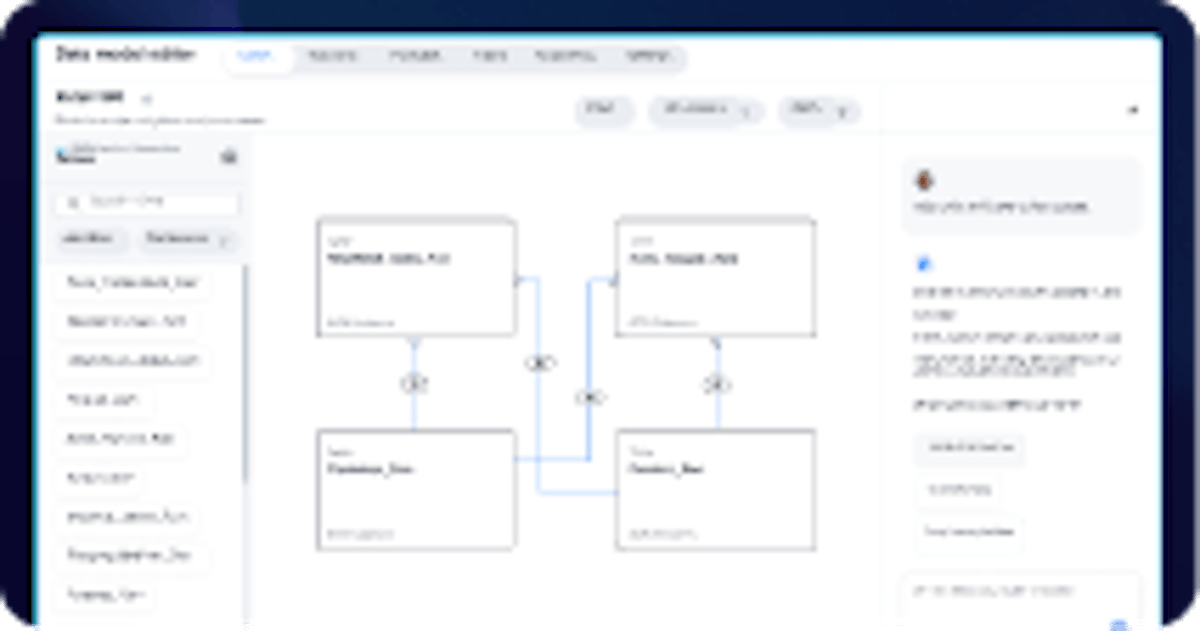
ThoughtSpot lets teams build a governed data model with business definitions layered over source data. In your evaluation, treat that model as one part of a broader governance system that also includes ownership, policy, testing, and review.
Keep Business Meaning With the Data
Catalog entries and table names help people find data. They rarely explain what counts as active revenue or which date defines a completed order. Those answers require canonical metrics, approved joins, calculation rules, and clear access boundaries.
Your team can use a semantic model to connect technical structures with business language. Decide which measures, relationships, calculations, synonyms, and reusable terms belong in it. Then review whether that context supports consistent interpretation of raw columns.
As a governance practice, your team can maintain reviewed answers and query patterns for recurring questions. Decide who reviews that logic, when it expires, and how later changes are approved.
Permissions must remain part of that context. Row and column controls should follow the user or service identity. Test whether each role receives only its permitted data.
ThoughtSpot positions its Context Layer around governed business meaning for analytics and AI-agent experiences. In your evaluation, test its natural-language-to-governed-SQL behavior against modeled definitions and guardrails while data values remain at the source.
That design does not remove your need for governance review. You still decide which definitions are canonical, who can certify them, how changes are approved, and how conflicting terms are resolved across business units.
Evaluate Cost, Operations, and Platform Fit
Build your cloud data lake cost model beyond storage price. Consider storage classes, requests, data transfer, compute, orchestration, catalogs, observability, retention, replication, support, and the people who would run the platform.
Then model how your expected workloads could affect those categories. Frequent scans, cross-region transfer, duplicated data, or idle compute are examples to test, not assumptions about your final bill.
The FinOps Foundation's FinOps cost-data guidance states that normalized cost and usage data can support spending analysis and governance. Use that narrow principle as an operating input, not as evidence of savings or low total cost.
When comparing live queries and cached datasets, ask how each pattern could affect freshness, source-system demand, data copying, refresh schedules, and query behavior. Test both patterns against representative workloads where they are under consideration.
Neither pattern should win by default. Evaluate concurrency, governance, recovery needs, and how users should respond when data is delayed or unavailable.
Use a scorecard that connects platform features to the responsibilities your team will own. Weight each area according to your workloads rather than giving every category equal importance.
| Selection Area | What to Evaluate | Evidence to Request |
|---|---|---|
| Interoperability | Supported formats, engines, interfaces, and metadata exchange | A working flow across your priority systems |
| Governance | Ownership, classification, lineage, quality, policy, and audit workflows | A trace from source through a governed consumer |
| Workload support | Batch, streaming, SQL, data science, AI, and application patterns | Tests using representative data and concurrency |
| Operational effort | Deployment, monitoring, upgrades, incident response, and recovery | Runbooks, role assignments, and failure exercises |
| Security controls | Identity, row and column controls, encryption, logging, and policy enforcement | Role-based access tests across tools |
| Cost visibility | Allocation, normalized usage data, budgets, anomaly review, and reporting | Cost records tied to workloads and owners |
| Portability | Data formats, metadata export, business-logic portability, and exit paths | A documented migration or recovery test |
| Analytics consumption | Business definitions, query transparency, freshness, and user access | Real questions answered with traceable logic |
Questions to Ask Before You Build or Migrate
Before you commit, ask questions that expose ownership and tradeoffs. The answers should be concrete enough to shape architecture, migration plans, acceptance tests, and operating responsibilities.
Which workloads and business questions have priority during the first phase?
Where do current pipelines, models, permissions, or consumption paths create friction?
Which residency, retention, classification, and legal requirements apply to each dataset?
How will human users, applications, and agents authenticate and receive access?
What recovery objectives and service expectations apply to each workload?
Who owns metadata, quality rules, business definitions, and change approval?
How will you allocate storage, compute, transfer, and shared-service costs?
Which dependencies must move together, and which can remain in place during migration?
What are your exit options for data, metadata, models, and orchestration logic?
Who owns adoption, support, and feedback after the first release?
Separate launch controls from later improvements. Identity, access, ownership, recovery, critical quality checks, and cost visibility may belong in your initial acceptance criteria, while lower-priority automation can follow a planned sequence.
Connect Governed Lake Data to Analytics and AI Agents
A cloud data lake is not the destination for your data strategy. Its value depends on whether people and AI agents can ask trustworthy questions while business definitions, permissions, and source context remain intact.
The consumption path starts with governed data and metadata, then adds semantic definitions that explain how your business measures performance. Analytics tools and agents can use that context to interpret questions, generate governed queries, and present results with a traceable path back to the source.
Without shared meaning, two teams can query the same lake and produce different answers to the same business question. The technical data may be available, yet disagreements about joins, filters, dates, or metric rules can still slow a decision.
ThoughtSpot is an Agentic Analytics Platform that works across cloud data platforms and data sources. With governed models and context, your teams can explore governed cloud data while data values remain at the source.
The same context can support AI-agent experiences by giving agents approved definitions, relationships, and guardrails. This is a capability you should validate against your own data and policies, not a universal promise about accuracy or adoption.
For a data leader, the practical goal is a visible chain from business question to governed logic to source data. Assess ThoughtSpot's analytics for data leaders against that chain. Include your requirements for access, freshness, review, and portability.
Test the Consumption Layer
A proof of concept should test behavior you can observe, inspect, and repeat. Use real business questions, representative roles, and data that exposes the joins and definitions your teams find difficult.
Ask the same business question with different phrasing and compare the interpretation.
Inspect the generated SQL or query logic before accepting the result.
Verify that canonical metrics use approved filters, joins, dates, and aggregations.
Test row and column permissions with multiple user and service identities.
Trace each answer to its source tables, fields, and freshness information.
Check how the system handles missing context, ambiguous terms, and unsupported questions.
Compare live and cached access where both patterns are under consideration.
Review failure behavior when a source, pipeline, or permission service is unavailable.
Document who can certify answers and how later changes are reviewed.
Include a disputed metric, a restricted field, an ambiguous phrase, a late pipeline, and a question that should go for review. Record what worked, what failed, which controls required manual steps, and which responsibilities would remain with your team.
Make the Lake Useful at the Point of Decision
Choose and operate cloud data lakes around the questions, controls, and consumption patterns your business needs. Storage architecture matters, but its value is limited when people cannot find governed data, understand its meaning, or use it through an appropriate access path.
Start with one priority decision and trace it through the architecture. Assess ingestion, ownership, definitions, permissions, operating cost, and consumption. Then test governed analytics with the people who rely on that answer.
Your next step is concrete: select three high-value business questions and name their owners. Run them through a proof of concept with real definitions and role-based access. Use every break in meaning or control to set your build, migration, or platform-selection priorities.