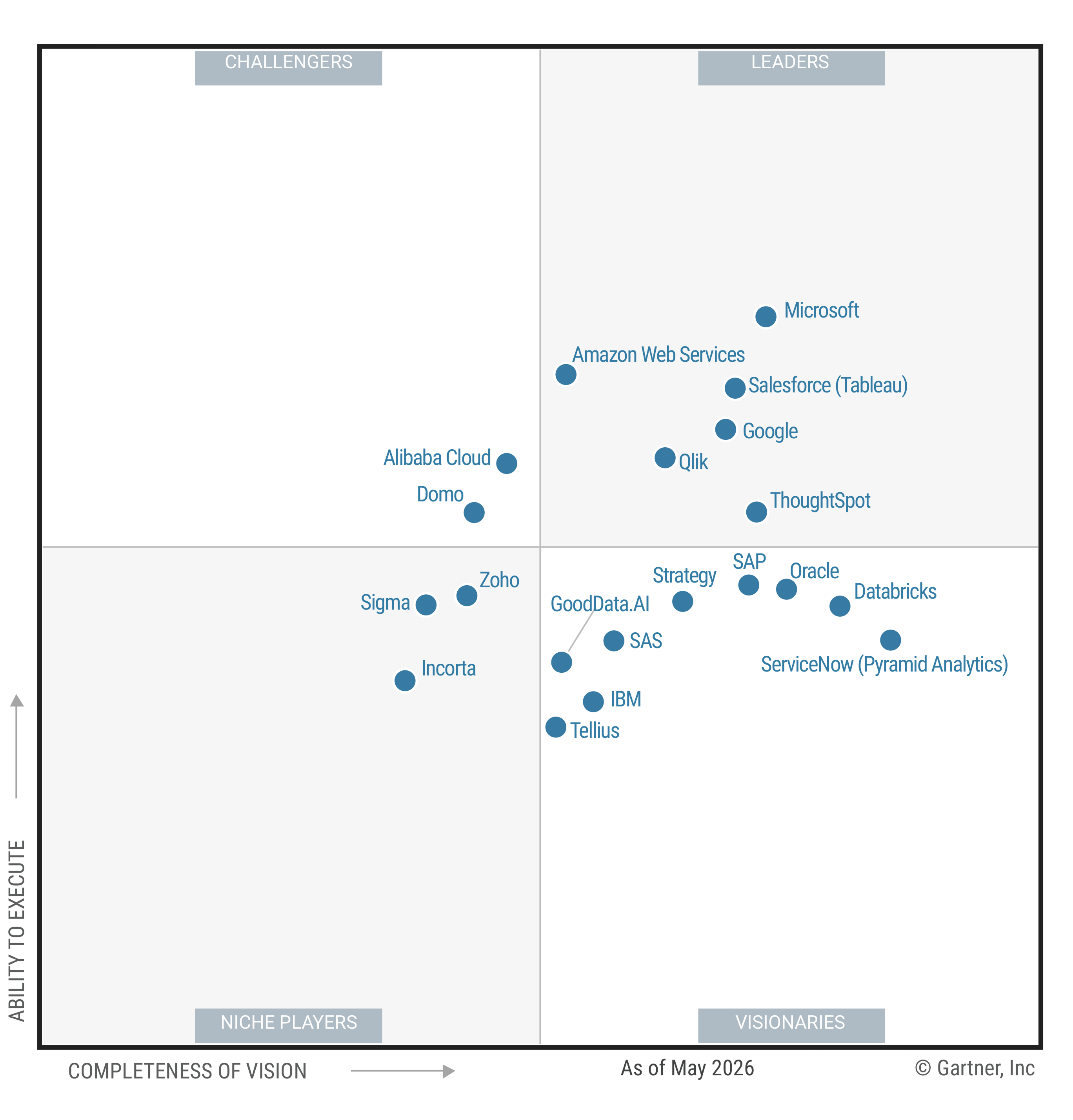
- A self service data analytics platform lets business users explore approved data, ask follow-up questions, and share findings without waiting in a report queue.
- Trust depends on a governed semantic foundation, shared metric definitions, clear permissions, and answers people can inspect.
- AI makes analytics more conversational, but it also raises the standard for context, visible logic, security, and human review.
- A useful evaluation tests real decisions, real data, representative users, and measurable adoption rather than relying on a feature checklist alone.
A self service data analytics platform gives business teams direct access to approved data for asking questions, refining results, and sharing findings without SQL. Can that model work at scale? Yes, when data teams control definitions, permissions, quality, and context behind every answer.
That balance is the buying challenge: you want faster answers without creating competing versions of revenue, churn, or customer health. If your teams need that balance, explore how ThoughtSpot provides trusted insights for business leaders while keeping query details and filters visible.
What Is a Self Service Data Analytics Platform?
A self-service analytics platform gives people an interactive way to explore business data on their own. Instead of accepting a fixed report, you can ask a new question, filter the result, and follow your next line of thought.
How is that different from traditional business intelligence? Traditional BI often centers on analyst-built reports and static dashboards, while self-service business intelligence gives a broader group more control over exploration.
The experience usually follows a simple path:
You ask a question in familiar business language or select fields through a visual interface.
The platform queries approved data through a governed model.
You inspect the result, change the question, or drill into a segment.
You save or share the finding with the people who need it.
This approach supports descriptive analysis, which tells you what happened, and diagnostic analysis, which helps you investigate why. Those are two of the four types of data analytics that teams may use as questions become more complex.
Natural-language access can make this process feel easier, but a fluent answer is not automatically a trustworthy one. Can users see the filters, metric definitions, query logic, or assumptions that shaped the result?
When those details stay hidden, your team may hesitate to act. True self-service gives people a path to inspect an answer, challenge it, and correct the context when needed.
The Foundation: Trusted Data, Context, and Governance
Every useful self-service experience rests on architecture that most business users should not have to manage. Still, you should understand the basic pieces before evaluating a product.
At the bottom are your connected data sources, such as cloud warehouses, lakes, databases, and files. Above them sits a governed semantic model that gives shared meaning to terms such as net revenue, active customer, or qualified pipeline.
That model should apply consistent formulas, relationships, and access rules. Role-level and row-level controls then limit what each person can view, while the user interface supports search, dashboards, or AI-assisted exploration.
Why treat governance as an adoption feature? People stop using analytics when two tools return different answers or when nobody can explain a number.
A semantic layer helps by giving metrics and business terms a shared definition. ThoughtSpot describes its agentic semantic layer as a source of governed business context, formulas, synonyms, model instructions, and analyst feedback.
Provenance matters, too, because users need to know where an answer came from and how it was formed. The NIST AI Risk Management Framework says maintaining training-data provenance and supporting attribution of AI decisions can assist with AI risk management.
That guidance does not endorse a vendor or certify a product. Instead, it highlights a practical principle for buyers: AI analytics needs documented controls, traceable inputs, and human review.
Data leaders already rank governance among their most pressing concerns. The MIT Sloan governance survey covered a 2022 study with more than 260 CDO-type respondents and 25 interviews. Of those surveyed, 45% named clear and effective governance among their top three priorities.
During a product review, ask who owns metric definitions and how changes are approved. Then ask whether a user can trace an answer back to its governed source without calling an analyst.
What Self-Service Looks Like When It Works
When self-service works, the practical change is straightforward: the person closest to a decision can investigate a question while it still matters. Analysts can spend less time rebuilding routine reports and more time improving models, quality, and advanced analysis.
That may shorten the path from question to action, but the result depends on data readiness and rollout quality. You still need clear use cases, user education, feedback channels, and accountable data owners.
Consider a weekly revenue review. A regional leader sees that bookings are down, asks which segments changed, and then filters by product or customer type.
With a static dashboard, each follow-up may become a new request. With governed self-service dashboards, the leader can explore within approved definitions while the data team keeps oversight of the model.
Customer outcomes vary because self-service depends on more than product access. Data readiness, workflow fit, and rollout quality shape whether teams trust and use the experience.
User education, feedback channels, and accountable owners also matter. Together, these practices help teams address confusion and improve adoption over time.
Adoption also needs active management. ThoughtSpot's self-service analytics rollout lessons describe capabilities such as natural-language search, explainability, live access, and granular governance while stressing that self-service complements data teams.
A focused rollout usually beats a broad launch with vague goals. Start where the current reporting delay is visible, the decision recurs often, and the business owner can define what a useful answer looks like.
How to Evaluate a Self Service Data Analytics Platform
A polished demo can show that a platform produces charts. Your evaluation should go further by testing whether people can reach, understand, and trust an answer using your data.
Use this six-part checklist to structure the review:
| Evaluation Area | What to Test | Questions to Ask |
|---|---|---|
| Business-user experience | Natural-language questions, visual exploration, filters, sharing, and mobile access | Can a new user answer a real question without training in data syntax? |
| Governed metrics and security | Shared definitions, model controls, permissions, and row-level access | Does each metric mean the same thing across teams and roles? |
| Follow-up questions and AI | Conversational refinement, suggested questions, visible logic, and correction paths | Can users understand why an answer appeared and flag a problem? |
| Data-stack fit and live data | Connections, query modes, freshness, scale, and semantic logic | Can it fit your architecture without creating another source of truth? |
| Analyst workflow and oversight | Model management, query inspection, certification, monitoring, and feedback | Can analysts review behavior and improve the experience without rebuilding every answer? |
| Adoption measurement | Usage by role, repeat use, question completion, trust signals, and decision impact | Can you tell whether self-service is becoming part of real work? |
Data-stack fit deserves special attention because architecture choices shape freshness, cost, and governance. Review how you can connect your existing data, and test both live-query and cached approaches against your operational needs.
Next, look closely at the data team's daily work. A credible evaluation should cover the analyst workflow and oversight required to model data, review logic, manage quality, and support advanced questions.
Governance activity can be difficult to connect to visible business value. Board.org's small 2025 governance survey covered 14 senior data leaders. It found that 54% focused modernization on governance within workflows and automation, while 39% struggled to demonstrate its impact.
Because the sample was small, treat those findings as directional context rather than market-wide proof. They still point to a useful evaluation question: can your platform make governance visible through trusted answers, fewer disputes, and sustained usage?
Run a pilot around one recurring business decision. Define the target users, approved data, test questions, expected answer quality, and success measures before anyone signs in.
Then observe what users actually do. Can they ask follow-up questions, interpret the output, spot a wrong assumption, and recover without abandoning the task?
Measure adoption through repeat use and completed workflows, not account creation alone. If users generate answers but still export everything for manual checking, trust has not yet taken hold.
Why AI Changes the Self-Service Standard
AI can make analytics feel more conversational by accepting natural-language questions, suggesting follow-ups, and surfacing patterns. ThoughtSpot SpotIQ supports automated insight detection across anomalies, root causes, leading indicators, trends, and forecasts.
Yet a chatbot placed over dashboards does not solve the core trust problem. Without verified business definitions, security rules, and a clear path to inspect logic, confident language can make a weak answer look stronger than it is.
Context-aware AI analytics raises the bar in five areas:
Business meaning: The system should understand approved metrics, synonyms, formulas, and relationships.
Visible logic: Users should be able to inspect filters, query details, and assumptions behind an answer.
Security: Existing role and row-level policies should apply to conversational questions.
Feedback: Users and analysts need a practical way to correct context and improve future responses.
Oversight: Data teams should retain control of models, quality standards, and certified answers.
ThoughtSpot positions itself as the Agentic Analytics Platform, with Spotter as its conversational AI analyst. Spotter is designed to work with semantic models and human-in-the-loop feedback, so business users can ask questions in familiar language while analysts keep oversight.
The broader architecture matters as much as the interface. ThoughtSpot's discussion of AI-ready analytics architecture connects defined business metrics, governed tables, a semantic layer, and a consumer-ready experience.
During a pilot, ask the AI the same business question in several reasonable ways. Do the results stay consistent, and can a user see enough detail to explain the answer in a meeting?
Also test failure, not just success. Give the platform an ambiguous term, a restricted request, and a question with missing context. Does it ask for clarification or show its limits?
Choose for Trust, Then Build for Adoption
The right self service data analytics platform gives your teams timely answers while keeping definitions, access, and accountability clear. Begin with one high-value workflow, test it with representative users and real data, and expand after you see both trust and repeat adoption.
A feature checklist can narrow the field, but a real pilot shows whether transparent answers and governed context survive everyday questions. When you're ready to explore that approach, see ThoughtSpot Spotter in action.