You’re reviewing readmission rates, and everything looks fine until a closer look shows three high-risk patients were discharged yesterday without follow-up care. By the time anyone notices, they’re already back in the ER. Predictive analytics could’ve surfaced that risk days earlier.
That’s the gap in most healthcare analytics today. Dashboards tell you what happened, but not what’s ahead. They’re helpful for reporting, but they don’t catch sepsis hours early or flag the patient who’s likely to skip their medications before they even leave the pharmacy.
Predictive analytics changes how care teams work by giving you early insight into what’s likely to happen next, while there’s still time to act.
So what exactly does predictive analytics mean in a healthcare setting, and how does it work?
What is predictive analytics in healthcare?
Predictive analytics in healthcare uses historical health data, statistical algorithms, and machine learning to identify the likelihood of future health outcomes. Instead of waiting for symptoms to appear, you can anticipate and prevent health issues before they start.
The core components work together:
Historical data: Electronic health records (EHRs), lab results, imaging, and claims data
Statistical algorithms: Mathematical models that find patterns in your data
Machine learning: Systems that learn and improve accuracy over time
Predictions: Concrete outputs like risk scores, readmission probability, or disease likelihood
This approach doesn't replace clinical judgment. It augments your decision-making with data-driven insights that help you provide better care.
Why predictive analytics actually matters for patient care
When you can see health events coming, you can intervene earlier and more effectively. This translates directly into better quality of life and saved lives.
1. Preventing costly hospital readmissions
Predictive models identify patients at high risk of returning within 30 days by analyzing medication history, social factors, and previous admissions. That gives your teams time to step in with targeted follow-ups, helping patients stay healthier at home while avoiding financial penalties.
2. Catching diseases in their earliest stages
These systems spot warning signs long before symptoms become obvious. Some can detect sepsis up to six hours earlier than traditional methods or flag diabetes risk years in advance. Early detection means simpler treatments and better outcomes.
3. Personalizing treatment plans for better results
Instead of one-size-fits-all approaches, predictive analytics helps you choose the most effective treatment for each individual. Models analyze outcomes from thousands of similar patients to suggest which therapies work best.
With a conversational analytics tool like AI Analyst, you can explore these complex risk factors by asking simple questions in natural language. This makes predictive insights accessible right at the point of care, without needing a data science degree.
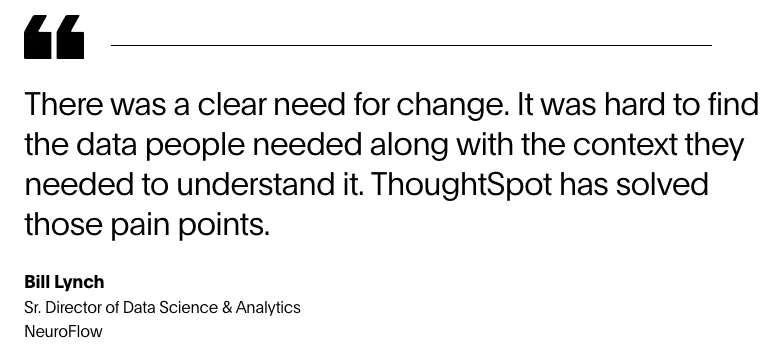
You can see this shift in action with NeuroFlow. Their care teams struggled to surface timely insights on mental-health trends, relying on hundreds of static dashboards and the central data team for answers.
But once they empowered every clinician to simply ask questions in ThoughtSpot's natural-language search, the shift was immediate: active usage jumped to 70%, dashboards dropped from 137 to just 18, and decisions to improve patient outcomes happen in minutes instead of days.
Start Getting Better Insights
Top predictive models that drive better health outcomes
Not all predictive models serve the same purpose. While some focus on individual patient risks, others help you manage hospital resources more effectively, which is just one element within the broader types of analytics used in healthcare.
1. Risk stratification models
These models categorize patients into risk levels like low, medium, or high for specific conditions. You can focus your attention and resources on patients who need it most. Common examples include heart failure risk scores or fall risk assessments.
2. Clinical outcome prediction models
These get more specific about individual events. They might predict surgical infection risk or medication response rates. This helps you proactively manage care and prevent adverse events before they happen.
3. Resource optimization models
These focus on operational efficiency by predicting patient volume, bed availability, and staffing needs. You can adjust resources in real time to reduce wait times and avoid being understaffed during peak periods.
4. Population health management models
Taking a community-wide view, these identify disease trends and at-risk groups across geographic areas. You can use them to predict flu outbreaks in specific neighborhoods or identify communities with high diabetes risk.
|
Model type |
What it predicts |
Key data sources |
Primary benefit |
|
Risk Stratification |
Patient risk levels for conditions |
EHR, claims, demographics |
Prioritize high-risk patients |
|
Clinical Outcome |
Specific health events or complications |
Lab results, vitals, medical history |
Prevent adverse events |
|
Resource Optimization |
Hospital capacity and staffing needs |
Admission patterns, seasonality |
Improve operational efficiency |
|
Population Health |
Community-wide health trends |
Geographic, socioeconomic data |
Guide preventive interventions |
How to implement predictive analytics successfully
Getting started doesn't have to feel overwhelming. Breaking it down into clear steps makes the process manageable and increases your chances of success.
1. Evaluate your data foundation
Your predictions are only as good as your data. Before investing in models, assess whether your electronic health records are complete, accurate, and standardized. If your systems can't share data effectively, start there first.
2. Build support across your organization
You need buy-in from every corner. Frame the benefits in terms that resonate with each group. Clinicians care about saving time and improving patient care. Executives focus on ROI and competitive advantage. IT teams want to know about system integration.
As Robert Garnett mentions in an episode of The Data Chief
"Analytics should be at the table, not a takeaway from the table. So I think analytics, when they're sitting around the table with the business when they're making decisions...is a very different construct than traditional models where the business convenes, works through a problem, then decides, well, we need more data."
3. Choose the right analytics platform
Prioritize platforms that clinicians can actually use without extensive training. Look for systems that work with live data and support Live Analytics rather than stale reports. Most importantly, find a platform that explains why it made specific predictions to build trust.
Traditional BI tools often create bottlenecks when clinicians need to explore follow-up questions about patient risk factors. That was the case for MDaudit. Their teams routinely waited on updated reports or had to loop the data team back in just to answer simple questions.
Once they embedded self-service analytics, those bottlenecks disappeared, and the impact was tangible: more than 25 percent business growth and a 10x faster time to market for new capabilities.
With Liveboards, you get interactive dashboards that let you drill down into predictive insights in real time. Instead of static risk scores, you can explore the underlying factors driving a patient's readmission probability or infection risk, all through an intuitive interface that works like a search engine.
4. Start with focused pilot projects
Don't try to solve everything at once. Choose a pilot with clear, measurable outcomes and strong clinical support. Good options include readmission prediction for a specific department or infection risk monitoring on one hospital floor.
5. Scale into daily workflows
Make predictions part of regular work by embedding alerts directly into your EHR or creating automated tasks triggered by high-risk scores. The goal is to fit these predictions into your workflow without disrupting existing processes.
Overcoming implementation challenges
Even with the right plan, predictive analytics comes with real hurdles. Here’s how to navigate the most common ones without slowing momentum.
Data quality and system integration issues
Healthcare data is messy, scattered across systems, and rarely standardized. Instead of waiting for everything to be perfect, start with the cleanest, most complete datasets tied to a single use case. Build from there. Layer in validation checks and governance step by step rather than trying to fix everything at once.
Building physician trust in AI predictions
Clinicians have every reason to question a model that can’t explain itself. Trust grows when physicians can see how a prediction was made and have a voice in shaping the model’s logic. Start with recommendations that support clinical judgment instead of directives that feel prescriptive.
Dr. Dana Rollison of Moffitt Cancer Center put it clearly in an episode of The Data Chief
"It's not just how accurate the algorithm is, but also how well the physicians understand it. They're less likely to trust a black box. If they understand what's behind the black box, then they may be more inclined to use it."
Addressing privacy and ethical concerns
Using patient data responsibly means thinking beyond compliance. Set clear guardrails early, including an AI ethics committee, routine bias audits, and transparent documentation. These steps help protect patient trust while keeping your predictive program on solid ground.
Measuring success and demonstrating ROI
To justify your investment and secure future funding, you need concrete proof that your predictive analytics program is working.
Before implementation, establish baseline healthcare KPIs. Then track progress across these key areas:
Clinical outcomes: Reductions in adverse events, lower readmission rates, shorter hospital stays
Operational efficiency: Time saved by clinical staff, fewer unnecessary tests, shorter wait times
Financial impact: Cost savings from prevented complications, avoided penalties, and overall program ROI
Many traditional analytics platforms make it difficult to track these diverse metrics in one place. You end up juggling multiple dashboards and waiting for IT to modify reports when you need different views of the data.
With the Modern Analytics platforms like ThoughtSpot, you can search across clinical and financial data using natural language queries. Ask questions like "compare readmission costs before and after model deployment" and get instant, interactive visualizations that make it easy to demonstrate value to any stakeholder.
|
Metric category |
What to measure |
Target improvement |
Measurement frequency |
|
Clinical Quality |
Complication rates |
15-20% reduction |
Monthly |
|
Patient Experience |
Satisfaction scores |
10% increase |
Quarterly |
|
Operational |
Length of stay |
0.5-1 day reduction |
Weekly |
|
Financial |
Cost per patient |
10-15% decrease |
Monthly |
Put predictive analytics to work for better health outcomes
Healthcare is moving rapidly toward predictive, personalized care, a shift underscored by recent AI data trends. By successfully implementing tools like ThoughtSpot, you can attract top talent, achieve better patient outcomes, and operate more efficiently in an increasingly competitive environment.
Ready to see how ThoughtSpot can help you improve patient outcomes through predictive insights? Start your trial and see how you can turn complex healthcare data into clear predictions that help you save lives.
Frequently asked questions about predictive analytics in healthcare
1. How long does it take to implement predictive analytics in a hospital setting?
A focused pilot program can be operational in three to six months. A comprehensive program that's fully integrated into clinical workflows typically takes 12 to 18 months to deploy successfully.
2. What's the difference between predictive and prescriptive analytics in healthcare settings?
Predictive analytics tells you what's likely to happen, such as which patients face readmission risk. Prescriptive analytics recommends specific actions to prevent those outcomes, like targeted interventions or care protocols.
3. How much patient data do you need to build effective predictive models?
You can develop useful models with as few as 1,000 to 5,000 patient records for specific conditions. Data quality matters more than quantity; clean, complete data on fewer patients often outperforms messy data on larger populations.
4. Can smaller healthcare organizations benefit from a predictive analytics platform?
Yes. Smaller organizations often see significant benefits by focusing on specific use cases like reducing appointment no-shows or preventing readmissions. Cloud-based analytics platforms have made these capabilities much more accessible and affordable.
5. How do you maintain predictive model accuracy as patient populations change?
Models require regular monitoring and retraining with new data to stay accurate. Most successful programs retrain models quarterly or whenever performance drops below predetermined thresholds, using automated monitoring systems to track effectiveness.