You're evaluating AI tools for your data strategy, but the AI agent vs AI assistant debate feels like comparing apples to oranges. One promises autonomous insights while the other offers controlled exploration, yet most explanations focus on technical features rather than which approach actually solves your daily data challenges.
Here's what you need to know: the choice between an AI agent and an AI assistant isn't about picking the "better" technology. It's about matching your data maturity, risk tolerance, and analytical goals with the right level of AI autonomy to get faster, more reliable insights from your data.
What are AI assistants for data analytics?
An AI assistant in data analytics is a reactive tool that responds to your specific questions about data. Unlike general assistants like Siri, a data AI assistant waits for you to ask something like "What were our sales last quarter?" and then provides the answer. Think of it as having a knowledgeable colleague who only speaks when spoken to.
How AI assistants work with your data
AI assistants operate through a simple request-response cycle. You type a question, and the assistant, often powered by large language models, interprets your request, queries your database, and returns a visualization or answer. The key difference is that these systems only act when you give them a direct command.
The process involves several components:
Natural language processing: Converts everyday questions into database queries using advanced NLP techniques
Context awareness: Remembers what you asked earlier in the conversation
Guided exploration: Suggests follow-up questions to help you dig deeper
Key benefits of AI assistants
The real value lies in making data exploration faster and more intuitive for you. You don't need to know SQL or understand complex database structures to get answers.
Core capabilities include:
Instant visualizations: Turn questions into charts within seconds
Conversational analytics: Ask follow-up questions naturally
Democratized access: You can explore data without technical training
What are AI agents for data analytics?
While AI assistants wait for your commands, AI agents take a fundamentally different approach. AI agents are proactive systems that work autonomously to monitor, analyze, and even act on your data without needing specific prompts for every action.
How AI agents work autonomously
Being proactive means an AI agent continuously scans your data streams looking for important patterns. For example, an agent might detect unusual customer churn patterns, automatically investigate potential causes like recent pricing changes, and alert you with a complete analysis. This shifts you from asking "What happened?" to being told "Here's what's happening and why."
The autonomous capabilities include:
Continuous monitoring: Scans data 24/7 for anomalies
Multi-step reasoning: Chains analyses together to find root causes
Proactive alerting: Surfaces insights before you know to look for them
Understanding agent boundaries
Even autonomous agents, what Gartner categorizes as agentic analytics, operate within carefully defined guardrails. According to Bernard Marr, getting executive buy-in is key to bringing everyone along on the analytics journey. He says, "...it's really important to take everyone with you on this journey." This journey includes setting clear boundaries like data access permissions and escalation triggers that bring humans into important decisions.
Start Getting Better Insights
Key differences between AI agents and AI assistants
Now that you understand how each approach works, here are the three fundamental differences that will guide your decision.
1. Level of autonomy
AI assistants are like having a data analyst on call who waits for your questions. AI agents are like having an analyst working independently on your behalf, constantly monitoring for important changes.
The autonomy spectrum ranges from:
Reactive assistance: Only responds to direct queries
Proactive monitoring: Continuously watches for patterns
Autonomous action: Can execute pre-approved workflows independently
2. Human oversight requirements
AI assistants keep humans in every step of the analytical process. You ask a question, review the answer, and decide what to do next. AI agents are designed to reduce constant oversight, only involving you at key decision points or exceptions.
3. Data processing approaches
The systems interact with data in fundamentally different ways:
Timing: Assistants process data when asked; agents monitor continuously
Scope: Assistants answer specific questions; agents explore broadly
Discovery: Assistants find what you ask for; agents find what you didn't know to look for
Benefits of AI assistants for your data needs
For many teams like yours, AI assistants represent the ideal balance of advanced analytics and user control. As ThoughtSpot Co-founder Amit Prakash explains, "trust is so important in the data space. You cannot put a product in front of people that's supposed to answer data questions, and it gets it wrong."
1. Predictable and controlled insights
Every insight from an AI assistant traces back to your specific query, making the entire process transparent. This is perfect when you need to explain quarterly results to your board and must have complete confidence in how every number was derived.
2. Lower risk for sensitive data
The human-in-the-loop model greatly reduces risks of unauthorized data access. This matters especially if you work in healthcare, finance, or government, where strict compliance requirements govern how data gets used.
3. Clear audit trails
Every interaction creates a documented path from question to answer. This supports both compliance audits and helps you understand how people actually use data across your teams.
Benefits of AI agents for your data needs
When you're ready to scale analytical capabilities beyond manual oversight, AI agents offer compelling advantages. They multiply your team's capacity without multiplying headcount.
1. Autonomous insight discovery
AI agents don't just answer questions; they find important questions you should be asking. ThoughtSpot's Spotter automatically detects anomalies and trends without manual prompting. While you sleep, an agent could identify that a competitor's product launch correlates with shifts in your customer behavior.
2. Continuous data monitoring
An agent can monitor hundreds of metrics simultaneously, something impossible for human analysts. In manufacturing, an agent monitors production quality across multiple plants 24/7, flagging deviations so you can act immediately.
3. Scalable analytics workflows
A single agent performs exploratory work, often considered AI analytics, equivalent to several analysts digging through data to find correlations and root causes. This frees your experts to focus on strategic interpretation and decision-making rather than data hunting.
Top use cases for each approach
Understanding where each approach excels helps you match the technology to your specific needs.
AI assistants excel in interactive scenarios
AI assistants shine when you need quick answers to specific business questions. The ThoughtSpot Analytics platform provides these search-based capabilities, allowing you to get instant answers through natural language queries.
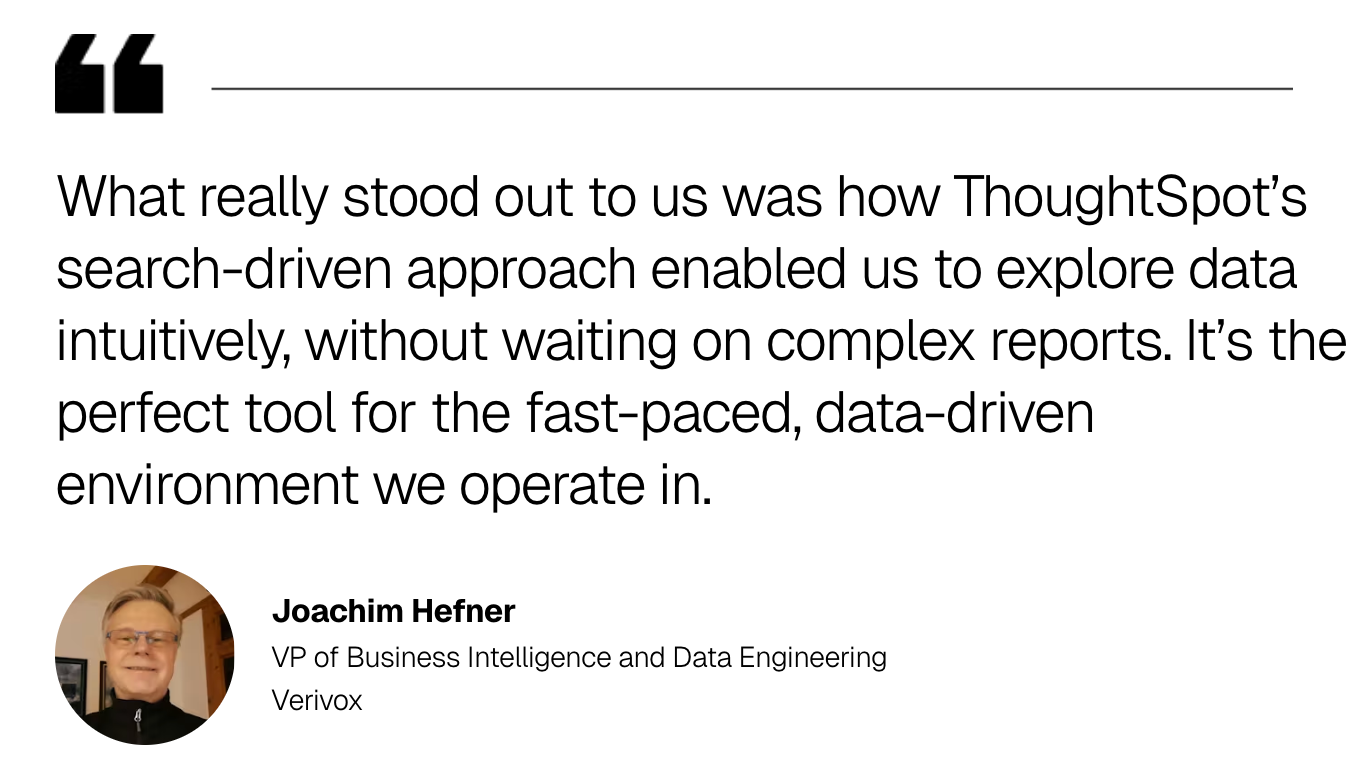
Take Verivox for example. Their business teams were stuck with slow time-to-insight and limited options for exploring data. But once they embedded ThoughtSpot's search-driven analytics as an AI assistant, the shift was immediate: adoption soared, teams began monetizing their data, and instant insights became the new normal.
Common use cases include:
Executive meetings: Leaders ask follow-up questions during board presentations
Sales conversations: Reps check customer history between calls
Financial reporting: Analysts validate numbers before monthly close
AI agents thrive in continuous monitoring
AI agents work best for use cases requiring autonomous, always-on operation:
Fraud detection: Monitor millions of transactions 24/7 for suspicious patterns
Supply chain optimization: Balance inventory with demand signals automatically
Customer health tracking: Predict churn risk across thousands of accounts
How to choose between AI agents and assistants
The choice isn't about which approach is "better." It's about which aligns with your data maturity, risk tolerance, and analytical goals.
Assess your current data maturity
Your existing data practices indicate which approach fits best:
Early stage: Inconsistent definitions, manual processes → Start with AI assistants
Developing: Standardized metrics, some automation → Consider a mixed approach
Advanced: Well-governed data, scaled processes → Ready for AI agents
Evaluate your autonomy comfort level
Consider these questions about AI independence:
How quickly do you need insights delivered?
Can you define clear boundaries for automated decisions?
What's your tolerance for AI-initiated actions?
As Bernard Marr notes, AI will "augment all our jobs rather than replace them," but this augmentation requires trust in autonomous systems.
Consider compliance requirements
Your regulatory environment influences the choice. Captain Brian Erickson asks, "Are we all just ethicists?" If you work in a field with strict audit requirements, you may prefer the transparent query trail of an assistant, while others benefit from an agent's continuous compliance monitoring.
Infrastructure requirements for each approach
Your choice between agents and assistants impacts your data infrastructure needs.
AI assistant infrastructure needs
AI assistants work with existing infrastructure but perform best with:
Semantic layers: Define business terms consistently, a capability central to augmented data management
Live connectivity: Enable instant queries against current data
User management: Support secure, personalized access
AI agent infrastructure requirements
AI agents demand more robust infrastructure due to their autonomous nature. ThoughtSpot's Falcon in-memory calculation engine provides the high-performance foundation agents need.
Key requirements include:
Event streaming: Continuous data feeds, not batch updates
Scalable compute: Processing power for concurrent analyses
Workflow orchestration: Systems to manage multi-step agent actions
|
Infrastructure Need |
AI Assistant |
AI Agent |
|
Data Processing |
On-demand queries |
Continuous streaming |
|
Compute Requirements |
Moderate, scales with users |
High, scales with data complexity |
|
Governance Needs |
User permissions |
Automated decision boundaries |
Put your data to work with the right AI approach
Whether you choose the controlled assistance of an AI assistant or the autonomous power of an AI agent depends on your team's readiness and your needs. The key is selecting a platform that grows with you.
ThoughtSpot's Agentic Analytics Platform supports both approaches, letting you start with search-based AI assistance and gradually introduce autonomous capabilities. You can begin where you're comfortable and evolve as your team builds confidence and your data infrastructure matures.
Start your free trial today to experience how the right AI approach turns your data into decisions.
FAQs about AI agents and assistants for data analytics
1. Can you switch from an AI assistant to an AI agent later?
Yes, modern platforms like ThoughtSpot allow you to start with AI assistants and gradually introduce agent capabilities as your data maturity and comfort with automation grow.
2. How do AI agents handle data quality issues differently from AI assistants?
AI agents can autonomously detect and flag data quality problems during continuous monitoring, while AI assistants typically surface these issues only when you encounter them during specific analyses.
3. What happens when an AI agent makes an incorrect data interpretation?
Well-designed AI agents include confidence thresholds and human escalation triggers that automatically flag uncertain results for review rather than acting on low-confidence interpretations.
4. Do AI agents work with live streaming data?
Yes, AI agents are designed to process continuous data streams, making them ideal for fraud detection or operational monitoring that requires immediate response to changing conditions.
5. How much training does your team need for each AI approach?
For AI assistants, your team will need basic training on forming effective natural language questions, while for AI agents, your data team will need to understand governance, boundary-setting, and exception handling.