- For clarity, this article uses “database type” to mean the database’s primary data model.
- Relational and NoSQL are practical starting points; in general, four major NoSQL models are document, key-value, wide-column, and graph.
- Your choice should begin with data shape, access patterns, integrity needs, operating constraints, and the skills available to run the system.
- Storage is only part of the path to useful analytics. Teams should document shared definitions and calculation logic across sources.
Choosing among the many types of databases can feel harder than it should. Labels overlap, vendor groupings differ, and the SQL versus NoSQL debate can hide the question that matters most: what work must your database support?
A useful decision starts with your data model and workload. From there, you can compare how each option organizes data, handles access patterns, supports integrity, fits operational requirements, and feeds analytics.
What Do “Types of Databases” Actually Mean?
The phrase “database type” is used inconsistently, which can make comparisons harder than they need to be. Some sources use the term more broadly, so the boundaries of a comparison may shift. For clarity, this guide uses it to mean the database’s primary data model.
That includes models such as relational, document, key-value, wide-column, and graph. This framing gives you a practical starting point rather than a complete taxonomy. By fixing the definition up front, you can compare models without treating this guide as an exhaustive inventory.
The IRS describes the relational database model as two-dimensional tables connected through common fields. Nonrelational approaches organize data through other primary structures, depending on the model.
A database also differs from an analytics system. The database manages stored data, while an analytics layer helps people query, model, interpret, and present that data for decisions.
Relational Databases: Best When Structure and Relationships Matter
Relational databases organize data into tables made of rows and columns. A row represents a record, a column represents an attribute, and shared keys connect related records across tables.
For example, an orders table might hold an account ID that links each order to the matching account record. According to IEEE’s overview of how relational databases organize data, those relationships are expressed through shared key values.
Structured Query Language, commonly called SQL, is widely associated with relational systems. It gives you a standard way to define structures, retrieve records, join related tables, and update data, although specific features vary among products.
When might a relational model fit? It can be a strong candidate when your data has predictable structure, your queries combine several related entities, or your application depends on controlled transactions.
Consider an order-processing workflow. If one operation coordinates an order, inventory, and payment status, transactional integrity may carry more weight than schema flexibility.
That does not mean relational databases cannot scale, support distributed deployments, or work with varied data. Modern implementations differ widely, so compare actual product behavior and architecture against your requirements rather than relying on category shortcuts.
Your schema also creates an explicit contract. That contract can clarify dependencies, but schema changes may require coordination across services, pipelines, and downstream analytics.
NoSQL Databases: Four Common Models for Different Data Shapes
NoSQL is commonly used as an umbrella term for nonrelational data models. The name does not reliably tell you whether a product supports SQL-like queries, so focus on how the system organizes and retrieves data.
In general, the National Institute of Standards and Technology identifies four major NoSQL database models. They are key-value, document, wide-column, and graph databases, and each can fit particular access patterns.
Document databases store records as documents, often with flexible or variable fields. They may fit applications that work with self-contained objects whose attributes change across records or over time.
Key-value stores organize data around a unique key and its associated value. When your main operation is direct retrieval by a known key, that simple access pattern may align well with the model.
Wide-column databases organize data into rows with columns that can vary. They may suit workloads that need sparse records or access organized around selected column groups, depending on the implementation.
Graph databases represent entities as nodes and relationships as edges. If relationship traversal is central to your workload, a graph model may be worth evaluating alongside other options.
Capabilities still vary by product, configuration, and deployment. Treat these model descriptions as a shortlist for testing, not as automatic predictions about speed, scale, availability, or security.
Document, Key-Value, Wide-Column, and Graph at a Glance
IEEE also groups types of NoSQL databases by their primary data model. The comparison below keeps the focus on workload fit rather than ranking one model above another.
| Model | How Data Is Organized | A Workload Pattern That May Fit | Question to Ask Before Choosing |
|---|---|---|---|
| Document | Self-contained, semi-structured documents with fields that may vary | Applications that read and write complete business objects | Will you frequently join data that lives across many documents? |
| Key-value | Unique keys mapped to values | Direct lookup when the application already knows the key | Do you need rich queries across fields inside each value? |
| Wide-column | Rows with potentially variable columns, often grouped for access | Sparse or large datasets accessed through known row and column patterns | Do your query paths match the planned partition and column design? |
| Graph | Nodes for entities and edges for relationships | Traversal across connected entities and paths | Are relationships central enough to justify a relationship-first model? |
Graph is a good example of why conditional language matters. Connected data alone does not make graph the default; the frequency, depth, and importance of relationship traversal should guide your evaluation.
The relational and NoSQL models above are a practical starting point, not a complete inventory of database technologies. Evaluate any additional system using the same workload, operational, governance, and integration requirements.
How to Choose a Database Type Without Guesswork
A clean comparison begins with workload requirements, not a favorite product or a broad category claim. IEEE notes that nonrelational approaches may be designed around particular access patterns, scalability characteristics, or data structures, which makes those factors useful starting points.
How do you turn a vague database debate into a concrete technical review? Use the following workload-first checklist.
Data shape: Is the data tabular, document-oriented, sparse, relationship-heavy, time-oriented, or represented another way?
Access patterns and queries: Which reads and writes dominate, which joins or traversals matter, and which fields drive filtering?
Integrity and consistency: Which operations must stay coordinated, and where could delayed consistency be acceptable?
Latency and throughput: What response times and request volumes does the workload expect under realistic conditions?
Growth and availability: How may data volume, traffic, geographic distribution, recovery needs, and uptime targets change?
Governance and security: Which access controls, audit records, retention policies, and data classifications apply?
Integration: How will the database connect to services, pipelines, analytics platforms, and data movement processes?
Operational skills: Can your staff design, monitor, tune, secure, and recover the system with confidence?
Turn those questions into tests wherever possible. Representative data, realistic queries, failure scenarios, and operational drills will tell you more than a category label can.
You may also find that the right answer is a combination of systems. In that case, give each database a defined job and account for synchronization, governance, and operational costs.
Architecture reviews should document trade-offs, not just the selected product. That record gives future developers and data leaders the context they need when workloads change or a new requirement challenges the original design.
From Database Choice to Trusted Analytics
A well-matched database can serve its intended workload, but storage alone does not give people a shared interpretation across sources. The UK Government Digital Service’s data ownership guidance calls for data to be clearly and consistently defined for common interpretation. That guidance supports a shared reference point, not a guarantee that every analysis will reach the same conclusion.
In the federal context, the Federal CIO Council and CISA list business glossaries and metadata libraries among governance artifacts. These artifacts may help teams record terms and context without prescribing one semantic-model design.
Depending on your implementation, you may place a governed data model over those sources as a reusable logical layer. Your team can use that layer to document definitions and calculation logic for analytics consumers.
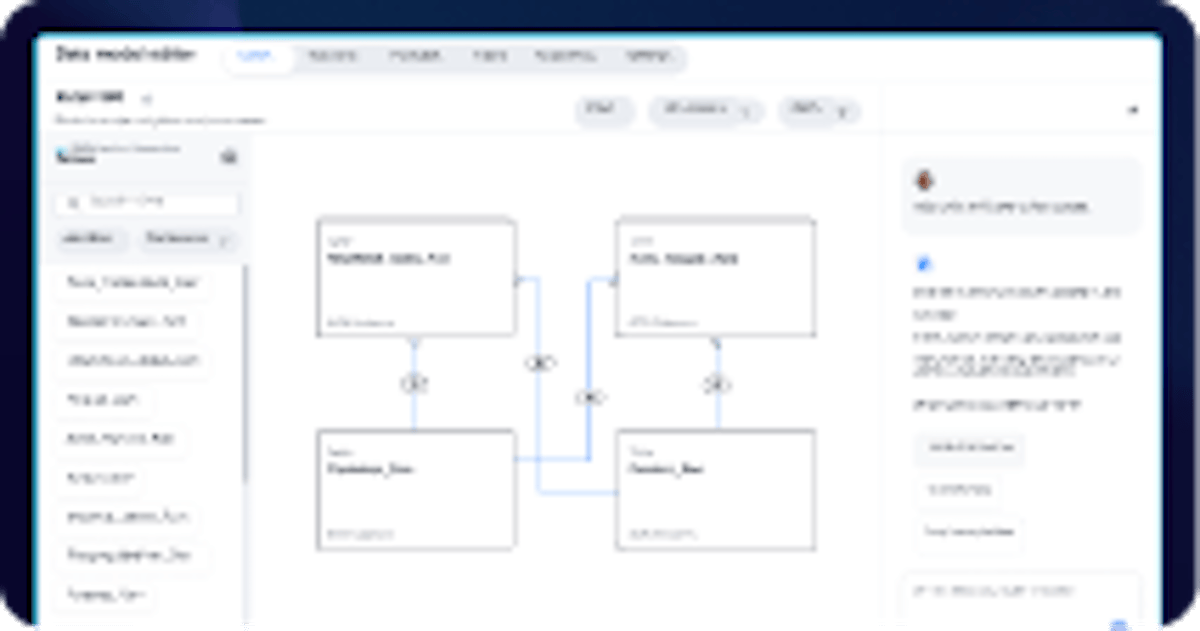
When data is analyzed across sources, teams should document shared definitions and calculation logic so results can be interpreted consistently. This practice gives your team a documented reference when reviewing results.
ThoughtSpot Connect can connect data across your ecosystem by pulling live data from databases, data warehouses, and data lakes. It also supports imports from files and feeds. With ThoughtSpot Model, you can build governed data models with business logic, joins, calculated metrics, synonyms, filters, and access controls.
The storage layer and logical layer solve different problems. Your database choice should serve the workload, while your modeling approach should make the resulting data understandable and governed for analytics.
Choose the Model That Matches the Work
There is no universally best database type. Start with the job your system must do, then evaluate data structure, access patterns, integrity, latency, scale, availability, governance, integration, and operating skills.
When several systems fit different parts of the architecture, clarity becomes the common requirement. Give each database a defined role, document the trade-offs, and use governed definitions when data reaches analytics.
Do you need consistent business context across several data sources? Explore trusted enterprise analytics as a practical next step.