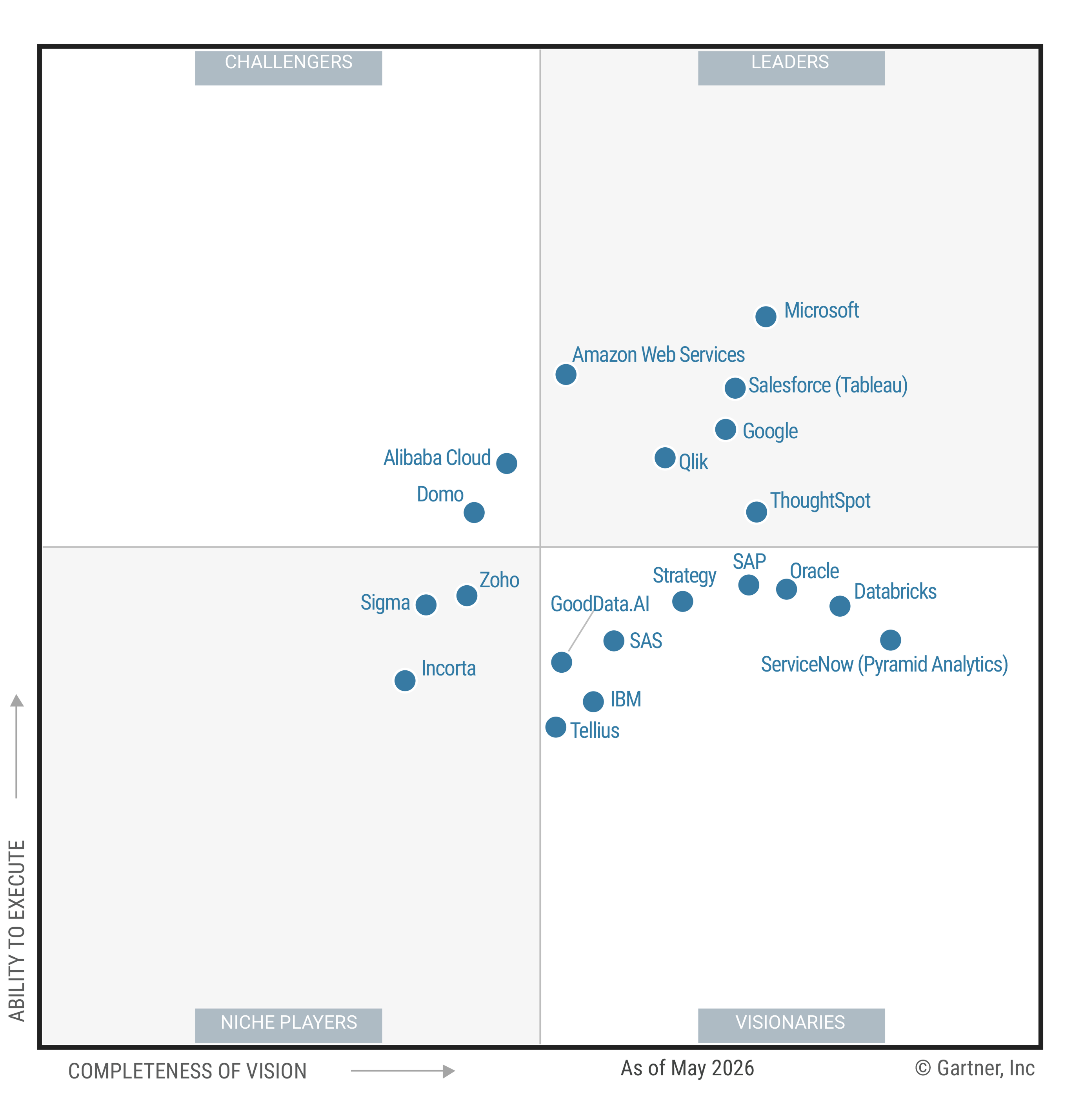
📌 Key takeaways
- 1. An AI analyst is software that reasons through a question and queries live data, while a BI tool only retrieves views someone already built.
- 2. The gap between the two shows up on follow-up questions, like why, what-if, and what next, that a dashboard was never designed to answer.
- 3. A trustworthy AI analyst shows its work: it traces every answer back to a governed definition and explains how it got there.
- 4. An AI analyst augments the BI tools and warehouse you already run rather than replacing them.
- 5. ThoughtSpot's Spotter reasons through each step, checks its own work, and answers through a governed semantic layer.
Your BI tool can tell you that sales dropped in the Midwest last month. Ask it why, or what to do about it, and the conversation stops. That moment is what an AI analyst is built for: the follow-up question a dashboard can't take, the one you'd normally hand to a person and wait on.
Traditional BI answers questions someone anticipated and built for in advance. It's excellent at showing what happened and nearly useless the second you need something the dashboard wasn't designed to display. The real analysis, the why behind a number, the what-if, the next question the first answer raises, routes to an analyst's queue, and that handoff is where the time goes.
Teams try a few ways to close that gap. Some train more business users on the BI tool, which helps until the question outruns what the interface can express. Others lean harder on analysts, which works until the queue backs up. A newer option is an AI agent for data analysis: one that doesn't just retrieve a pre-built view, but reasons through the question, runs the query against live data, checks its own work, and returns an answer a person can act on. The distinction that matters is whether the tool retrieves or reasons, because only one of those can take the follow-up.
This article breaks down what an AI analyst actually does, where it picks up exactly where a BI tool stops, how it handles follow-up questions that used to mean a support ticket, and what to look for so its answers are ones you can trust.
What is an AI analyst?
An AI analyst is a software agent that reasons through a business question, runs it against live data, and returns an answer, not a pre-built report someone has to go find. It differs from a human data analyst in speed and scale: it doesn't queue requests, and it can run the same investigation across thousands of records in seconds. It differs from a static BI tool because it interprets a question rather than matching it to an existing dashboard.
That reasoning step is the core distinction. A BI tool executes a query someone wrote in advance; an AI analyst decides what query to run based on what you actually asked, then adjusts if the first answer doesn't fully address it.
Start Getting Better Insights
AI analyst agent vs. AI data analyst: clearing up the terms
"AI analyst" and "AI data analyst" get used almost interchangeably online, but they point to different things. An AI data analyst usually refers to a human career, a person who uses AI tools to do analyst work faster, the kind of role career sites describe with job descriptions and salary ranges.
An AI analyst, or an AI agent for data analysis, refers to the software itself: the agent doing the reasoning and querying, not the person using it. If you're researching a career path, you want the human-role definition. If you're evaluating a tool for your data stack, the agent is what this article, and the rest of your search, should be about.
The questions your BI tool can't answer
Most BI abandonment happens at the same point: a dashboard answers the first question, then the user has a follow-up and has no path to it inside the tool. They either open a ticket, wait for an analyst, or give up. An AI analyst is built to keep that conversation going instead of ending it.
Here are the follow-ups that typically stall in a dashboard but that a reasoning agent like Spotter can pick up in the same session:
"Why did this number move?" This calls for pinpointing the driver behind a metric change, not just flagging that it changed.
"What happens if...?" This means running a hypothetical against live data instead of requiring a new report.
"What should we do next?" This turns an observation into a recommended action.
"Show me this a different way." This reshapes the same data into a new view without a rebuild request.
"Is this normal?" This compares a number against historical patterns to say whether it's worth worrying about.
Each of these requires reasoning about the question, not just looking up an answer someone already prepared, which is exactly the line a static dashboard can't cross.
What an AI analyst actually does, step by step
Underneath a single question and answer, an AI analyst runs through several steps a BI tool skips entirely:
Interprets the question in plain language, including messy or ambiguous phrasing, rather than requiring a specific query syntax.
Runs the query against live data rather than a pre-built extract, so the answer reflects what's true right now.
Reasons through multi-step analysis instead of returning a single lookup, chaining together the queries a human analyst would run in sequence.
Checks and refines its own work before answering, catching an incomplete or off-target result before it reaches you.
Traces the answer back to governed definitions, so "revenue" or "active user" means the same thing it means everywhere else in your data.
That sequence is what separates an agent from a search box. It's also why the answer can hold up under a follow-up question, since the agent already has the context from the step before.
AI analyst vs. traditional BI vs. a human analyst
None of these three replaces the other two outright. They handle different parts of the same workload, at different speeds and depths.
|
Dimension |
Traditional BI |
AI analyst |
Human analyst |
|
Speed |
Instant, but only for pre-built views |
Seconds, on a new question |
Hours to days, depending on the queue |
|
Handles |
Questions anticipated during design |
Novel and follow-up questions in natural language |
Any question, including judgment calls |
|
Stops at |
The first unanticipated question |
Questions needing outside context or a decision only a person should make |
Available hours and headcount |
The honest read: BI is fast but rigid, an AI analyst is fast and flexible within the data it can see, and a human analyst is the ceiling for judgment calls that shouldn't be automated. Most teams need all three working together, not one replacing the rest.
Where an AI analyst agent fits in your existing stack
An AI analyst sits on top of the BI tool and data warehouse you already run. It doesn't ask you to rip either one out. This is what AI for data analytics looks like in practice: an agent layer that answers the questions your dashboards can't, using the same governed data those dashboards already pull from.
6 characteristics to look for in an AI analyst agent
Not every tool marketed as agentic AI for data analysis actually reasons through a question the way the term implies. These six characteristics separate the agents that hold up from the ones that just add a chat window to old BI:
Runs on live data, not scheduled extracts, so answers reflect the current state of the business.
Provides consistent answers your team can trust, returning the same result for the same question every time.
Traces back to a source and a governed definition, so you can see exactly where a number came from.
Enforces business definitions with a semantic layer, keeping metrics like "churn" or "MRR" consistent across every question asked.
Handles follow-up questions in context, remembering what was already asked instead of starting over each time.
Works inside the tools your team already uses, rather than forcing a separate workflow just to get an answer.
Questions to ask before you trust an AI analyst's answer
Before rolling an AI analyst out to business users, push on how it justifies what it tells you:
"Can it show how it reached the answer?"
"Does it use the definitions our data team validated?"
"What does it do when it isn't sure?"
"Can we audit what it ran?"
An agent that can't answer these clearly is asking you to take its output on faith, which defeats the point of replacing a manual, checkable process with an automated one.
How ThoughtSpot's Spotter works as your AI analyst
Spotter is built to close the exact gap this article describes: it reasons through a question step by step, checks its own work before answering, and traces every result back through ThoughtSpot's governed semantic layer, so the follow-up question gets the same rigor as the first one. See it work against your own data with a ThoughtSpot demo.