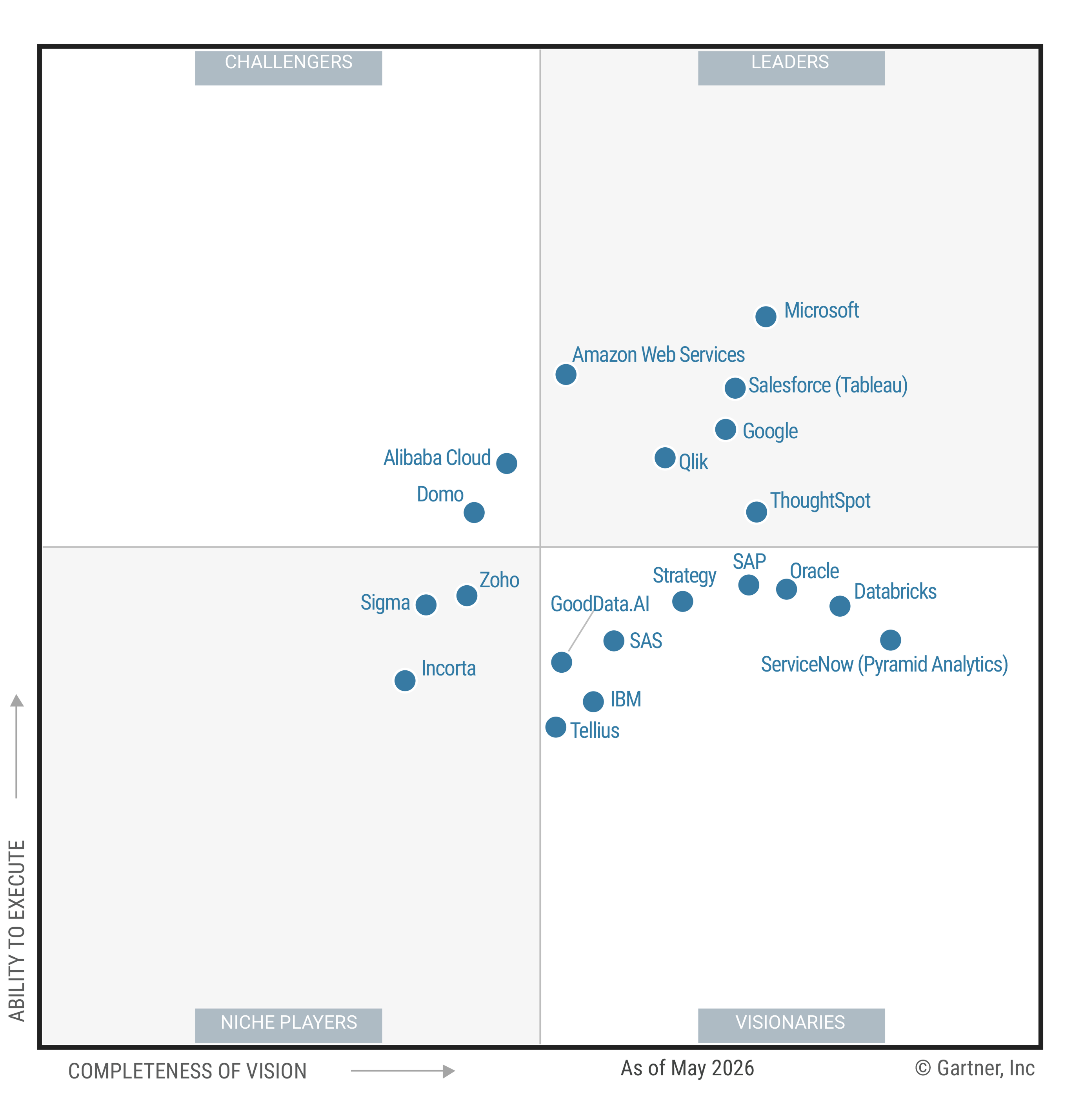
If you're evaluating BI platforms in 2026, you've probably noticed the conversation has changed. It's not "which tool has the prettiest dashboard" anymore. It's "which platform can actually reason across your data and tell you what to do next." That shift is exactly where ThoughtSpot and Omni Analytics start to look very different from each other.
Both platforms talk about AI. Both platforms sell you on speed. But once you get past the marketing language, the two take almost opposite approaches to how AI should work inside a BI product. Here's what the data shows, and why it matters for how you and your team make decisions.
The core question: is your AI grounded, or is it guessing?
This is the heart of the comparison, and it's worth sitting with for a second.
Omni pairs a shared semantic model with what it calls "just-in-time" modeling, which sounds flexible on paper. In practice, metrics and logic can stay trapped in local topics unless someone promotes them into the shared model. Joins are optional and scattered across workbooks, topics, and files. That flexibility comes at a cost: duplicate logic, silent inconsistencies, and governance that becomes optional rather than built in.
ThoughtSpot takes a different bet entirely. Every relationship, from a simple join to a complex galaxy schema, gets defined upfront in a governed semantic layer. Spotter, ThoughtSpot's AI agent, uses patented Search Tokens that map directly to that layer instead of relying on an LLM to guess at a query. The result: answers grounded in facts your team already trusts, not probabilistic guesses dressed up as insights.
If you've ever caught two teams reporting different numbers for the same metric, you already know why this distinction matters more than any chart style or color palette ever could.
Where the two platforms actually diverge
Here's the side-by-side, pulled straight from the comparison data:
| Capability | ThoughtSpot | Omni |
|---|---|---|
| Data unification | Queries structured and unstructured data across CDWs, enterprise apps, and web knowledge in one pane | Cannot query unified structured and unstructured data across CDWs, apps, and web knowledge |
| AI agent | Spotter performs multi-step reasoning and code generation across all data models | Blobby has limited multi-step reasoning and no code generation for advanced queries |
| Automated analytics | Native outlier detection, cross-correlation, and proactive trend forecasting | No native statistical analysis; forecasting is on-demand and limited to chart overlays |
| Alerting and monitors | AI-driven KPI monitoring with automated anomaly detection | Manually configured, row-based KPI tiles with no continuous AI monitoring |
| Connectors | Plug-and-play, bidirectional sync with tools like Jira, Salesforce, and Slack | No native plug-and-play connectors; workflows are mostly outbound |
| Dashboards | AI-augmented "drill anywhere" exploration, with auto-generated dashboards | Preset drill paths only; AI assistant scoped to a single topic or dashboard |
| Embedded analytics | Visual Embed SDK, developer playground, and SpotterCode for rapid builds | iframe with a TypeScript SDK and limited customization |
A few of these gaps are worth unpacking, because they show up in your day-to-day work whether you notice the underlying architecture or not.
Your data doesn't live in one warehouse, so your BI tool shouldn't assume it does
Documents, call transcripts, emails, and web signals carry real context, but they only count if someone has already cleaned and loaded them for you. Omni operates inside the walls of structured data. Anything outside that boundary is invisible until a human intervenes.
Spotter connects directly to your source apps, from CRM feeds to transaction logs to regulatory filings, and reasons across that entire stack in real time. No uploads. No pre-cleaning. No waiting on someone else to prep the data before you can ask a question.
A dashboard that can't answer your follow-up question isn't actually helping you
Omni's charts follow preset drill paths. If an analyst didn't map your specific route in advance, you're stuck clicking around hoping to stumble onto the answer. Its dashboard assistant is also scoped to a single topic or dashboard, so you can't reason across datasets without switching context entirely.
ThoughtSpot's "drill anywhere" approach, powered by AI-augmented charts and Muze (its native visualization engine), turns that static map into something closer to a real conversation with your data. Ask a question, get an answer, ask the next question. That's the difference between a summary and an investigation.
Reactive monitoring means you find out about problems after they've already cost you something
Omni's KPI tiles require manual configuration and stay row-based, with nothing watching your metrics in the background. You find out something went wrong when you happen to check.
ThoughtSpot's monitoring works the other way around: it's built to flag anomalies the moment they happen, so you're acting on a signal instead of doing forensics after the fact.
Start Getting Better Insights
Why this matters beyond the feature checklist
None of this is really about who has more checkboxes. It's about what happens when you ask your data a hard question. As Hyatt's Director of Data Architecture and Platform Engineering, Rooshana Purnyn, puts it: ThoughtSpot isn't about dashboards; it's about making decisions at the speed of business.
That's the real test for any analytics platform in 2026. Can it keep up with the questions you're actually asking, or does it hand you a chart and leave the "why" and "what next" for you to figure out on your own? Omni's Blobby can help you steer through simple queries. Spotter is built to investigate, using multi-step reasoning to get you to a prescriptive recommendation instead of just a number.
The bottom line for your evaluation
If your team is comparing ThoughtSpot and Omni, the decision usually comes down to one question: do you want an AI assistant that's confined to a single topic and a set of pre-built drill paths, or one that reasons across your entire data ecosystem, structured and unstructured alike, and tells you what to do about it?
For teams operating under real governance requirements, deterministic answers grounded in a semantic layer aren't a nice-to-have. They're the difference between an AI feature you can actually put in front of your board and one you have to caveat every time someone asks how it got that number.
Want to see how Spotter handles your own data instead of a demo dataset? Start a free trial and find out.
FAQs
What's the main difference between ThoughtSpot and Omni?
The biggest gap is how each platform grounds its AI. Omni pairs a shared model with "just-in-time" modeling, so metrics and logic can stay trapped in local topics unless someone promotes them, and joins stay optional and scattered across workbooks. ThoughtSpot defines every relationship upfront in a governed semantic layer, and Spotter uses patented Search Tokens that map directly to it instead of asking an LLM to guess at your query.
Can Omni analyze unstructured data like documents and call transcripts?
No. Omni operates exclusively in the silo of structured data, so anything outside that boundary is invisible until someone pre-cleans and loads it. Spotter connects directly to your source apps, from CRM feeds and transaction logs to call transcripts and regulatory filings, and reasons across that stack in real time with no uploads required.
How does Spotter compare to Omni's Blobby AI assistant?
Spotter performs multi-step reasoning and code generation across all your data models, while Blobby has limited multi-step reasoning and no code generation for advanced analytical queries. Blobby is also scoped to a single Topic or dashboard, so it can't reason across your broader data ecosystem the way Spotter does.
Does Omni support proactive anomaly detection?
Not natively. Omni's KPI tiles are manually configured and row-based, with no built-in AI to continuously monitor metrics or flag anomalies on its own. ThoughtSpot's AI-driven KPI monitoring detects anomalies automatically and surfaces them before they escalate into bigger problems.
Which platform is better for embedded analytics?
ThoughtSpot's Visual Embed SDK, developer playground, and SpotterCode are built for precise, themed embedding and faster prototyping. Omni relies on an iframe with a TypeScript SDK, which limits advanced customization and doesn't include a developer playground for UI component theming.
Can I switch between conversational AI and traditional dashboards in Omni?
Not seamlessly. Users on Omni's Blobby in standalone mode can't move from conversational mode into data exploration within its workbook UI without breaking context. ThoughtSpot lets you move back and forth between conversational analytics and point-and-click exploration without losing your place.