- A BI Service engagement can combine advisory work, implementation, and managed operations, but each responsibility should be clearly defined.
- Start with business decisions, KPI ownership, and metric definitions before investing in dashboards or AI-assisted analysis.
- Establish clear requirements for data reconciliation, access controls, testing, release management, training, support, and handover.
- Treat AI as an extension of governed analytics, supported by traceability, trusted data, and appropriate human oversight.
- Retain ownership of your business definitions, semantic models, documentation, and exit plan, even when a partner manages day-to-day operations.
A dashboard can look complete while important questions remain unanswered. Who owns the KPI? Which data source takes precedence when figures do not match? Who can access row-level information when a calculation changes?
These questions matter when evaluating a business intelligence engagement. Without clear ownership, governance, and operational processes, even a well-built analytics environment can become difficult to maintain and trust.
The term "BI Service" can also refer to Power BI Service. In this guide, it refers to business intelligence services: the advisory, implementation, and managed operations that help organizations build and maintain their analytics capabilities.
Here's what to evaluate, what to include in your scope of work, and what your organization should retain control over after implementation.
What Business Intelligence Services Include
A business intelligence services proposal may combine strategy, implementation, and ongoing support under one engagement. While this can simplify procurement, it can also make vendor comparisons difficult if the responsibilities are not clearly separated.
Most BI engagements fall into three broad categories. A provider may deliver one or all three, depending on your organization's internal capabilities, data environment, and operational requirements.
| Service category | Primary purpose | Common work | Acceptance evidence | What it does not replace |
|---|---|---|---|---|
| BI consulting | Determine what to build and how to govern it | Decision mapping, KPI workshops, architecture reviews, roadmaps, operating models, and platform assessments | Prioritized use cases, named owners, approved definitions, target architecture, risk assessments, and delivery plans | Executive accountability, KPI ownership, procurement review, or technical approval |
| BI implementation | Build or improve the analytics environment | Data integration, modeling, dashboard development, access configuration, testing, deployment, training, and documentation | Reconciled metrics, completed tests, approved access, deployed analytics, training records, and handover materials | Clean source data, stakeholder approval, or a permanent support function |
| Managed BI services | Operate and improve the analytics environment | Monitoring, incident management, releases, access administration, usage reviews, backlog management, and user support | Service reports, issue history, release records, access reviews, support metrics, and improvement backlogs | Client ownership of business definitions, risk decisions, budgets, or exit planning |
Look beyond the number of dashboards or reports a provider promises to deliver. Dashboard completion does not necessarily mean users will adopt the analytics capability or that the underlying metrics are reliable.
A strong scope of work should clearly document assumptions, exclusions, dependencies, and responsibilities. It should also identify who provides data access, approves metrics, validates results, and signs off on production releases.
Governance should be part of the engagement from the beginning, not something added after implementation. Data quality, source availability, access permissions, and stakeholder approvals can all affect delivery timelines.
Start with Business Decisions, KPI Ownership, and Metric Definitions
Before discussing dashboards, identify the business decisions the engagement should improve.
Work backward from those decisions to determine the questions, metrics, dimensions, and data required to support them.
For example, "improve revenue reporting" is too broad to serve as an implementation requirement. A more useful use case identifies the audience, decision, review frequency, and expected action. A regional sales leader might review weekly pipeline movement to investigate deals that have changed stages or experienced delays.
Each KPI should have a clearly identified business owner who is responsible for approving its meaning. The data team can validate that the calculation works as intended, but the relevant business function must determine what the metric represents.
A KPI definition record should include:
The business question and decision the KPI supports.
The formula, level of detail, time basis, dimensions, filters, and exclusions.
The system of record for each input and the rules for resolving conflicting values.
The expected refresh frequency and acceptable data latency.
The business owner, approvers, review date, and change-management process.
The user groups permitted to access detailed or restricted information.
KPI validation should be measurable. Ask your BI partner to reconcile a representative reporting period against an approved source and document any differences. The team should also test edge cases and demonstrate how changes to a metric definition are reviewed, approved, and released.
Pay attention to differences in business terminology across departments. Terms such as "customer," "revenue," and "active account" may have different meanings depending on the business unit. Rather than forcing a single definition where it does not make sense, establish the appropriate context and make those differences visible to users.
Semantic models help maintain these definitions and business rules across analytics workflows, giving users a consistent foundation for exploring data.
Before implementation progresses, the business owner, data owner, and relevant stakeholders should approve the same set of definitions. This becomes the baseline for testing, training, ongoing support, and future changes.
Build the Governed Data and Access Foundation
Once KPI definitions are approved, map each metric to its source fields, joins, filters, and update processes. This is what turns a BI implementation into a repeatable analytics capability rather than a collection of disconnected dashboard queries.
In ThoughtSpot, Spotter Semantics provides a way to define shared business logic, metrics, and calculations for dashboards, queries, and AI agents. By establishing consistent definitions, organizations can give users and AI-powered analytics experiences a common understanding of business data.
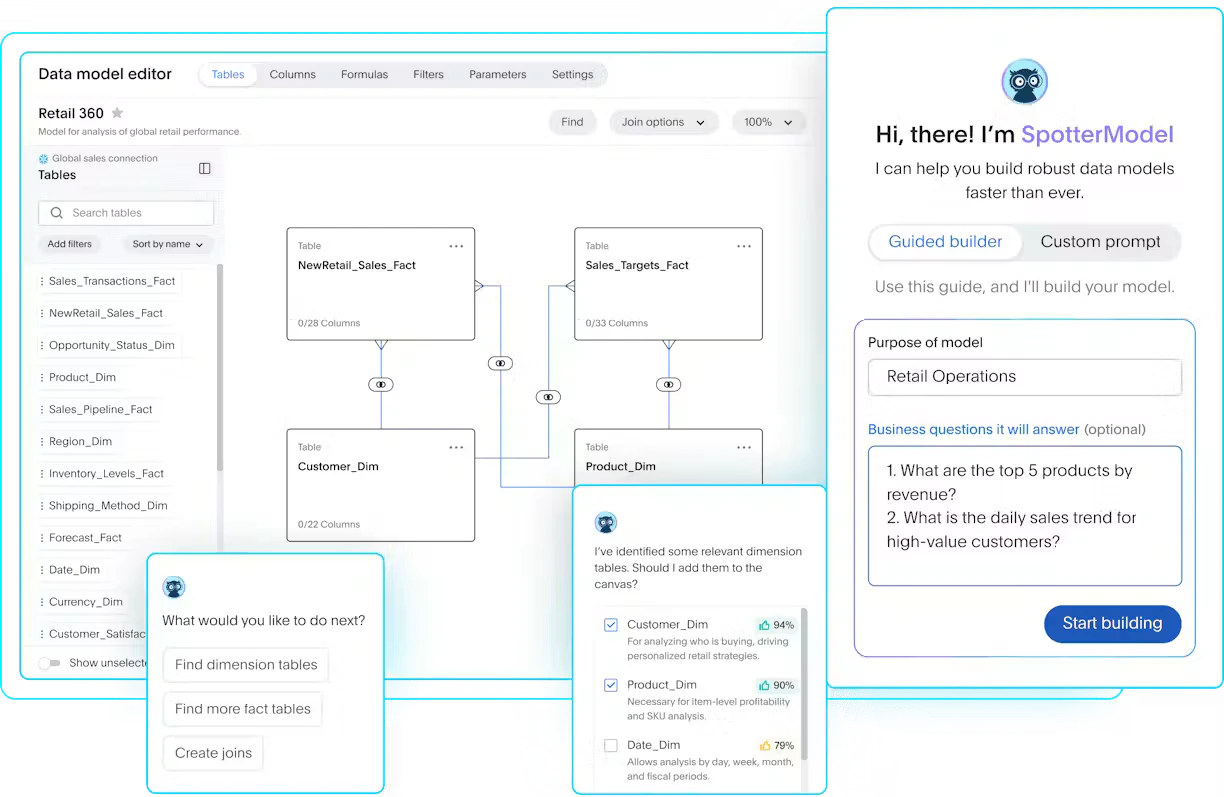
The data foundation should also include a source inventory, integration architecture, data lineage, model ownership, and test data.
Technical teams may need code-first analytics workflows to work with SQL, Python, or R as part of the broader analytics environment.
Testing should go beyond checking whether a query executes successfully. A comprehensive validation process should cover:
Row counts, duplicate records, and null handling
Join cardinality and relationships between tables
Time zones and currency conversions
Late-arriving data and historical restatements
Data freshness and refresh failures
Permission boundaries and restricted information
Data reconciliation should have its own acceptance criteria. Select representative totals and records, compare them against approved sources, investigate discrepancies, and document acceptable tolerances.
When source data changes, regression testing should identify which models, metrics, and reports need to be reviewed.
Access governance is equally important. Build an access matrix that maps user roles to data domains, row-level restrictions, administrative permissions, export capabilities, and approval owners.
Test these permissions using representative accounts, including users who should not be able to access particular datasets or information.
Before a model or analytics asset moves into production, require a release review covering metric approval, reconciliation, access testing, documentation, and rollback procedures.
Deliver Usable Analytics, Then Operate and Improve Them
A governed data foundation only delivers value when people can use it to make decisions. Analytics experiences should reflect the questions, responsibilities, and data access requirements of different user groups.
ThoughtSpot's Liveboards provide interactive dashboards that support filtering, drill-downs, and data exploration. Its Spotter relational-search capabilities bring business context from underlying data models into conversational analytics.
For enterprise teams, transparency in AI-assisted analysis matters as much as the answer itself. Spotter, ThoughtSpot's AI analyst for business data, supports this by retaining conversation corrections and allowing users to review or update how those corrections influence answers. It can also work with ThoughtSpot's semantic models and supported external semantic models.
Users also need ways to evaluate the answers they receive. ThoughtSpot's Spotter documentation describes feedback capabilities that let users provide input, request a double-check, and inspect the search tokens used to construct an answer.
These capabilities are particularly relevant when AI-assisted analytics is used in business-critical workflows. Generated summaries and answers should be checked against governed metrics and approved source data, with human review appropriate to the business decision involved.
Usability also extends to accessibility. The W3C's Web Content Accessibility Guidelines (WCAG) 2.2 provide guidance on color contrast, keyboard navigation, focus visibility, alternative text, control labels, and predictable interactions.
For browser-based dashboards and analytics applications, these guidelines provide useful areas for accessibility testing. However, reviewing individual elements does not automatically establish that an application conforms to WCAG.
Once analytics is in production, the operating model becomes central to maintaining reliability. Define monitoring requirements for:
Data freshness and failed pipelines
Query performance and system availability
User adoption and analytics usage
Access exceptions and permission changes
Support requests and incident resolution
These processes should be supported by release management, incident ownership, scheduled access reviews, and a prioritized improvement backlog.
Training should also reflect different user responsibilities. Business users need guidance on exploring data, asking follow-up questions, and interpreting metric definitions. Analysts need training on data models, testing, and release processes. Administrators need documented access procedures, audit requirements, and incident-management steps.
Finally, define how improvement requests become governed changes. Whether the request involves a support issue, a metric correction, or a new analytics use case, it should have an assigned owner, impact assessment, test plan, approval process, and release record.
Choose a BI Service Partner That Leaves You in Control
A successful BI engagement should leave your organization with an analytics capability that is easier to understand, operate, and improve.
When evaluating potential partners, look beyond their presentations and proposed delivery timelines. Ask for evidence of how they approach governance, testing, documentation, and long-term ownership.
Use the following areas to structure your evaluation:
Scope: A clear separation of consulting, implementation, and managed operations, including assumptions and exclusions.
Ownership: Defined client and partner responsibilities for KPI approvals, data access, architecture, testing, releases, and support.
Data controls: Source mappings, lineage requirements, semantic-model ownership, access design, and data retention or export rules.
Testing: Sample reconciliation, permission testing, regression coverage, defect management, and documented acceptance records.
Handover: Business definitions, semantic models, code, tests, runbooks, release history, training materials, and administration guidance.
Support: Service hours, severity levels, escalation contacts, monitoring, reporting, and backlog reviews.
Exit planning: Data and asset exports, credential transfers, knowledge transfer, outstanding issues, and transition assistance.
During the evaluation, give each shortlisted provider a disputed KPI and an access-sensitive scenario. Ask them to explain how they would establish the definition, validate the results, document the decision, and manage a subsequent change.
This exercise can reveal more about a partner's working practices than a generic implementation diagram.
Commercial terms should reinforce the same principles. Clarify ownership of all created assets, identify which changes require additional fees, and document how responsibilities can transition to your internal team.
You should also understand how pricing changes when scope, data volumes, support requirements, or service levels change.
As enterprise analytics increasingly incorporates conversational interfaces and AI-assisted analysis, retaining ownership of business definitions, semantic models, and governance processes becomes even more important.
A BI partner should help your organization build a sustainable analytics capability, not create long-term dependence on external expertise.
Explore ThoughtSpot's enterprise analytics platform.