- The strongest artificial intelligence applications start with a defined workflow, user, decision, and acceptable output.
- Five practical uses include customer and revenue work, strategy, operations, IT support, and analytics for business decisions.
- Trusted data, business context, clear ownership, and output evaluation matter as much as the underlying model.
- Start with a narrow pilot, compare results with known ground truth, and expand only when the application meets your threshold.
Artificial intelligence applications are software systems that use AI techniques to perform or support a specific task. In business, practical applications include analyzing documents, finding information, investigating changes in data, prioritizing issues, and helping people ask better questions.
The hard part is rarely finding another AI idea. Your real challenge is choosing a use case tied to trusted data, a clear decision, and a person accountable for reviewing the output.
What are artificial intelligence applications?
An AI model is the mathematical engine that recognizes patterns or produces an output. An AI tool packages one or more models into a usable product. An AI application connects that capability to a specific workflow, data source, and decision.
That distinction matters when you move from a promising demo to daily business use. A general model might summarize text. An enterprise application also needs access rules, relevant definitions, and a clear next step after it produces an answer.
For example, an analytics application can let you ask a natural-language question about governed business data. The answer becomes useful when you can inspect the underlying metric and ask a follow-up question. You can then judge whether the result fits the task.
AI agents take that workflow connection a step further by working through defined tasks with tools, context, and oversight. AI agents for business data can support analytics workflows where the agent must interpret a question, work with governed data, and return an answer that a person can review.
A practical enterprise application therefore brings together three parts: a task worth supporting, data you understand, and a decision or action with a named owner. If one part is vague, the pilot will be difficult to evaluate because success has no clear meaning.
Five artificial intelligence applications in business
Where are firms applying AI today? A U.S. Census Bureau analysis examined AI-using U.S. firms during November 2025 through January 2026. The Census AI adoption analysis reported sales and marketing at 52%, strategy and business development at 45%, and IT at 41%.
These percentages describe reported business-function uses among firms that said they used AI. They do not represent guaranteed results, adoption across every firm, or proof that any use case improved performance.
The five applications below map common AI capabilities to workflows you can define and test. Before deployment, each one needs a question that keeps the scope grounded.
| AI application | Workflow it supports | Question to answer before deployment |
|---|---|---|
| Customer and revenue work | Drafting, customer-context review, segmentation support, and information search | Which output will a seller or marketer review before acting? |
| Strategy and business development | Summarizing internal information and comparing scenarios | Which decision will the analysis inform, and who owns it? |
| Operations monitoring | Investigating metric changes, exceptions, and recurring process issues | Which metrics and thresholds reflect the actual operating process? |
| IT support | Searching knowledge, grouping incidents, and prioritizing issues | What evidence must support a recommendation or priority? |
| Analytics for business decisions | Asking questions, exploring drivers, and reviewing governed metrics | Can the user trace the answer to trusted data and business definitions? |
Customer and revenue work
If your customer workflow draws from account notes, campaign results, product information, and internal documents, an AI application could help organize those inputs. A defined use case might support drafting, document analysis, information search, segmentation, or the review of relevant customer context.
The useful boundary is assistance within a defined process. If an application drafts an account summary, you still need someone to check whether the source material is current. That reviewer should also confirm the customer context and next step.
The same discipline applies to segmentation. You can use AI to help organize patterns or explain differences between groups. The categories should come from governed data and a clear business question, not an opaque label without context.
For an enterprise example, HP’s AI-driven insight program shows how analytics can be organized around broader access to relevant business information. The lesson for your pilot is straightforward: connect the application to the information people need, then define how they will validate and use the result.
Strategy, operations, and IT
A strategy use case might bring together performance updates, customer signals, market notes, and operational reports. Within that defined scope, AI could summarize material, search internal knowledge, or organize evidence around a question. The decision owner still weighs tradeoffs and makes the call.
In operations, anomaly detection can flag a metric that moved outside an expected range. Root-cause analysis can then help you investigate possible drivers. Both tasks depend on governed metric definitions, relevant comparison periods, and human interpretation of the operating context.
Suppose order cycle time rises. A useful application should help you inspect where the change occurred and compare segments. You can test plausible drivers before accepting a confident explanation.
An IT pilot could apply the same pattern to internal knowledge search, incident summaries, or issue prioritization. Before an output shapes a response, you should know which sources it used, how current they are, and what evidence supports the suggested priority.
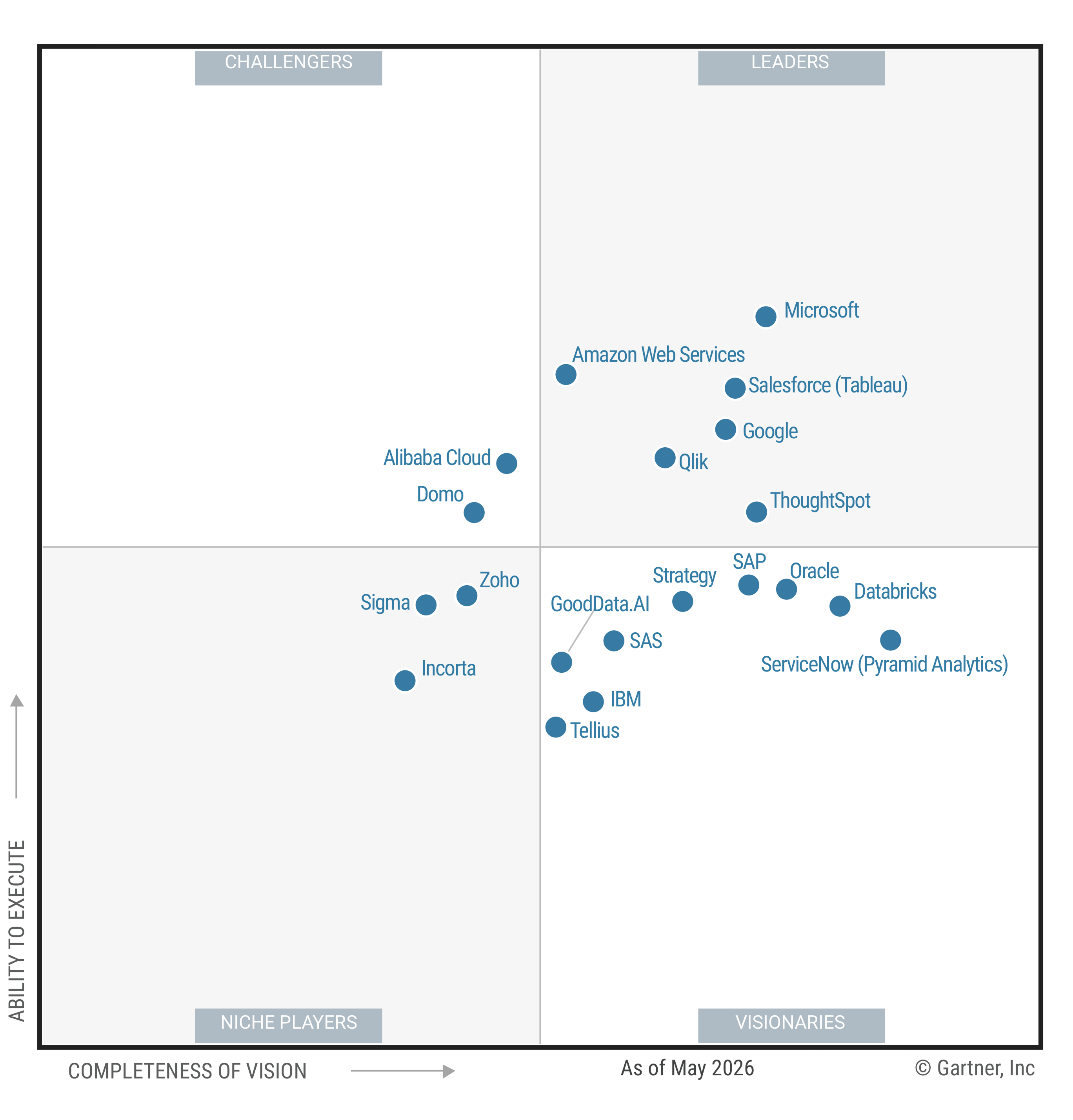
ThoughtSpot’s automated analytics insights offer one product example of this investigative pattern. In any implementation, you should be able to move from a high-level change to follow-up questions. Governed metrics and business context keep the analysis tied to shared definitions.
Why analytics is a high-value AI application
Many lists of AI applications focus on standalone tasks. For enterprise analytics, value comes from connecting a question to live business data and applying the right definitions. You also need enough reasoning to judge the answer.
Natural-language analytics gives you a conversational way to ask a data question, but the interface is only one part of the experience. You also need relevant business context, access controls, consistent metric logic, and a way to inspect how the answer was formed.
Consider a revenue question: “Why did renewal performance change last month?” A useful AI analyst should let you clarify the metric and compare customer segments. You can then examine contributing factors without rebuilding the analysis after every question.
In an agentic analytics design, AI agents should coordinate defined steps across the analytics workflow. Governed business context should also constrain how terms, metrics, and relationships are interpreted.
ThoughtSpot’s Spotter product documentation describes a conversational analytics experience with contextual follow-up questions. The Analyst Studio launch announcement explains how analytics teams can prepare data and move findings into Liveboards for ongoing use.
ThoughtSpot supports embedding the Spotter experience, including conversational analytics capabilities, into an application through its Visual Embed SDK.
Transparency still matters at every step. You should be able to review the source data, understand the metric definition, and give feedback when an answer misses relevant context.
What responsible generative AI applications need
Once you know where an application fits, the next question is operational: what must be in place before people rely on its output? For generative-AI use cases, NIST’s voluntary guidance recommends documenting data provenance and human oversight roles, then assessing outputs against known ground truth. Those recommendations inform five connected practices.
Define the use case and decision. Name the user, workflow, decision, acceptable output, and conditions that require review or rejection.
Document data provenance and quality. Record the data’s origin, changes, freshness, and limitations that could affect the output.
Add business context and governance. Maintain an inventory of the system, its purpose, its data, its risks, and the criteria used to approve deployment.
Assign human oversight. Specify who reviews which outputs, when escalation is required, and what authority the reviewer has to pause or reject a result.
Evaluate against ground truth. Test accuracy, quality, reliability, and authenticity against known data, then set measurable performance or assurance thresholds for the use case.
These practices should fit the application’s decision setting and risk level. A system that summarizes internal meeting notes may need a lighter review pattern than one influencing a material business decision. Both still need a defined owner and evaluation criteria.
NIST presents voluntary suggested actions for generative AI risk management. The guidance is not a legal mandate, a universal control list, a product endorsement, or a guarantee that an application will be safe or successful.
What does this mean for your program? You need thresholds that reflect the job the application performs, plus monitoring that shows whether performance stays within those boundaries after launch.
How to choose your first AI application
Start with a repeated workflow that creates noticeable friction, but keep the first scope narrow. A focused pilot helps you define ground truth and observe how people use the output. You can then decide whether the application meets your requirements.
Use this sequence to choose and test the first use case:
Identify a repeated workflow. Look for a task with clear inputs, a known user, and a decision or action at the end.
Define the operating details. Write down the user, decision, data sources, acceptable output, review owner, and conditions for rejection.
Choose a narrow pilot. Limit the initial data, user group, or task so that you can observe failures and compare results consistently.
Set evaluation criteria. Use known ground truth where available, define measurable thresholds, and document how reviewers will score the output.
Monitor before expanding. Track results, exceptions, corrections, and user feedback; add scope only after the application meets the agreed threshold.
A phased approach also matches the pattern in the Census research. In that analysis, 57% of AI-using U.S. firms integrated AI in three or fewer business functions during November 2025 through January 2026.
That finding does not measure maturity or predict success. It does show that reported use among adopters was often limited in breadth. That pattern supports learning within a bounded workflow before adding more functions.
Keep a named person in the loop throughout the pilot. Your approach to human oversight in AI should define review authority and clear escalation steps, rather than expect someone to catch every problem.
Before you expand, ask one final question: can you explain why the application passed? If the answer relies on enthusiasm rather than documented results, the pilot needs clearer criteria or more testing.
Conclusion
The most valuable artificial intelligence applications solve a defined business problem and make their inputs, output quality, and accountability visible. When you connect a specific workflow to governed data, business context, human oversight, and measurable evaluation, you gain a clear basis for deployment decisions.
Ready to bring governed data into more everyday decisions? Explore ThoughtSpot’s Agentic Analytics Platform.