- AI is the broader field for systems that generate predictions, recommendations, decisions, or other useful outputs.
- Machine learning is a subset of AI, and many ML systems learn statistical patterns from data for specific tasks.
- Modern business systems may combine models with data, interfaces, rules, tools, workflows, and human judgment.
- Enterprise analytics use cases can benefit from governed business context, careful evaluation, transparent answers, and accountable oversight.
AI and ML are closely related, but they are not interchangeable. NIST describes an AI system as an engineered or machine-based system that, for stated objectives, generates outputs such as predictions, recommendations, or decisions.
Machine learning is one family of techniques used in AI systems, and not every AI system depends on ML. For your business, the challenge is connecting models to reliable definitions, permissions, and decision-making processes.
What Are AI and ML?
Artificial intelligence includes a broad set of approaches and systems that can generate outputs for defined objectives. Depending on the application, those outputs may include language, visual classifications, recommendations, predictions, or decision support.
Machine learning sits within that broader field. Many ML systems learn statistical patterns from data to support task-specific predictions, classifications, rankings, or other outputs.
Think of AI as an umbrella covering many techniques and applications. ML is one important area beneath it, alongside rule-based systems, search methods, planning, and other approaches.
That relationship matters because not every AI system uses machine learning. A system may follow carefully designed rules, call specialized tools, or combine several methods to complete a task.
AI Is the Broader Field
AI capabilities often appear as practical business functions rather than abstract intelligence. A customer support application might interpret a question, retrieve relevant information, draft a response, and route the case for review.
Computer vision systems may classify images or identify patterns in visual data. Recommendation systems can rank products, content, or next steps based on available signals and defined objectives.
Generative AI can produce text, code, images, or summaries from instructions and context. Fluent output alone does not establish factual accuracy or suitability for a particular decision.
Decision-support systems can also combine predictions with business rules. They may help a person prioritize an investigation, compare options, or identify where additional attention is needed.
ML Learns Patterns From Data
Machine learning begins with data selected for the problem you want to address. A forecasting model might use historical demand, seasonality, pricing, promotions, and other relevant signals.
During training, a model adjusts its internal parameters to identify statistical relationships in those examples. It may then apply learned patterns to new data for a task-specific prediction or classification.
Evaluation examines performance against appropriate test cases and business needs. The right measure depends on the decision, since a useful forecasting metric may be unsuitable for fraud detection.
Data quality, representativeness, labels, and deployment context can affect system trustworthiness or lead to misleading outputs. The NIST AI Risk Management Framework recommends testing under intended conditions and monitoring systems during operation.
Measurement choices matter too. A technical benchmark may not demonstrate performance under the conditions or decision context of deployment.
How AI and ML Work Together
ML supplies many AI systems with pattern recognition, prediction, ranking, and generation. The wider AI system then connects those capabilities to an interface, relevant context, rules, retrieval, tools, and review steps.
For example, an ML model might predict which accounts need attention. An AI application could explain the supporting signals, present related data, and guide a user toward an appropriate workflow.
Deep learning is a subset of ML that uses multilayer neural networks. Stanford HAI explains that large language models use deep-learning techniques to predict and generate language.
In applications, LLMs may support conversational interfaces, summarization, and classification. The surrounding application can pair them with retrieval, business rules, tools, data, and review workflows.
These components work best when each has a clear role. The model handles learned patterns, while the surrounding system supplies context, boundaries, interaction, and accountability.
From Data to Useful Output
A useful AI or ML initiative starts with a decision, not a model. Define what someone needs to decide, who owns that decision, and what a helpful output should contain.
Next, prepare the relevant data. This includes checking its quality, documenting definitions, applying permissions, and determining whether it represents the situations the system will encounter.
Then train a model or configure an existing system for the task. Test it under realistic conditions, including edge cases, ambiguous requests, and examples where the safest response is escalation.
Fluent output alone is not evidence that a response is factually correct or suitable for a decision. The NIST Generative AI Profile addresses risks including confidently stated false content, along with governance, testing, monitoring, and content provenance.
NIST also identifies characteristics organizations should consider when assessing trustworthiness. These include validity, reliability, safety, resilience, transparency, explainability, privacy, and fairness with harmful bias managed.
Finally, monitor the system after deployment. Data changes, user behavior shifts, business definitions evolve, and new risks may emerge, so evaluation should continue over time.
Why Enterprise AI Needs Business Context
Enterprise analytics questions often rely on shared meaning. When someone asks about revenue, churn, pipeline, risk, or inventory, the answer may depend on agreed definitions and relationships across business data.
Those details include metric formulas, table joins, fiscal calendars, access policies, and domain terminology. Without them, an AI system may produce a polished response that uses an unintended calculation or context.
A governed agentic semantic layer can provide shared business definitions and relationships for AI-driven analysis. It can also help teams inspect how a question maps to data and logic.
Traceability gives reviewers a path back to the inputs, assumptions, and calculations behind an answer. Human review remains important when decisions affect customers, employees, finances, compliance, or operations.
ThoughtSpot approaches this challenge through governed analytics connected to live business data. Its Agentic Analytics Platform helps people ask questions in natural language, explore supporting information, and continue analysis through interactive workflows.
The surrounding interface matters because business questions rarely stop after one answer. You may need to compare segments, check a time range, investigate a change, or involve someone with deeper domain expertise.
What a Semantic Layer Adds
A semantic layer is a shared business model that gives data terms, metrics, and relationships consistent meaning. It translates technical structures into concepts that people across your organization can use.
For example, a semantic model can define revenue once while preserving the relevant filters, currencies, calendars, and access controls. Teams can then analyze that metric without rebuilding its logic for every question.
This consistency supports enterprise business intelligence by connecting exploration to governed definitions. It can also make analytical answers easier to review because the underlying data relationships remain visible.
ThoughtSpot’s approach pairs governed business context with traceable analysis and human feedback. Those elements can help people assess an answer, refine a question, and identify where judgment is still required.
Data teams also need an AI-ready data foundation for preparing, analyzing, and validating data. The goal is a practical connection between technical work and the decisions business teams make.
Where AI and ML Create Business Value
AI and ML can support selected business functions when the task, data, risk, and evaluation method fit together.
Common enterprise use cases include:
Anomaly detection and root-cause analysis: ML may flag unusual patterns, while AI can help users explore related factors and supporting data.
Forecasting: ML may model historical patterns and relevant signals, while an AI interface can help people compare assumptions or investigate changes.
Recommendations: Models can rank products, actions, or content when inputs and evaluation fit, while business rules and human review shape their use.
Customer support triage: AI may classify requests, summarize context, retrieve information, and route cases according to defined policies.
Document and workflow automation: AI may extract information, draft content, or initiate steps while keeping review points for sensitive actions.
These applications require fit-for-purpose evaluation. A model used for low-risk content suggestions needs different controls than one influencing credit, healthcare, hiring, or financial reporting.
In analytics, automated business insights can surface changes and patterns for further investigation. People still need context to decide whether a change is meaningful and what action, if any, follows.
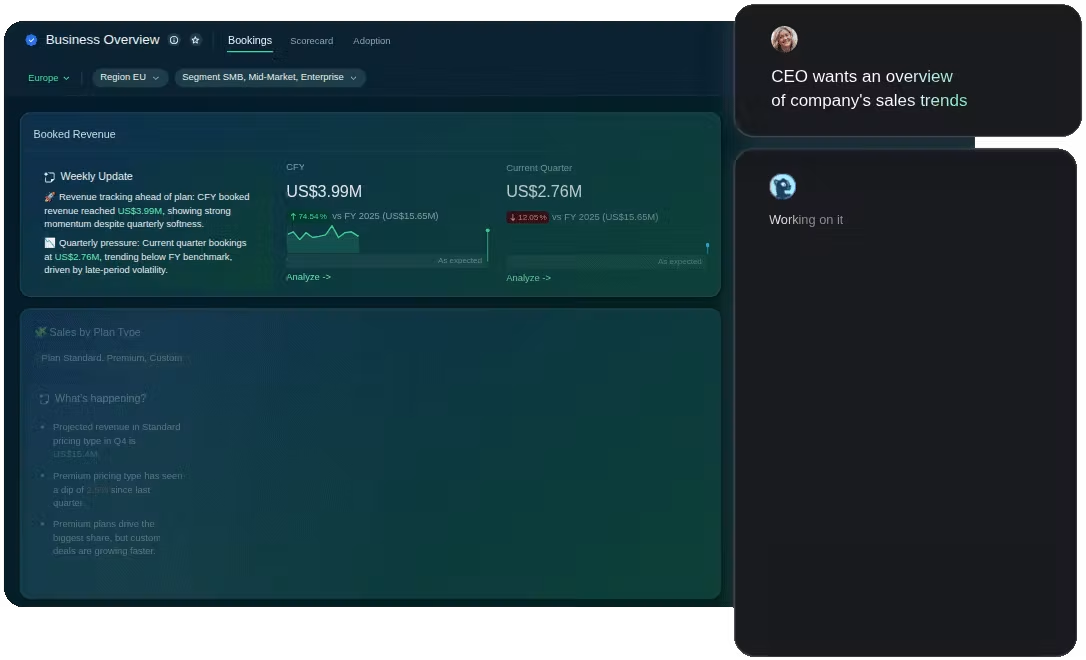
The figure below is illustrative. Its dashboard values and displayed metrics demonstrate an interface concept, not documented customer results or performance evidence.
Start With Decisions, Not Demos
A compelling demonstration can show what a technology might do. A responsible enterprise rollout must show whether it supports a real decision under realistic conditions.
Use this practical checklist to shape an AI implementation:
Choose a decision with a clear owner. Identify who will use the output, what they will decide, and when they need it.
Document trusted inputs and definitions. Confirm data sources, metric logic, permissions, terminology, and known limitations before testing begins.
Test realistic questions. Include routine requests, difficult edge cases, ambiguous language, missing data, and situations requiring escalation.
Keep review paths. Make it easy for users to inspect supporting information, question an answer, and involve a qualified person.
Measure use and decision fit. Track whether people use the system appropriately and whether its outputs meet predefined criteria for the targeted process.
Transparent, governed analytics can support this approach by connecting answers to shared definitions and visible data. That gives your teams a stronger basis for review than a standalone response.
As use expands, revisit permissions, monitoring, and ownership. The controls that fit a pilot may need to change when more teams, data sources, and decisions become involved.
Put AI and ML to Work With Trust
AI and ML complement each other. ML learns patterns from data, while broader AI systems connect models to context, interfaces, rules, tools, and workflows.
For enterprise use, the quality of that connection matters. Reliable data, shared definitions, traceable logic, realistic testing, and human accountability all shape whether an output supports a sound decision.
ThoughtSpot brings these elements together in an Agentic Analytics Platform designed for governed exploration of live business data. If you want to see how conversational analysis can support your teams, explore ThoughtSpot’s AI analyst.