- Start with the business decision, user group, workflow, and available data before you compare AI analytics companies.
- Choose a platform, services partner, or combined model based on your skills, capacity, complexity, and long-term ownership needs.
- Review governed business context, controlled data access, human oversight, feedback, and ongoing evaluation as connected requirements.
- Give every shortlisted company the same representative workflow, approved data, user roles, and evaluation criteria.
- Use company lists for discovery, then build your shortlist from evidence tied to your operating reality.
When you review AI analytics companies, you may encounter software platforms, implementation partners, or combinations of both. Treat these options as a practical buyer lens rather than a formal market taxonomy. Your strongest shortlist starts with the decisions you need to support, the people using the system, the available data, and your required controls.
A platform may fit a team ready to own analytics delivery. A services partner may fit a team that needs specialist support, while some organizations may benefit from both. Your choice should reflect your operating model and evidence from a representative evaluation, rather than a universal ranking.
What AI Analytics Companies Actually Provide
For this article, consider three practical options: an AI analytics platform, a consulting or implementation partner, or a combined delivery model. This buyer lens can help you organize the decision, but it is not a formal market taxonomy.
You may want to evaluate conversational questions, business context, dashboards, embedded experiences, automated insights, or advanced analysis. Ask how each provider supports those areas with your data, users, definitions, access rules, and review process. A long feature list cannot answer that for you.
ThoughtSpot positions itself as the Agentic Analytics Platform. The Spotter AI analyst product page describes natural-language analytics backed by business context and enterprise controls. Your evaluation should test how that positioning applies to your data and operating requirements.
Ask providers how business definitions, access, feedback, and evaluation are supported in your environment.
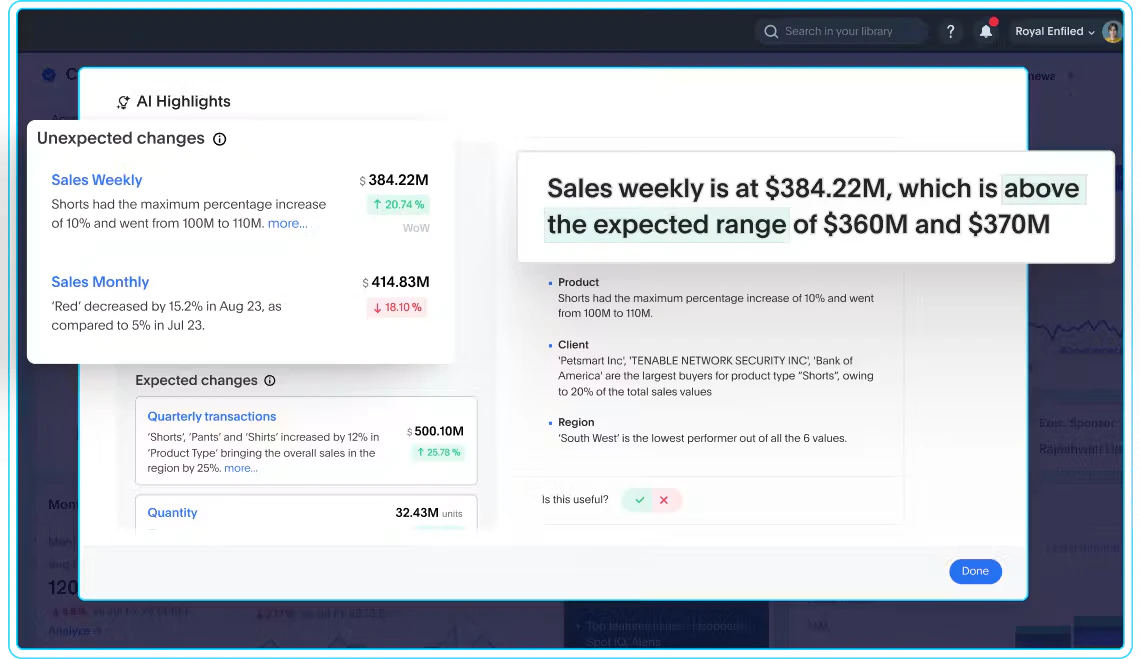
ThoughtSpot’s automated insights tools page describes insight narratives and anomaly signals for investigating metric changes. Treat the interface below as an illustration of that workflow, not evidence of actual results.
The important question is not how many capabilities appear on a product page. Ask how the provider supports a defined decision, your business context, and the way your team works.
Start With the Business Problem and Data
Before you compare AI analytics companies, write down the problem in operational terms. Who needs to make a decision? What question starts the workflow, which data supports it, and what action could follow?
Suppose a sales leader sees an unexpected revenue change. The use case could involve asking which region, product, or segment drove the movement, reviewing the supporting data, and deciding where to follow up. That is more useful than a broad goal to “add AI” to reporting.
Next, check whether the required data is available and usable. Identify the source systems, owners, quality concerns, sensitive fields, and access restrictions. If a partner or provider needs data access, define what can be shared and under which conditions.
Practical editorial guidance: Use this problem-and-data check to organize your shortlist. It is a buyer-focused framework for this article, not a formal market rule or externally attributed standard.
Your workflow should also shape where analytics appears. A standalone application may suit analysts or business teams doing focused exploration. If people need insights inside a product or operational application, review how ThoughtSpot describes its embedded analytics capabilities.
Conversational analytics can support the same problem-first approach. A user might ask about a metric change, inspect a visual breakdown, and refine the question based on the first response. The image below illustrates AI-assisted dashboard interpretation, but it does not prove financial performance or capabilities beyond this example.
Keep the business problem stable as you review companies. If every demonstration uses a different scenario, you cannot make a clear comparison. A shared use case gives each company the same starting point and gives your team a common basis for discussion.
Choose a Platform, Services Partner, or Both
For this article, use platforms and services partners as a practical buyer lens. This is not a factual market split, a ranking, or a standardized taxonomy. You may consider one option or a combination based on skills, capacity, complexity, and ownership goals.
Start by mapping the work involved. Consider data preparation, integration, business definitions, access administration, evaluation, user support, adoption, and ongoing improvement. Then decide which responsibilities your team can own and where outside support may help.
If you are considering an enterprise business intelligence platform, ask how it would fit business users, data teams, and administrators. You may also consider partner support for strategy, implementation, data work, or change management. Within this buyer lens, the options can be complementary.
Avoid assumptions about speed, cost, or effectiveness. Those outcomes depend on your starting point, scope, people, systems, and delivery model. Ask each company to explain its role in your specific operating plan.
When a Product Platform May Fit
A platform may fit when you have an established data team, clear ownership, existing governance practices, and enough capacity to manage ongoing use. You should still assign responsibilities before you commit.
Who will configure business context and administer access? Who will monitor quality, review feedback, and support adoption? If advanced users need a dedicated environment for deeper work, consider how an Analyst Studio workspace would fit their workflow and your wider governance model.
These are diagnostic questions, not proof that a platform is the right choice. A strong internal team may still need targeted support for a complex integration or a new operating process.
When a Services Partner May Fit
A services partner may fit when your team has limited implementation capacity, complex source systems, specialist data needs, or a major adoption challenge. The scope should be explicit because “services” can cover very different work.
Define the deliverables, decision rights, data access, review process, and knowledge transfer. Also decide who will own the resulting models, definitions, integrations, and operating practices after the engagement ends.
Do not treat data analytics consulting firms as interchangeable. Evaluate each proposed engagement against your problem, internal gaps, and desired long-term ownership.
When a Combined Model May Fit
A combined model may fit when you want durable internal ownership with focused delivery support. Your team can own the analytics platform and governance model while a partner contributes expertise in selected areas.
Write down the responsibility split across your organization, the platform provider, and the services partner. Cover implementation and ongoing operations, including data work, administration, testing, feedback, user support, and improvement.
This model should still reflect your capacity and complexity. Adding participants without clear ownership can create gaps, so give each responsibility one accountable owner.
Evaluate Governance, Context, and Real-World Fit
AI data analysis depends on more than the model or interface. Users need consistent metric definitions, controlled access, traceable data, and a practical way to challenge or correct an output. Without that foundation, a confident answer can still be unhelpful for a business decision.
Ask each company how it handles data provenance, model and version details, access modes, sensitive information, human oversight, and feedback. Then ask how quality is evaluated before deployment and monitored afterward.
The 2024 NIST GenAI risk profile supports requesting pre-deployment and ongoing evaluation, data provenance, model and version details, access modes, human oversight, and sensitive-data handling; it is voluntary risk-management guidance, not a product certification.
Value and governance should be tested together. In ISACA’s 2026 AI governance survey, a May 2026 global poll of more than 3,400 digital-trust professionals, 22% said AI ROI met or exceeded expectations and 38% reported a formal, comprehensive AI policy; these findings should not be generalized to all enterprises or AI analytics buyers.
Use the table below to structure buyer conversations. It is an evaluation aid, not a vendor scorecard or ranking.
| Buyer Evaluation Criterion | Questions to Ask | Evidence to Request |
|---|---|---|
| Business use case | Which decision, user, and workflow will this support? | A representative workflow tied to an agreed outcome |
| Data readiness | Which sources are required, and who owns their quality and access? | Source inventory, access plan, and data-sharing expectations |
| Governed context | How are metrics, definitions, permissions, and business rules managed? | Demonstration of metric consistency, access controls, and traceability |
| Evaluation | How will quality be tested before launch and monitored afterward? | Test plan, evaluation criteria, feedback process, and review cadence |
| Human oversight | Where can people review, challenge, or correct outputs? | Roles, escalation paths, and feedback handling |
| Sensitive data | How is sensitive information accessed, processed, and retained? | Documented controls, access modes, and handling practices |
| Operating fit | Who owns implementation, administration, adoption, and ongoing improvement? | Responsibility model, support scope, and knowledge-transfer plan |
A semantic or context layer deserves close attention during this review. Ask how the system maps business language to governed metrics, applies permissions, works across data sources, and handles conflicting definitions. Request a demonstration with your terminology rather than relying only on a prepared example.
Run a Representative Evaluation Before You Commit
Once you have a short list, run a bounded evaluation. Give every company the same representative workflow, approved data, user roles, and success criteria. This creates a clearer basis for comparison than separate demonstrations built around each company’s preferred scenario.
Review both functional and operating fit. Can users get useful answers and follow the supporting context? Are metrics consistent, access rules respected, and feedback captured? Your administrators should also assess setup, review work, and ongoing ownership.
Document assumptions and accepted limitations during the evaluation. Assign reviewers, record open questions, and define how monitoring will continue after deployment. A promising demonstration is one input to the decision, not the full operating plan.
ThoughtSpot’s Midas Pharma case study reports that it brought 72% of its initial user base onto ThoughtSpot in four months, alongside more than 10,000 monthly visualizations and 99% of queries under one second.
This customer-specific result provides context and is not a promise of similar outcomes.
Build a Shortlist Around Your Operating Reality
Lists of AI analytics companies can help you discover options, but they cannot make the final decision for you. A defensible shortlist begins with your problem and data, matches a delivery model to your team, examines governed context, and tests a representative workflow.
Write your problem statement before you schedule demonstrations. Identify the required data, assign ownership, and prepare one common evaluation scenario. You will give every company a fairer review and give your stakeholders a clearer decision process.
When you are ready to evaluate ThoughtSpot’s approach to business context, conversational analytics, and enterprise controls, Explore ThoughtSpot’s agentic analytics platform.