You’re working with data from everywhere: JSON logs from your product, XML feeds from partners, CSV exports from internal systems. It doesn’t fit neatly into tables, but it’s full of signals your teams care about.
The problem is that most analytics and AI workflows still expect a rigid structure. To make progress, you flatten everything, lose context, and spend more time preparing data than learning from it.
This is where semi-structured data comes in. It preserves context that AI models rely on, like relationships, metadata, and event sequences, without forcing everything into rows and columns first.
This guide breaks down what semi-structured data actually is, why it matters for modern AI workloads, and how to use it effectively.
What is semi-structured data?
Semi-structured data is information that doesn't fit neatly into traditional database tables but still contains some organizational elements, like tags or markers, to separate different pieces of information.
Think of it like an email. It has structured fields like "To," "From," and "Subject," but the message body can contain anything. This flexibility makes it more adaptable than rigid structured data but more organized than completely unstructured data.
Unlike data stored in fixed-schema tables, semi-structured data allows records to vary while maintaining enough structure for systems to interpret and process them.
Key characteristics that make data semi-structured
Understanding what makes data semi-structured helps you recognize it when you see it. These traits explain why it's become so valuable for modern applications:
Self-describing structure: Fields are labeled, so systems know what values represent without relying on a predefined schema (for example, customer_name or order_date).
Flexible schema: Records don't need identical fields; one customer might have a middle name, while another doesn't
Hierarchical organization: Information can nest inside other information, creating parent-child relationships
Metadata integration: Context about the data is included alongside values, not stored separately.
This combination gives you the best of both worlds: enough structure for computers to process efficiently, but enough flexibility to handle real-world messiness.
Start Getting Better Insights
Semi-structured vs. structured vs. unstructured data
Data exists on a spectrum of organizations. Here's where semi-structured data fits:
|
Data Type |
Structure Level |
Example |
Best For |
Storage |
|
Structured |
Rigid, predefined schema |
SQL databases, spreadsheets |
Financial records, inventory |
Relational databases |
|
Semi-structured |
Flexible with tags/markers |
JSON, XML, emails |
Web data, IoT sensors, logs |
NoSQL databases, document stores |
|
Unstructured |
No predefined organization |
Videos, images, text documents |
Creative content, social media |
Object storage, file systems |
The practical difference? Structured data is easiest to query but most rigid. Unstructured data is most flexible but hardest to analyze. Semi-structured data gives you a queryable organization without sacrificing adaptability.
Common formats and examples of semi-structured data
You probably work with semi-structured data every day without realizing it. Here are the most common formats:
JSON
Common in application logs, APIs, and event tracking. JavaScript Object Notation (JSON) is flexible and easy to generate, but its nested structure can make analysis harder if you’re forced to flatten it too early.
{

  "product": "laptop",

  "price": 899,

  "specs": {

    "ram": "16GB",

    "storage": "512GB"

  }

}
XML
Often used in partner integrations, configuration files, and legacy systems. Extensible Markup Language (XML) carries rich structure through tags, but its depth and variability can be challenging to query with traditional tools.
<product>

  <name>laptop</name>

  <price>899</price>

</product>
CSV and delimited files
Comma-Separated Values (CSV) files appear structured, but they rarely enforce consistent schemas. Columns can change between exports, data types vary, and important context is often implied rather than explicit.
NoSQL database formats
Modern databases like MongoDB, Redis, and graph databases store data in flexible formats designed to evolve over time. They’re commonly used when relationships or fields change frequently, which is why they’re often a source of semi-structured data for analytics teams.
💡 Pro tip: If you're seeing data with inconsistent fields or nested information, you're probably looking at semi-structured data.
Why semi-structured data matters for AI and machine learning
Semi-structured data works well for AI because it reflects how real-world information actually behaves. Fields change, events evolve, and relationships matter just as much as individual values.
This shift is already underway. As highlighted in our AI Data Trends report, semi-structured data now makes up the majority of data generated across modern organizations. That matters because AI models perform better when they can learn from context, not just isolated fields.
Semi-structured data preserves relationships, metadata, and sequences that help models learn not just what happened, but how and why. It also makes it easier to introduce new signals over time without constantly rebuilding schemas as data sources evolve.
As Pascale Hutz, CDO and EVP of Enterprise Digital & Data Solutions at American Express, shared on The Data Chief podcast:
“Data has to be a living, breathing kind of organism. And when you have that mindset, you don't really think of data as done. Data’s never finished.”
This "living" quality provides key advantages for your AI projects:
Rich context: Preserves relationships and metadata that help AI understand not just what happened, but why
Real-world adaptability: Prepares AI to handle variations and inconsistencies gracefully
Feature diversity: Provides more signals for models to learn from, leading to more accurate predictions
Rapid integration: You can add new data sources without restructuring your entire system
This is why modern analytics platforms are built to work directly with semi-structured data. With ThoughtSpot, you can explore semi-structured sources like JSON logs or XML feeds in plain language and act on insights without forcing everything into rigid schemas first.
How to prepare semi-structured data for AI models
Before feeding semi-structured data to AI models, you need solid data management to clean and organize it. Here's your step-by-step approach:
1. Data validation and quality checks
Start by making sure the data is usable.
Completeness: Make sure required fields exist across records
Consistency: Check that similar fields use the same data types
Accuracy: Validate against business rules and expected ranges
2. Schema inference and standardization
Discover patterns in your data and create consistency:
Pattern analysis: Identify common structures across all records
Unified schema: Create a flexible framework that accommodates variations
Documentation: Record your inferred structure for future reference
3. Feature extraction techniques
Pull meaningful signals from the raw data using modern data extraction tools and transformation techniques:
Flatten nested values: Extract hierarchical data into usable features
Encode categories: Convert text categories into numerical representations
Create derived features: Build new signals from timestamps and relationships
4. Optimization for model training
Prepare your dataset for the AI model:
Balance datasets: Avoid bias by making sure you have fair representation
Split appropriately: Divide data for training, validation, and testing
Consider augmentation: Generate additional examples for sparse categories
ThoughtSpot’s Analyst Studio streamlines this process by combining Python, R, and SQL in one environment. You can validate, clean, and prepare your semi-structured data without switching between different tools, then publish your prepared datasets directly to ThoughtSpot for others to use.
Top use cases for semi-structured data in AI applications
When semi-structured data is prepared properly, it becomes one of the most valuable inputs for AI. Its flexibility makes it especially useful in situations where signals evolve and context matters.
1. E-commerce personalization
In e-commerce, you can combine browsing history (JSON logs), product catalogs (XML feeds), and customer reviews to power your recommendation engines. The flexible format lets you continuously add new signals like social media trends or return reasons to make recommendations smarter.
2. IoT and sensor data analytics
Device data rarely arrives in a consistent shape. Semi-structured formats capture changing measurements and metadata, allowing AI models to predict failures, spot anomalies, and optimize operations in near real time.
3. Healthcare data integration
Patient records, lab results, and clinical notes often vary across systems. Semi-structured data helps preserve context across these sources, supporting risk identification and trend analysis without forcing everything into a single rigid schema.
4. Financial services automation
Transaction logs, market feeds, and regulatory data change frequently. Semi-structured data allows AI systems to detect fraud patterns, flag compliance risks, and respond to emerging signals faster than manual review.
Ready to put your data to work? See how you can turn complex semi-structured data into clear answers with AI-powered analytics. Start your free trial today.
Common challenges with semi-structured data and how to fix them
Working with semi-structured data introduces flexibility, but it also creates new challenges across querying, performance, and governance. Most teams run into the same friction points as they move from experimentation to production.
As Alberto Rey Villaverde, CDO of Just Eat, shared on The Data Chief podcast
“Any data product has three components you need to get right. One is the access... Two is the model... The third bit... is the last mile. The delivery."
1. Query complexity
The challenge: Querying semi-structured data requires specialized languages like JSONPath or XPath, which are slower and more complex than standard SQL.
The fix: Index frequently queried fields and use specialized tools. For your end users, you can bypass this complexity entirely with natural language interfaces. ThoughtSpot Embedded lets you place a search interface directly in your application so they can get answers without thinking about query languages.
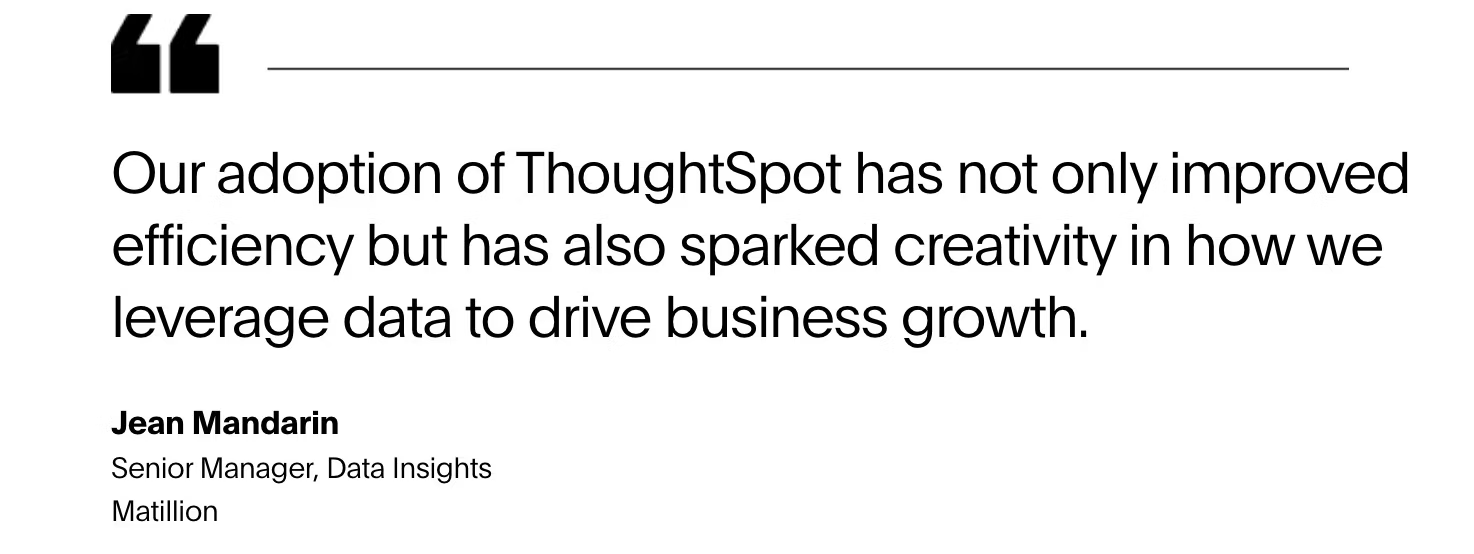
Take a look at Matillion. Their sales and FP&A teams were drowning in ad-hoc report requests and waiting days for answers. But once they put ThoughtSpot's search-driven analytics on top of Snowflake, the shift was immediate: self-service exploded, and report requests dropped by 80%.
2. Performance optimization
The challenge: Processing nested and variable data structures typically requires more compute than working with fixed schemas.
The fix: Implement smart caching strategies, use columnar storage for analytical workloads, and partition data based on access patterns.
3. Data quality and consistency
The challenge: Without enforced schemas, data quality can vary significantly between records.
The fix: Apply validation rules at ingestion, use data profiling tools to monitor for drift, and establish clear governance practices.
4. Integration with existing systems
The challenge: Legacy BI tools expect perfectly structured data and struggle with flexible formats.
The fix: Use modern ETL/ELT tools that handle semi-structured formats natively, and consider gradual migration strategies for older systems.
Best practices for storing and processing semi-structured data at scale
To get real value from semi-structured data at scale, you have to treat it as a long-term asset, not a one-off ingestion problem. The way you store, index, and govern this data determines how usable it remains as volumes grow and structures evolve.
As Jan Sheppard, CDAO at New Zealand’s Crown Research Institute, shared on The Data Chief podcast,
“In New Zealand, we have a word ‘taonga,’ meaning a treasure, a gift from the past to the future. That’s how we see our data.”
In practice, that mindset shows up in a few consistent ways:
Match storage to usage: Choose document stores for frequent updates, object storage, or a data warehouse architecture for archival data.
Index strategically: Balance query speed with storage costs by indexing frequently accessed fields.
Design for evolution: Expect schemas to change and build systems that can accommodate new fields without breaking downstream workflows.
Establish governance: Create clear ownership and quality standards with strong data governance, even with flexible formats.
Plan for compliance: Track and protect sensitive data wherever it appears, not just in predefined columns.
Turn your semi-structured data into AI-powered insights
Semi-structured data already runs through every part of your business, from application events and partner feeds to customer interactions and operational signals. The challenge isn’t collecting this data: it’s making sense of it without flattening away the context that gives it meaning.
Instead of forcing semi-structured data into rigid schemas or waiting on custom reports, ThoughtSpot lets teams explore data directly where it lives. You can ask questions in plain language, follow up as new patterns emerge, and see results update in real time across Liveboards.
Start your free trial to see how ThoughtSpot helps you turn semi-structured data into AI-driven insights your teams can use right away.
Frequently asked questions about semi-structured data
1. Is CSV considered semi-structured data?
Yes, CSV files are semi-structured because while they have rows and columns, they lack enforced data types and can have different schemas between files.
2. What's the difference between semi-structured data and schema-on-read?
Semi-structured data refers to the format itself, which contains organizational elements but not rigid schemas. Schema-on-read is a processing approach where you define the structure when querying the data.
3. Can you use semi-structured data directly for AI model training?
Most AI models require preprocessing and feature extraction first, though some modern frameworks can work with formats like JSON directly for certain tasks.
4. How do modern AI platforms handle semi-structured data?
You can use modern analytics platforms with schema inference, automatic parsing, and natural language interfaces to make your semi-structured data as easy to analyze as structured data.
5. What security considerations apply to semi-structured data?
With semi-structured data, you need field-level access controls and data masking because sensitive information can appear anywhere. Traditional column-based security isn't enough.