You’ve probably lived this moment: you ask your BI tool a straightforward question about last quarter’s performance and end up with three different answers depending on which dashboard you check. Now you’re stuck playing detective.
Context-aware AI changes that.
Instead of treating every question the same way, it understands why you’re asking, what data matters to you, and what decisions you’re trying to make. That means fewer conflicting numbers, fewer Slack pings to analysts, and insights that actually match the situation you’re in.
Let’s break down what that really means.
What is context-aware AI?
Context-aware AI is artificial intelligence that understands the situation surrounding a question so it can respond with answers that are relevant, specific, and trustworthy. It pays attention to who’s asking, what data is relevant, how your business defines key metrics, and what’s happening right now. In other words, it reads the room.
Traditional AI treats data like isolated facts. Ask it, “How did we perform last quarter?” and it may give you an answer that’s technically correct but completely disconnected from how your team actually measures performance.
Context-aware AI does the opposite. It thinks the way a good analyst does. It looks at:
Your role and your priorities
The business logic behind your metrics
Relationships between tables and systems
Recent events that may affect the numbers
It’s the difference between a map that simply shows roads and one that realigns based on traffic, weather, and where you prefer to drive. One gives you raw directions. The other gets you where you actually need to go.
This is why context-aware AI leads to answers you can trust. It’s not guessing. It’s applying the same mental model your best analysts use, but at scale and in real time.
Core principles of context-aware AI
At its core, context-aware AI works by bringing three types of intelligence together — the same ones your best analysts use when they answer questions.
1. Situational Awareness
Context-aware AI understands the environment in which a question is being asked.
It recognizes things like:
Who is asking the question
What they’re responsible for
What’s happening in the business at this moment
The same question, “How did sales perform last quarter?”, means something very different to a CFO than it does to a regional sales manager. Context-aware AI interprets those differences automatically.
2. Real-Time Adaptation
Context changes fast.
Markets shift, demand fluctuates, campaigns go live, and competitors move.
Traditional BI tools often rely on stale data extracts, which means the insight you get may already be outdated. Context-aware AI works directly with live data so answers reflect what’s happening right now, not last week.
3. Relationship Mapping
Data rarely tells the full story when viewed in isolation. Context-aware AI understands how different tables, metrics, systems, and events connect. Instead of just reporting what changed, it can show why it changed.
It thinks in patterns, not columns.
Start Getting Better Insights
How Context-Aware AI Works (Without the Technical Lecture)
You don’t need to be an engineer to understand how this works. Context-aware AI relies on a simple idea: insights only matter if they reflect how your business actually operates. To do that, it uses three layers working together.
1. Unified understanding of your data
Instead of treating data from your warehouse, CRM, product logs, and finance system as separate islands, context-aware AI connects them into one shared view.
This prevents situations where marketing is quoting one number, sales is quoting another, and the leadership team is stuck trying to referee. Everyone is now looking at the same reality.
2. Real-time processing
When numbers are stale, decisions start to drift. Context-aware AI reads from live or near-live data sources, so the insights reflect what is happening right now. If demand spikes, a supplier delays, or a customer cancels, your insights change in the moment. This keeps teams in sync with the actual state of the business, not last week’s version of it.
3. Learning from how you work
Context improves as you use it. As people ask questions, refine searches, save insights, and correct interpretations, the AI starts to understand what matters to your team and what does not.
Over time, it builds a working knowledge of:
The metrics your business cares about most
How you define those metrics
Patterns that signal real chang
Indicators that are usually just noise
This is how context-aware AI develops something similar to institutional memory.
Context-Aware AI vs. Generative AI
Context-aware AI and generative AI are often used interchangeably.
Generative AI is great at producing language. It writes, summarizes, rewrites, explains, and formats. Give it a topic and it will talk about that topic in a way that sounds polished.
Context-aware AI, on the other hand, is concerned with accuracy, relevance, and alignment to your business reality. It is focused on the meaning behind data, not just the presentation of it.
Think of them like two teammates:
One is a storyteller.
The other understands the business.
You need both, but they offer different value at different moments.
|
Context-Aware AI |
Generative AI | |
|
What it focuses on |
Understanding your data, definitions, systems, and how your business operates |
Producing text, explanations, summaries, or creative content |
|
Primary question it answers |
What is true here, and why? |
How should we communicate or describe this? |
|
Strength |
Produces accurate, consistent insights you can rely on for decisions |
Makes information more readable and shareable |
|
Weakness |
Less focused on packaging and narrative |
Can sound confident even when the underlying insight is wrong |
|
Example question |
“Why did conversion rates shift after last month’s campaign?” |
“Write a clear explanation of our campaign performance for the leadership deck.” |
The key difference is trust.
If the AI does not understand how your organization defines metrics, how your teams use data, or why your business cares about certain numbers, the answer may sound smooth but be completely off base. Generative AI is good at sounding right. Context-aware AI works to be right.
The best outcomes happen when they work together:
Context-aware AI finds the correct insight in real time, based on your actual business context.
Generative AI helps communicate those findings in a way that is clear and compelling.
Why context-aware AI leads to better analytics
Analytics tends to fall apart in the gap between what people ask and what the system thinks they mean. That’s where conflicting dashboards, mismatched numbers, and endless clarification threads come from. The problem usually isn’t the data itself. It’s the lack of shared context.
Context-aware AI closes that gap. Instead of treating every question the same, it interprets it the way a human analyst would. It understands how your organization defines metrics, how different teams use data, and what matters most in the moment.
This leads to a few meaningful shifts:
Consistent answers across teams: Everyone is working from the same definitions and logic, so “the number” is the same number everywhere.
Insights that match intent: The AI adjusts based on who is asking and why. A revenue leader, a product manager, and a customer support lead will not get the same interpretation of “performance,” and they shouldn’t.
Decisions grounded in current reality: Because the AI works with live or near-live data, insights adapt as conditions change instead of lagging behind.
Less back-and-forth: There are fewer “Wait, can you clarify?” questions because the interpretation already aligns with how your business operates.
The outcome is analytics that feels more like a conversation with someone who understands your work, instead of a lookup table that needs perfect phrasing.
Context-aware AI doesn’t just answer questions. It answers them in the way your business actually means them. That’s the difference between information and insight.
Real-world use cases of context-aware AI
Context-aware AI shows its value most clearly in messy, everyday decision-making. When the situation isn’t black and white, context decides whether the insight is helpful or misleading.
Finance
Identify real fraud rather than simply flagging any unusual activity
Assess risk by combining market conditions with individual portfolio performance
Personalize products and offers based on spending patterns and life events
Here, context prevents false alarms and surface-level interpretations.
Healthcare
Recommend treatment plans that reflect the full patient history, not just symptoms
Predict staffing needs by factoring in seasonal patterns, local conditions, and patient flow
Analyze population health with a nuanced understanding of demographics and outcomes
Context is what separates generic recommendations from clinically meaningful guidance.
Retail and E-commerce
Recommend products by taking behavior, timing, and environment into account
Adjust pricing based on demand signals, competition, and current trends
Plan inventory using live demand patterns instead of instinct or last season’s data
Context turns raw transactions into insight about actual customer intent.
In all of these cases, the value does not come from more data. It comes from the right interpretation of the data.
How to start using context-aware AI in your analytics
The goal isn’t to overhaul your data stack. It’s to help your data reflect how your business actually thinks. Context-aware AI builds on that foundation. Here’s how the shift happens in practice.
1. Establish a shared definition of your key metrics
Different teams often use different calculations for the same metric. That leads to conflicting answers before AI even enters the picture.
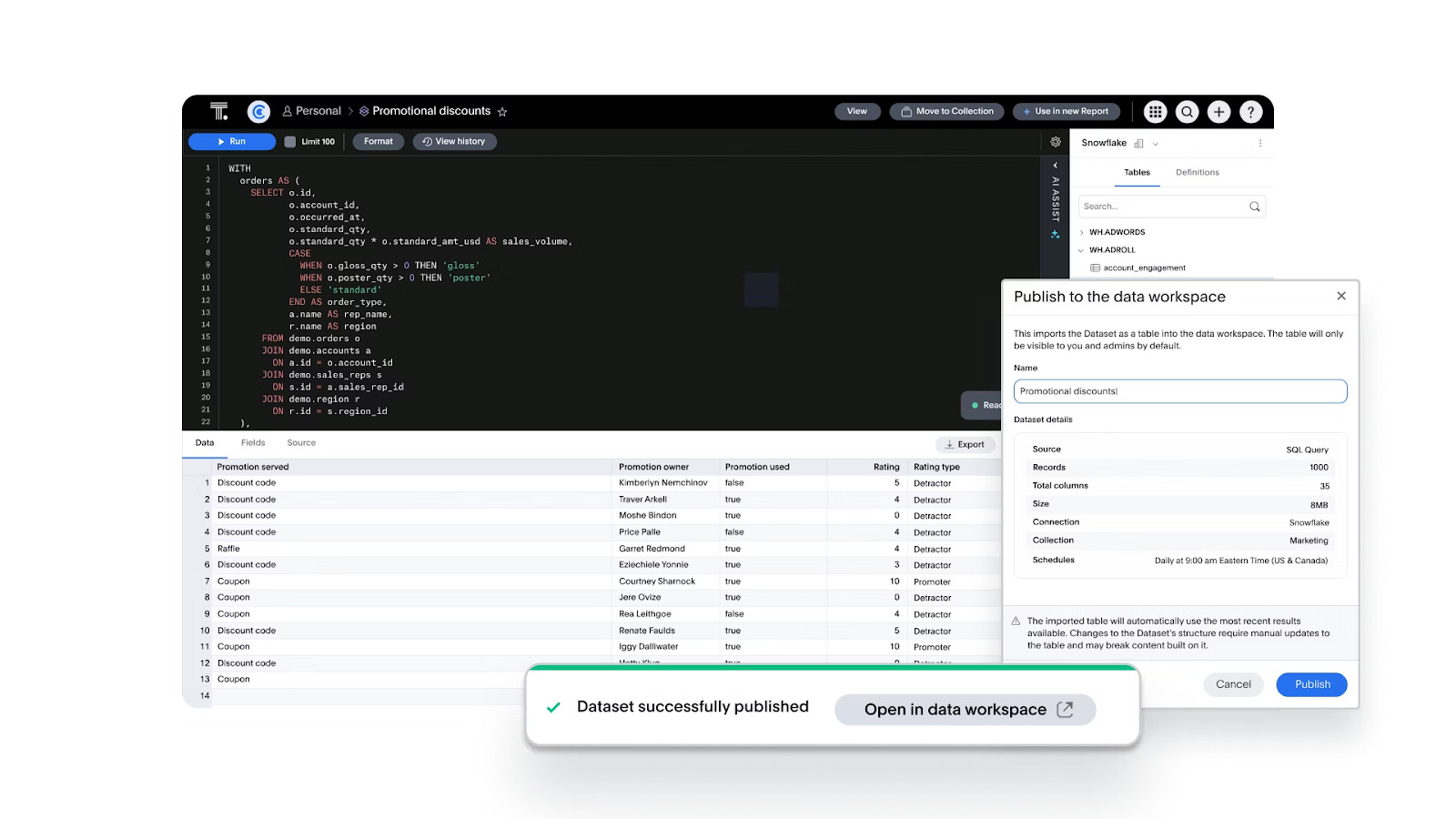
In Analyst Studio, your data and analytics teams define the business logic once, in a central model. This includes metric definitions, relationships between tables, and naming conventions. Once this foundation is in place, every answer your AI gives aligns with how your business measures success.
2. Work directly from live data
Context changes constantly. A report based on a stale extract can mislead the moment conditions shift.
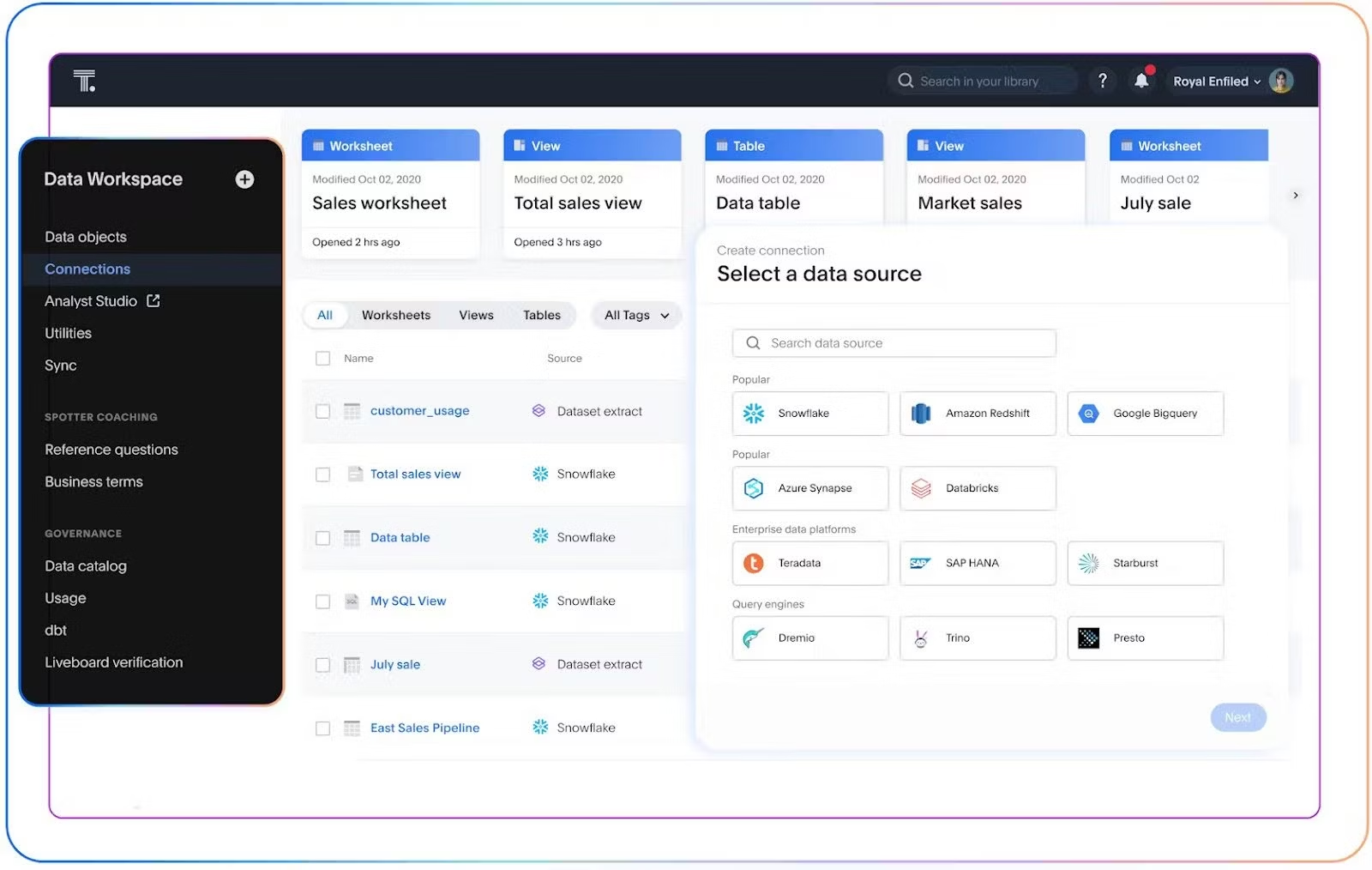
ThoughtSpot connects directly to cloud data warehouses like Snowflake, BigQuery, Databricks, and Redshift. This means your answers reflect what is happening right now, not last week.
3. Let people ask questions in their own language
Context-aware AI shines when people don’t need to translate their questions into SQL or hunt for the right dashboard.
This is where Spotter, your AI analyst, fits in. It understands natural language questions and interprets them through your defined business logic. The result is answers that feel aligned with your role, your metrics, and the situation at hand.
4. Bring insights to the place where decisions occur
If people have to switch tools or open dashboards to get an answer, the context is already disrupted.
With ThoughtSpot Embedded, context-aware insights appear directly inside the applications your teams already use. Think Salesforce, ServiceNow, Google Sheets, and other everyday workflow tools.
Why context is what makes analytics useful
Context-aware AI isn’t about adding more dashboards or increasing the volume of data. It’s about making sure the answers reflect how your business actually works. That means shared definitions, live context, and interpretation that matches intent. When analytics feels like a conversation with someone who understands your goals, decision-making becomes faster and far less frustrating.
This is where ThoughtSpot fits. It brings your business logic, your live data, and your context into one place. Analysts can define consistent metrics and relationships in Analyst Studio. Teams can ask questions in natural language and get meaningful answers with Spotter, your AI analyst. And insights show up inside the tools where decisions happen, so people never have to break their flow.
If that sounds like the analytics experience you’ve been trying to build, try ThoughtSpot and see how it feels to work with answers that match the moment, not just the query. Start a free trial today.