

I had the distinct pleasure of hosting a Snowflake Summit ‘26 session with Agustin “Augie” Del Rio, CEO and Founder of Gallus Insights, an analytics platform tailored specifically for mortgage lenders.
As we sat down to discuss the future of analytics, one core truth echoed throughout the room: the most ambitious AI goals live or die by the quality of the underlying data.
To truly harness the power of next-generation agentic analytics, organizations must ensure they have a high-performance data infrastructure. Gallus Insights has done exactly that.
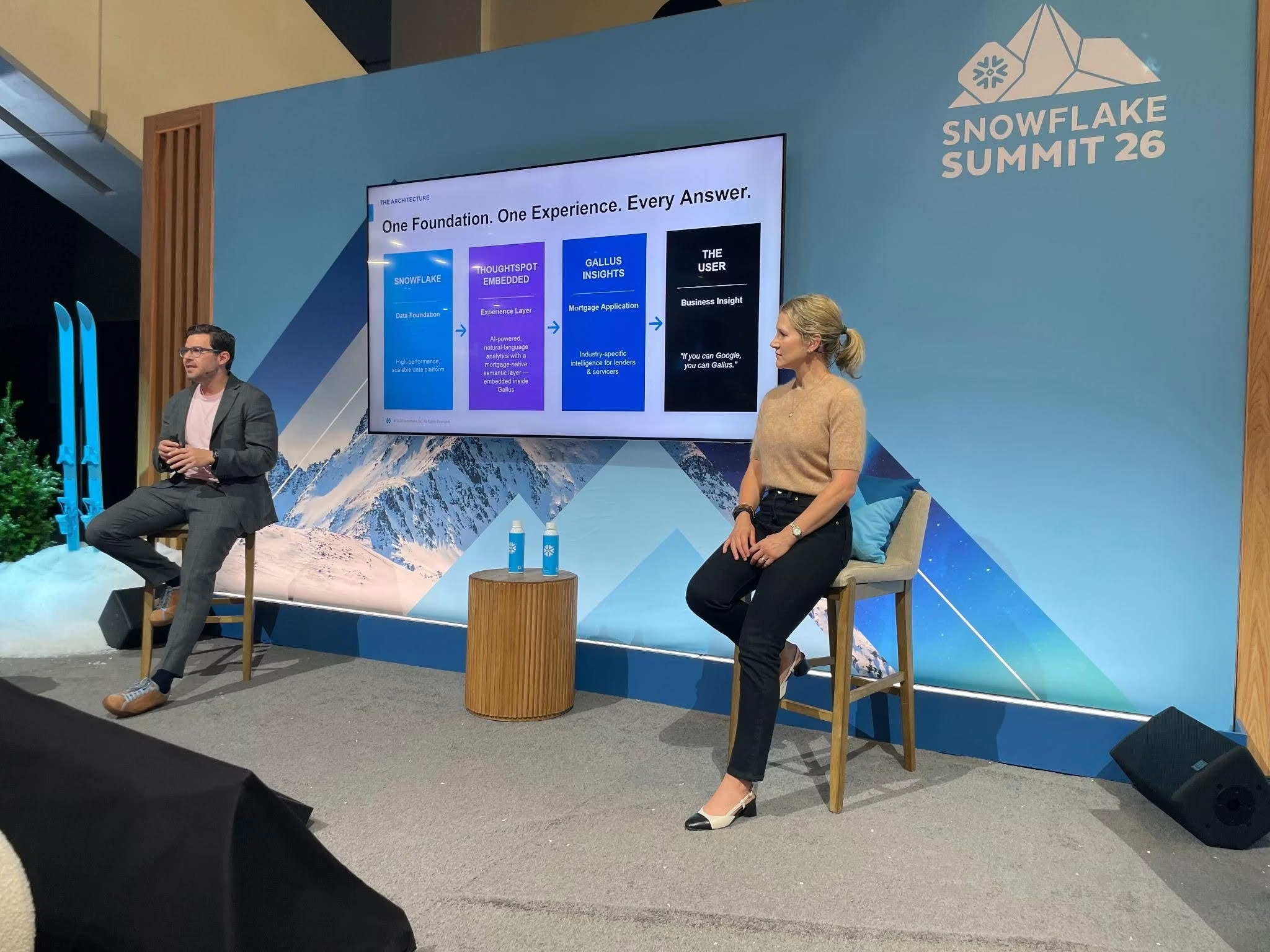
By building a robust, scalable architecture on Snowflake and seamlessly integrating ThoughtSpot Embedded, Gallus is delivering a conversational analytics experience to their end users (mortgage lenders), delivering intelligence where and at the speed they need it.
Today, Gallus is experiencing 10x faster performance and reduced data costs, turning complex data into a massive competitive advantage for their enterprise clients.
Here is my recap of how they transformed the analytics landscape.
The Gallus Mission: Solving Massive Industry Friction
To understand the magnitude of what Gallus has built, you first have to understand the sheer complexity of the mortgage industry. Gallus serves enterprise mortgage lenders and servicers—the massive companies that originate and manage home loans.
It’s an incredibly data-intensive business characterized by massive loan portfolios, razor-thin margins, and countless moving parts.
Historically, these corporations have invested millions in heavy data infrastructure, yet the people who actually need the data day-to-day to run the business still couldn’t access it. Augie explained that Gallus was created specifically to be the critical intelligence and analytics layer these organizations need to make faster, better operational decisions.
Gallus takes disparate, complex mortgage data and makes it genuinely usable. But as their growth has proven, what "usable" means to an enterprise has changed dramatically in recent years.
The Dashboard Dilemma: Too Much Friction, Not Enough Trust
During our chat, Augie illustrated a scenario that resonated with almost everyone in the audience. Imagine you’re a loan officer or an operations leader at a major mortgage company, and you notice a concerning dip in performance.
You ask yourself, "Why is my pull-through rate dropping this month?"
In the traditional setup, you are forced to hunt through a corporate library of 200 different, static dashboards. Maybe you find one that’s close, but it doesn't have exactly what you need. So, you submit a ticket to the internal data team. Two weeks later, you finally get a report back. By then, the market has moved, the crucial moment has passed, and you’ve already been forced to make a multi-million dollar decision based entirely on gut feel.
Augie hit the nail on the head with an insight that really stuck with me: “Having 200 dashboards doesn't mean you have too much information; it means you have too much friction between the question and the answer,” Del Rio said.
Worse yet, conflicting numbers across various legacy reports breed deep organizational distrust. The problem isn’t that the data doesn't exist; it’s that traditional BI tools were built exclusively for data specialists.
If you aren't a data analyst, you are entirely dependent on someone else. That dependency kills the ROI of an enterprise's data investment. Gallus set out to change that model entirely—putting the answer directly in the hands of the business user.
The Modern Tech Stack: Where Foundation Meets Experience
To eliminate this friction for their clients, Gallus built a modern data architecture divided into two distinct, high-performing layers that work together seamlessly.
1. The Foundation: Snowflake
Snowflake serves as the foundation where their clients' data lives. It provides Gallus with the enterprise-grade performance, security, and massive scale required to run complex analytics across millions of data points. Since migrating their architecture to Snowflake, Gallus has unlocked dramatically faster query performance—queries that used to take minutes now return in seconds. For enterprise clients expecting real-time answers, that difference is night and day.
2. The Experience Layer: ThoughtSpot Embedded
ThoughtSpot Embedded sits directly on top of the Snowflake foundation. Gallus integrated it deeply and seamlessly right into the Gallus application interface, meaning clients never have to leave their daily workflow to query data.
They simply type in plain English: "What’s my delinquency rate this quarter, and how does it compare to last year?"
As Augie puts it: If you can Google, you can Gallus.
The Unsung Hero: The Semantic Layer
One of my favorite takeaways from Augie was his emphasis on the semantic layer. Before Gallus could hand business users a natural-language interface, they had to ensure the underlying data was modeled perfectly.
“With ThoughtSpot, we built a semantic layer that turns complex mortgage business logic into trusted answers. It helps lenders understand how aging loans affect profitability and liquidity, where bottlenecks are forming, and how underwriter and processor activity connects back to the P&L. Simple operational adjustments can create meaningful revenue opportunities.”
Agustin Del Rio, Founder & CEO, Gallus Insights
If that foundation is wrong, the AI-driven answers will be wrong, and user trust vanishes instantly. Getting this translation layer right is what unlocked ultimate stability for Gallus. Because ThoughtSpot confidently knows what the data means, it can surface hyper-accurate, intelligent answers. Augie warned the crowd that most companies underestimate this modeling work at the start—and his advice was loud and clear: don’t.
Changing Behavior and Compressing Feedback Loops
What impressed me most about the Gallus story is that the most meaningful change their clients experience isn't just the sheer speed of the technology—it’s the behavioral shift that the speed enables.
Gallus has enterprise clients who went from waiting two weeks for a centralized data request to having individual managers asking dozens of questions themselves, every single day, completely independent of a data team. That completely changes how executive decisions get made.
Loan officers can now see when pull-through is slipping and take action before lost volume turns into lost revenue.
Operations leaders can see, in real time, where loans are aging, where underwriting or processing bottlenecks are forming, and how those delays affect profitability, liquidity, and overall P&L performance
The feedback loop between data and decision has compressed dramatically. That is where the true value of the Gallus platform lies: not just in providing a number, but in what that number makes possible for the business.
Final Thoughts
Redefining self-service analytics for the financial sector is no small feat, but by partnering with Snowflake and ThoughtSpot, Gallus Insights has built a blueprint for the industry. To close out our session, I asked Augie for his final piece of advice for organizations looking to replicate this success.
Speaking on behalf of the whole team at Gallus, his recommendation was beautifully simple: Start with a rock-solid data foundation, build for the end-user experience, and move quickly.


