


Your data’s never lived in one place. Customer records might be in your CRM, while sales and operational metrics are split among data platforms. And somewhere, there's critical budget data living in a spreadsheet, owned by a single person on the finance team.
Bringing it together has always come at a cost of speed vs. governance.
But today, Data Mashups in ThoughtSpot Analyst Studio (currently in Early Access) give analysts and data engineers the ability to blend data from any source into a single, governed model with a single SQL join, in the platform where it will actually be used without waiting on engineering or touching a warehouse schema.
For AI-driven organizations, the stakes go beyond just a slow analysis.
The Real Problem with Fragmented Data
Meaningful analysis requires unified data, and unifying has always been the hard part. You either stitch it manually in a local tool and race against the clock, or you wait on engineering and watch the moment pass while a ticket works its way through the sprint. Either way, a unified data set never arrives on time, and the delay becomes a normal part of the workflow.
That fragmentation snowballs into something most data leaders can’t see until it’s too late. Every combination that has to happen outside the governed environment is a gap in your data foundation—a version nobody can trace, an analysis that never made it back, a decision made on data nobody else could see. The fragmentation goes unresolved at scale, and the gaps become baked into design.
That’s where AI pays the price. AI agents answer questions based on the data they can see. So when there’s no unified model connecting your systems, the blind spots in your data become blind spots in your AI. That means the business makes decisions on incomplete data without knowing it.
Data Mashups fix that by completing your semantic layer, pulling every source your data lives in into one governed model.
What You Can Blend: The Possibilities Are Broader Than You Think
Data Mashups in Analyst Studio let you blend datasets from any source into a single, governed model, and the range of sources is broader than you might expect.
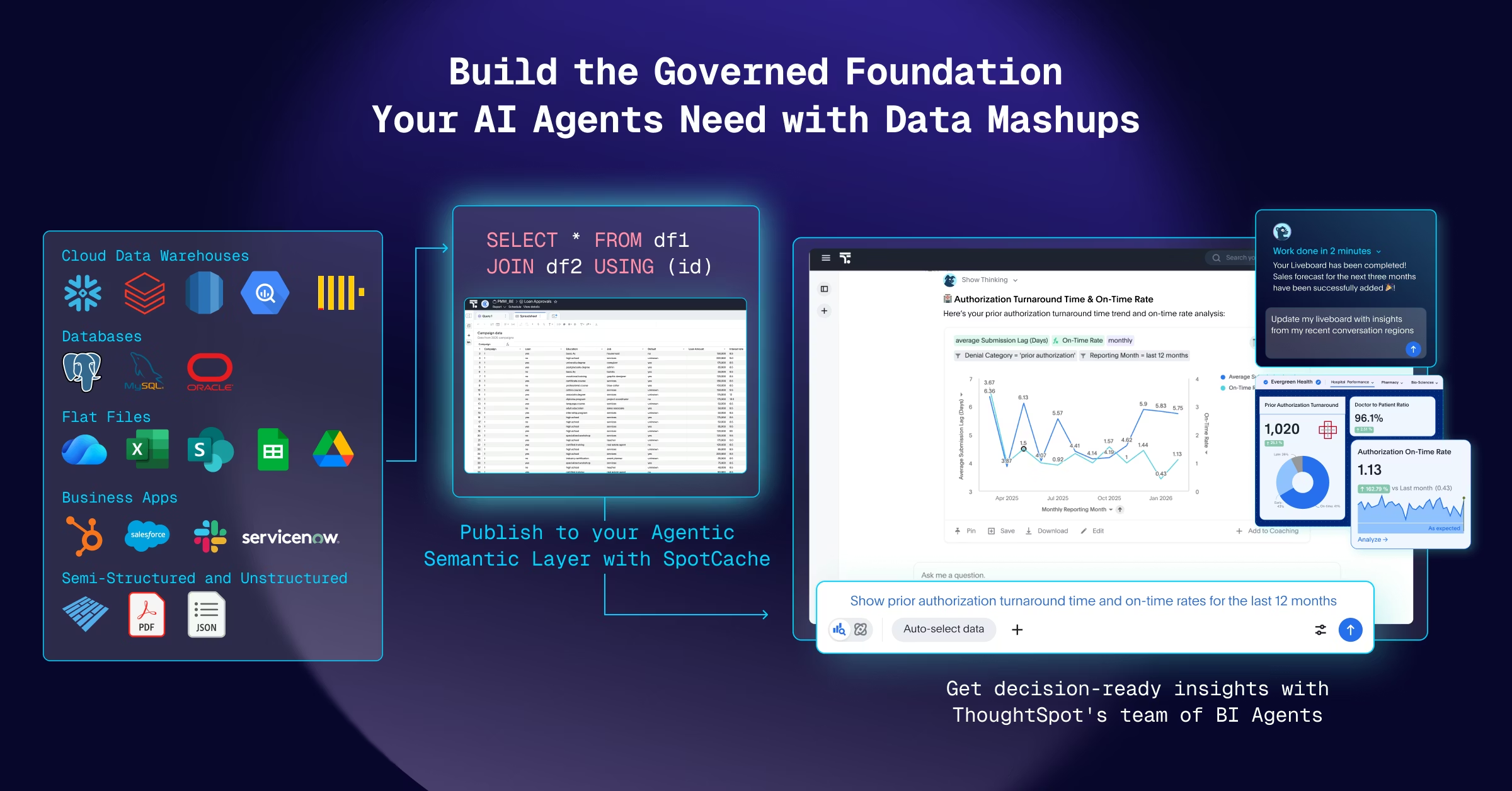
Flat Files and Spreadsheets
Upload local .csv, .tsv, or .xlsx files, import from Google Sheets in your Drive, or pull Excel files from Microsoft OneDrive and SharePoint. The budget spreadsheet your finance team maintains, the cohort list your marketing team built, the campaign data sitting in a shared drive or on local desktops—all of it can become part of a governed, queryable dataset.
You can even continue manipulating blended datasets using the native spreadsheet interface in Analyst Studio before publishing.
Cloud Data Warehouses and Databases
Connect directly to Snowflake, Databricks, Google BigQuery, AWS Redshift, MySQL, PostgreSQL, and other data platforms and databases. Blend tables across platforms—Snowflake customer data with Databricks event logs, for instance—into a single unified model without touching your warehouse schema.
Business Applications and Unstructured Data
Use Analyst Studio's built-in Python notebooks to connect to any business application via API—your CRM, your ERP, your marketing platform—and pull that data into a dataset. Or go further: read unstructured data like PDFs stored in your Google Drive, extract the relevant content, and bring it into the same model as your structured warehouse data.
Once your data is in Analyst Studio, it's one SQL join away from a single, governed model. And because every combined dataset is built on SpotCache, data teams, business users, and AI agents like Spotter can query it as many times as they want without driving up cloud warehouse spend.
The model you build is reusable and governed, living in your ThoughtSpot agentic semantic layer and available to everyone who needs it.
Complete the Data. Trust the AI.
Every dataset you unify in Analyst Studio strengthens your semantic foundation by expanding the surface area your AI can reason from and your business teams can trust.
That’s what Data Mashups makes possible. When any source your data lives in can become part of a single governed model with a SQL join, the gaps in your semantic layer close. Your AI stops reasoning around incomplete information and starts reasoning across your entire data foundation—and every answer it gives gets more reliable as the model grows.
The data teams getting the most out of AI aren't just investing in better models; they're investing in better data foundations, because that’s where reliable AI starts.
Build the Foundation Your AI Deserves
Data Mashups are part of the same vision driving the next generation of ThoughtSpot Analyst Studio: a single, governed loop where data preparation and AI-driven insight happen in the same place. Bring every source your data lives in—SQL, Python, spreadsheets, and beyond–into one trusted model, without ever leaving ThoughtSpot.
Data Mashups are now available in Early Access. Request a demo today.


