

Modern engineering teams face a familiar paradox: the bigger the system, the more time engineers spend managing the work rather than doing it.
Bugs pile up faster than they can be triaged. PRs wait days for review. On-call engineers spend hours reproducing what someone already debugged six months ago.
The knowledge to solve all of this exists, but it’s scattered across Jira comments, Confluence pages, Slack threads, and Grafana dashboards. You just never have it when you need it.
At ThoughtSpot, we build systems that help you make faster decisions from your data. We decided to apply that same principle internally: build a platform that puts the right engineering intelligence in front of the right person at the right moment.
The result is SpotDevOps, an AI SDLC platform that embeds specialized agents across the entire software development lifecycle.
Not a chatbot. Not a copilot.
A virtual engineering team that never sleeps, built on the same AI-first foundation that powers ThoughtSpot Spotter.
"We didn't want to build a tool engineers have to remember to use. We wanted agents that show up where the work is happening — in Slack, in Jira, in the incident channel — and do the work."
By the numbers
SpotDevOps has been in production for 72 active days. Here's where it stands today:
| METRIC | VALUE |
|---|---|
| Total tasks completed | 4,096 |
| Total tasks submitted | 4,561 |
| Active users | 302 |
| Conversations | 3,311 |
| Messages exchanged | 15,896 |
| Overall success rate | 89.8% |
| Bug Triager runs | 1,046 · 90.8% success · 14.5/day avg |
| SRE Agent runs | 1,076 · 89.2% success · 14.9/day avg |
| Standard agents (platform-built) | 13 |
| Custom agents (engineer-built) | 73 |
Usage has grown roughly 4× from January to March 2026, with daily peaks now exceeding 250 task executions. These aren’t experiments. They’re real engineering decisions being delegated to AI—every single day.
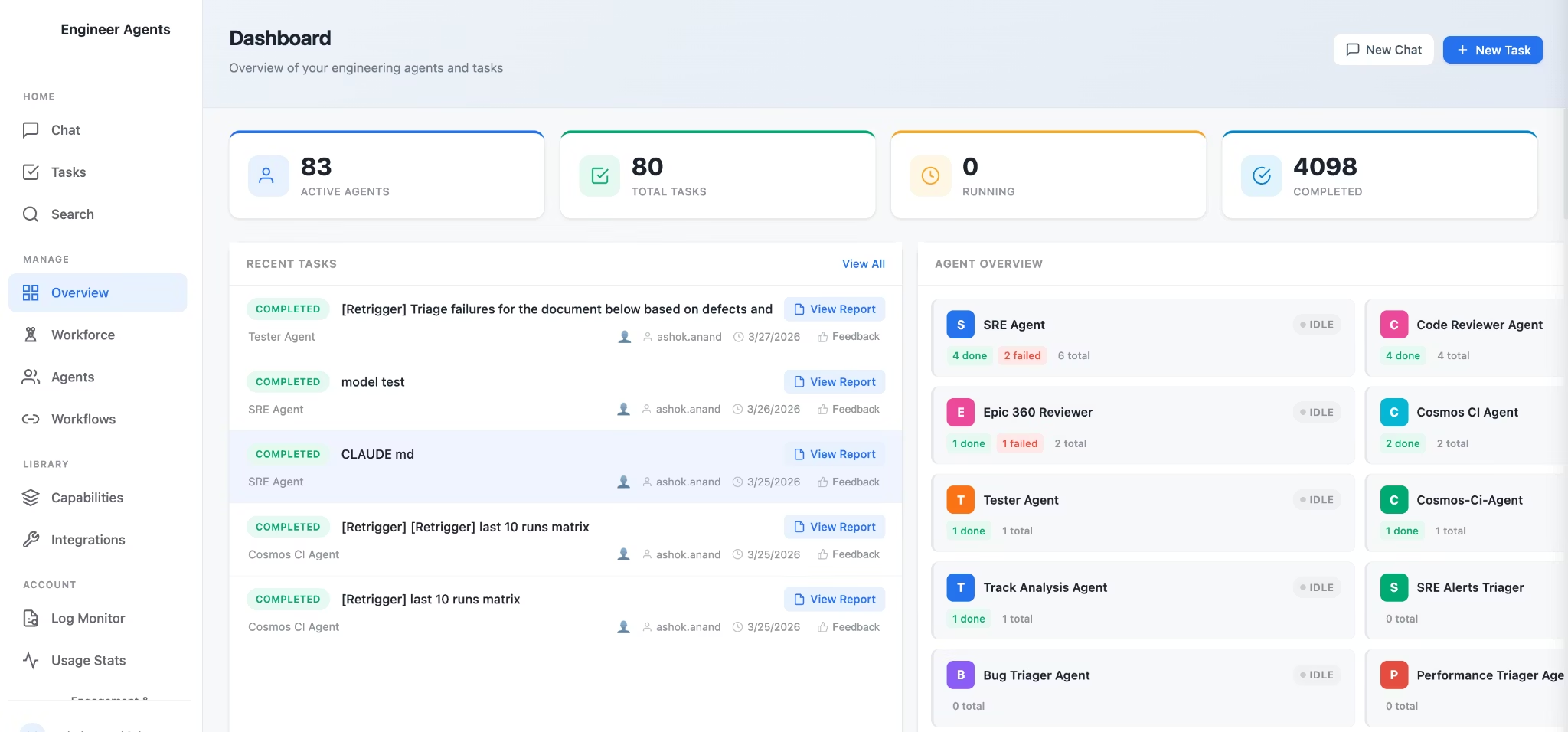
Figure 1 — SpotDevOps dashboard: 83 active agents across standard and custom categories, with real-time task status
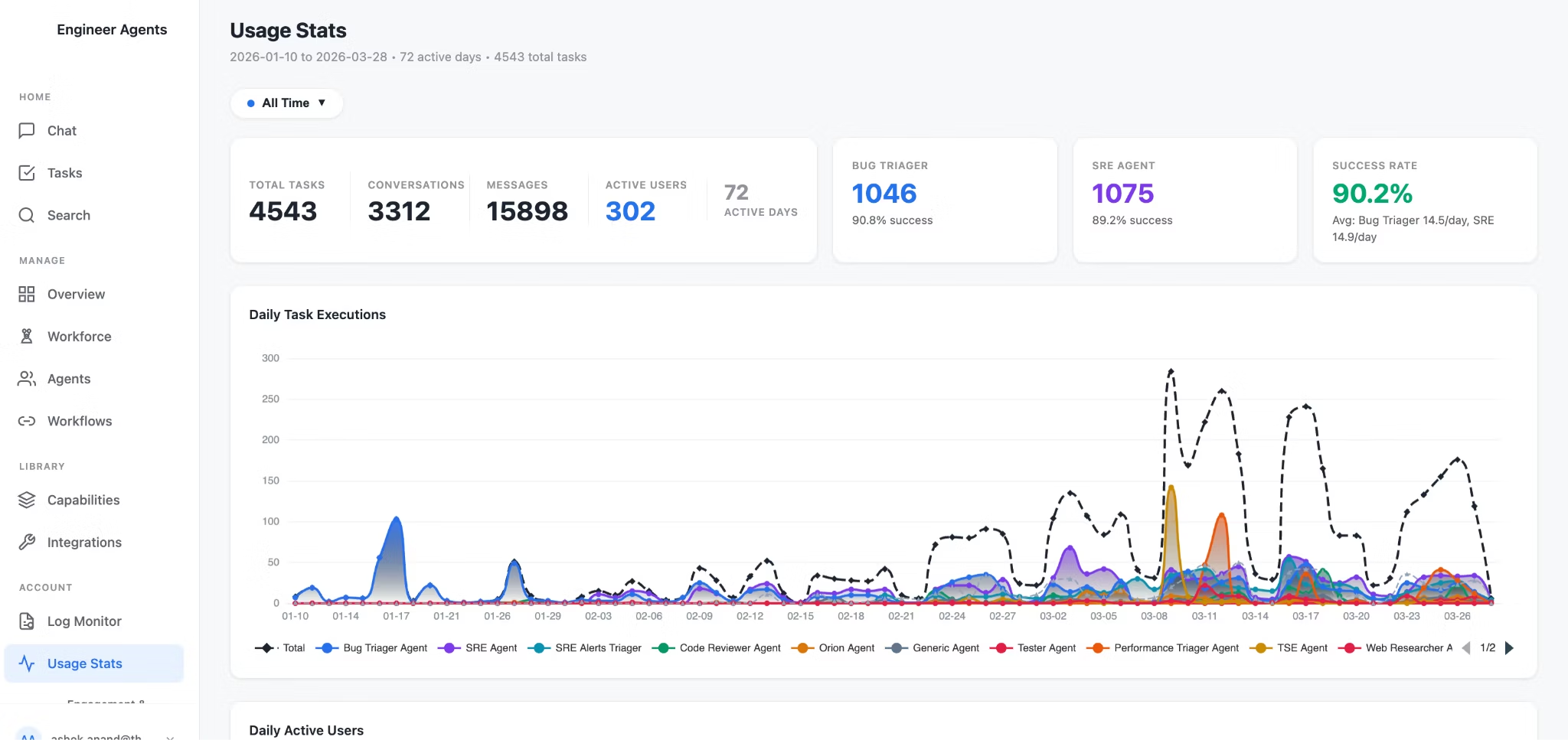
Figure 2 — SpotDevOps usage stats showing daily task volume over time, with 4× growth from January to March 2026
What engineers are asking it to do
The best way to understand SpotDevOps is to look at the task log. On any given day, here's the kind of work being delegated:
INCIDENT RESPONSE
[FIRING:1] cluster_memory_95 pro01-eu — auto-routed from PagerDuty. Agent checks cluster health, pulls Grafana metrics, finds the runbook, posts structured first-response before the on-call engineer finishes reading the alert.
"Check the cluster and advise if upscale is required"
"Identify the trend in EDA-prod memory usage before it hits 95% — proactively flag if it will surpass the threshold"
BUG INVESTIGATION
"Please do an initial triage on this ticket — the PR was raised last week"
"Dev harness failures triage in 26.4 GA"
Batches of 5 customer-found defects analyzed together: root cause, implicated code paths, regression coverage gaps
CODE REVIEW
"Show me a map of which Terraform variables can cause deletion or recreation of existing resources — safety analysis before touching IaC"
"Check if the developer properly resolved code review concerns, or if the changes created bigger problems in the big picture"
"Multi-Signal Spotter Reliability Degradation: GraphQL 504s, load balancer issues, HTTP 422s, and Jaeger traces showing request cancellation — across multiple clusters"
TESTING
"Analyze the test coverage for this Jira ticket — find the automation gaps"
"Diagnose this Allure Report — which failures are real vs. flaky?"
RELEASE MANAGEMENT
"Does this ticket need customer-facing release notes? If yes, write them."
"Daily update: new bugs, branch cuts, open PRs, actionable deltas since yesterday"
What stands out looking through the log isn't any one request; it's the breadth. QA engineers, product managers, SREs, and support engineers, all route work through the same platform, each to the agent that knows their domain.
The Platform: A virtual engineering team
SpotDevOps is built as a fleet of specialized agents, each connected to the tools relevant to its domain, and only those tools. Think of it as a virtual engineering team where every member has read every Jira ticket, every PR, every log, every runbook, and never forgets anything.
Just as ThoughtSpot Spotter gives business users a natural language interface to their data without needing to know SQL, SpotDevOps gives engineering teams a natural language interface to their entire engineering ecosystem, without needing to know which system to query.
| AGENT | WHAT IT SPECIALIZES IN |
|---|---|
| Bug Triager | 6-phase root cause analysis: ticket → code → logs → knowledge base → parallel hypotheses → synthesis. 90.8% success across 1,000+ real tasks. |
| SRE Agent | Cluster flags, crashes, log analysis, monitoring guidance, incident response. |
| SRE Alerts Triager | Alert-specific runbooks, Grafana dashboards, mitigation-first — fires automatically on PagerDuty escalation. |
| Performance Triager | HAR files, screenshots, log correlation, Grafana traces. |
| Infra Agent | Cluster operations: disk triage, upgrades, patches, backup/restore, health checks. |
| Thoughtspot Embed Agent | ThoughtSpot Embedded: SDK validation, HAR analysis, SFDC case history. |
| Code Reviewer | PR security, performance, behavior changes, regression risk. |
| Tester Agent | Browser automation, test workflows, screenshot validation. |
| Developer Agent | Writes code, manages git branches, commits and pushes. Raises PRs with test evidence attached. |
| Generic Agent | Open-ended investigation with citations and visual reports. |
All agents share access to the same ecosystem of 30+ integrations:
Jira · GitHub · Slack · Confluence · Kibana · Grafana · Salesforce · Google Docs · Jenkins · PagerDuty · Gong · + 20 more
The part that surprised us: Engineers built 73 of the 86 Agents
We shipped 13 standard agents. Then we built a Custom Engine, a self-service agent builder where any engineer can create a new agent by describing what it should do and choosing its tools. No code required.
and counting
The teams closest to the problem build the best solutions for it. The platform's job is to make that easy, not to anticipate every use case.
Slack as the operating interface
We didn't build a new interface. We put agents where engineers already work.
When a PagerDuty alert fires, it lands in Slack. A matching rule kicks off the SRE Alert Triager. The analysis comes back in the same thread, before anyone types a word. The autotriage agent watches #escalated-alerts for new support tickets and routes them automatically. The dm-bug-triage-followup agent monitors a channel for newly-filed Jira bugs and sends them to the Bug Triager without being asked.
The AI shows up where the work is happening. That turned out to be the adoption unlock; engineers didn't need to learn a new tool because the tool came to them.
Connect from anywhere via MCP
SpotDevOps exposes a full MCP server, so any compatible tool like VS Code, terminal, Claude can access the same capabilities without context switching.
In practice, this means the platform isn’t tied to an interface. It follows the engineer.
// Add to ~/.claude.json to use SpotDevOps tools from Claude
"mcpServers": {
  "myspotdevops": {
    "type": "sse",
    "url": "https://spotdevops.thoughtspot.dev/mcp/sse",
    "headers": {
      "X-API-Key": "your-api-key"  // generate at /api-doc
    }
  }
}
A platform that gets smarter over time
After every bug triage, the agent captures what it learned. A reviewer approves it. The next time a similar pattern appears, the agent already knows the history; it's the same feedback loop that makes ThoughtSpot's AI analytics more accurate the more your team uses it, applied to engineering operations.
SpotDevOps also syncs continuously from Confluence, Jira, Google Docs, Gong call transcripts, and Salesforce, so agents always reason with the current context, not stale snapshots. The first time an agent sees a problem class, it reasons from first principles. By the tenth time, it's fast, confident, and drawing on institutional memory.
Built with AI, to build more AI
Here's the part that closes the loop: SpotDevOps was largely built with AI.
The backend, the agent implementations, the integrations, and the frontend, a significant portion of this codebase was written through AI-assisted development using Claude Code. We described what we wanted. The AI wrote it. We refined it together.
We used the tool to build the tool. And the tool helped us keep building faster.
This is the feedback loop that AI-native engineering teams are discovering: a platform that helps you ship faster creates cycles that make the platform itself better. At ThoughtSpot, that loop is now running.
What we learned
01. Specialized agents beat general-purpose ones. A generic "analyze this Jira ticket" prompt is fine for demos and mediocre in production. Our 6-phase Bug Triager runs at 90.8% success across 1,000+ real tasks. Depth beats breadth.
02. Give engineers the keys. We built 13 agents. Engineers built 73 more. The teams closest to the problem build the best solutions for it. The platform's job is to make that easy, not to anticipate every use case.
03. Event-driven beats on-demand. Agents that react to Slack events run before anyone asks. This shifts the value from "assistant you query" to "teammate that watches your back."
04. Trust requires guardrails. Role-based access, approval workflows for knowledge base writes, sandboxed execution, and audit trails are what made production access acceptable. Oversight and utility aren't opposites.
05. Cost visibility compounds. Track every token, every task, every agent. At 14+ tasks/day each for Bug Triager and SRE Agent, you need to know the economics to optimize them.
SpotDevOps is already a hit internally. And we're just getting started.
If you're building engineering intelligence platforms, working on agent reliability, or thinking about multi-agent architectures — let's compare notes.


